

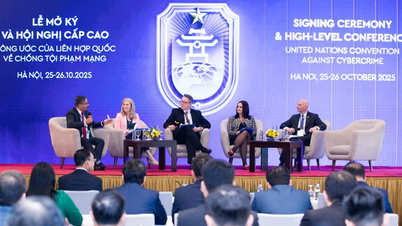
Following the solemn opening ceremony of the signing of the United Nations Convention against Cybercrime, high-level discussions and roundtables on important topics took place throughout today (October 25), with many practical experiences and initiatives from various countries being shared.
By this afternoon (October 25), representatives from nearly 70 countries and international organizations had signed the United Nations Convention against Cybercrime, demonstrating a strong political commitment for the Convention to be ratified and implemented as planned by the United Nations Office on Drugs and Crime (UNODC) in 2027.
The adoption of the Convention marks a new era of cooperation among governments , international organizations, businesses, and civil society organizations, all sharing the common goal of ensuring cybersecurity, protecting data, and upholding justice in the digital age.
Within the framework of the opening ceremony of the Hanoi Convention, a series of plenary discussions and side seminars were held, including: the role of Interpol in enforcing the United Nations Convention on Cybercrime, artificial intelligence in cybercrime and cybersecurity... Notably, for the first time in a United Nations Convention, there is a specific provision to protect child victims and vulnerable groups.
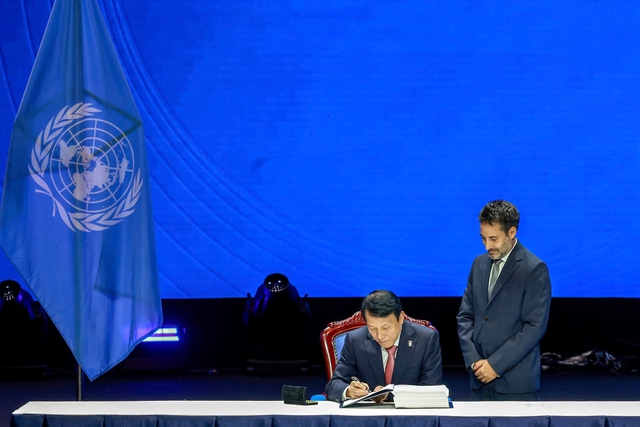
General Luong Tam Quang, Minister of Public Security, representing Vietnam, signed the United Nations Convention against Cybercrime (Hanoi Convention). (Photo: NLĐ)
Aaron Walsh (Director of Knowledge) expressed: "I am delighted that we finally have a strong enough legal framework to protect the identity and dignity of victims and provide a compensation mechanism for vulnerable people."
Delegates from various countries also shared their experiences and initiatives to further promote close cross-border cooperation to prevent all forms of cybercrime. Close public-private partnerships with technology companies and corporations were also emphasized as an effective solution.

Wang Qun, Chargé d'affaires of the Chinese Embassy in Vietnam, signs the United Nations Convention against Cybercrime. (Photo: NLĐ)
"A joint effort is needed, not only from the government but also from the private sector, banks, schools, and the community, for prevention among citizens to be effective before combating crime," said Bertha Nayelly Loya Marin (United Nations Office on Drugs and Crime - UNODC).

Representatives of the European Union sign the United Nations Convention against Cybercrime. (Photo: NLĐ)
"The signed convention will help promote the sharing of electronic evidence between countries in real time, and virtual reality technology is a new way for us to support training, turning something seemingly intangible like blockchain into something tangible," said AM Chandra Bahadur Dhami (Cybercrime Investigation Specialist, United Nations Office on Drugs and Crime - UNODC).
Many solutions and initiatives will continue to be shared tomorrow (October 26) at professional workshops, aiming to promote global coordination in preventing and combating online fraud.
Source: https://vtv.vn/gan-70-quoc-gia-ky-cong-uoc-ha-noi-100251025205629858.htm




















![[Photo] Prime Minister Pham Minh Chinh holds a phone call with the CEO of Russia's Rosatom Corporation.](/_next/image?url=https%3A%2F%2Fvphoto.vietnam.vn%2Fthumb%2F1200x675%2Fvietnam%2Fresource%2FIMAGE%2F2025%2F12%2F11%2F1765464552365_dsc-5295-jpg.webp&w=3840&q=75)













































Comment (0)