

Hanoi Convention: A global turning point in combating cybercrime
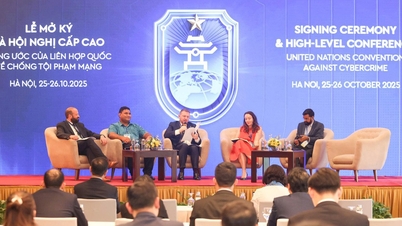
The United Nations Convention against Cybercrime (Hanoi Convention) is the first global legal instrument of the United Nations on preventing, investigating and punishing cybercrime, adopted by the United Nations at the end of 2024 and opened for signature in Hanoi on October 25.
The Convention stipulates a series of contents: From criminalizing cyber attacks, illegal system intrusion, data interference, online fraud, online child exploitation... to international cooperation mechanisms on extradition, judicial assistance, sharing of data and electronic evidence, technical support and capacity building for developing countries.
In particular, the Hanoi Convention requires each country to designate a 24/7 contact point to provide emergency assistance in investigating, prosecuting and collecting electronic evidence – a key point in reducing the time it takes to resolve cross-border cybercrime cases.
The signing of the Convention in Hanoi, with the participation of the UN Secretary-General, senior Vietnamese leaders and thousands of international delegates, is not only a diplomatic milestone, but also affirms Vietnam's role and responsibility in shaping a new legal order in cyberspace.
In that context, the draft Law on Cyber Security being discussed at the National Assembly is an important "link" to transform international commitments into specific domestic legal mechanisms.

The signing ceremony of the Hanoi Convention attracted more than 70 countries to sign the Convention on October 25-26, 2025, of which 64 countries signed right at the signing session in the main hall.
Draft Law on Cyber Security: Perfecting the legal framework for cyber security
The draft Law on Cyber Security was built on the basis of merging the 2018 Law on Cyber Security and the 2015 Law on Network Information Security, adding urgent regulations in the context of rapidly developing technology and increasingly sophisticated cybercrime.
The draft Law specifies the policy of "a task is assigned to only one agency to preside over and take primary responsibility" and unifies the focal point for state management of cybersecurity as the Ministry of Public Security.
In terms of content, the draft Law adds many key points. For the first time, it clearly defines data security as an organic component of cyber security, not only stopping at personal data but also including organizational data, infrastructure, and data in transmission - in line with the trend of considering data as a national asset, the driving force of digital transformation.

On November 7, 2025, General Luong Tam Quang, Minister of Public Security, gave a speech explaining and clarifying a number of issues of concern to National Assembly deputies regarding the draft Law on Cyber Security.
The draft requires businesses providing services on cyberspace to identify, manage and provide information about IP addresses to specialized forces protecting network security, overcoming the "ask-give" situation and delays in tracing cybercrime.
The draft stipulates that information technology application plans, projects, and programs of state agencies, organizations, and enterprises must ensure at least 10% of funding for cybersecurity, in accordance with international practices and previous instructions of the Government.
It can be affirmed that the draft Law on Cyber Security is a comprehensive upgrade and improvement of the national legal framework on cyber security, while paving the way for the effective implementation of the Hanoi Convention.
Similarity of goals: Protecting people, sovereignty and digital order
It can be seen that the draft Law on Cyber Security of Vietnam and the Hanoi Convention have deep similarities in core objectives.
Both aim to protect information systems and critical digital infrastructure. The Hanoi Convention requires countries to criminalize acts of system attacks, data interference, and sabotage of critical information infrastructure, while Vietnam's draft Law on Cyber Security takes an approach towards protecting information systems important to national security, clearly defining security standards, technical regulations, monitoring mechanisms, and incident response.
Regarding the prevention and combating of cybercrime and high-tech crimes, the Hanoi Convention establishes a framework for cooperation in investigation, extradition, judicial assistance and sharing of electronic evidence. The draft Law on Cyber Security stipulates that the Ministry of Public Security is the national focal point in the fight against cybercrime, connecting to the 24/7 communication network according to the Convention, ensuring the collection and preservation of electronic evidence in accordance with international standards.
Regarding the protection of human rights and privacy in the digital environment, the Hanoi Convention emphasizes the need to respect human rights and privacy. The draft Law on Cyber Security was developed in the context of Vietnam having a Law on Personal Data Protection, while complying with the Constitution on the protection of human rights, creating a basis for designing detailed regulations, balancing security and privacy.
Regarding the protection of vulnerable groups and a healthy online environment, the Convention addresses online child exploitation and abuse, cross-border fraud and scams. Vietnam's draft Law on Cyber Security, together with other specialized laws, creates a legal framework to deal with harmful content, online fraud, and protect women, children and domestic users.
It can be affirmed that the draft Law on Cyber Security that the National Assembly is discussing and expected to pass on December 10, along with the Hanoi Convention, are "two parallel tracks", both aiming at the goal of building a safe and healthy cyberspace that respects national sovereignty and human rights.
The Hanoi Convention creates a global cooperation framework, connecting Vietnam with the network of other countries to prevent and combat cybercrime. The draft Law on Cyber Security helps Vietnam have enough legal tools, organizational apparatus, resources and mechanisms to protect information systems, data, people and businesses.
In the digital age, where all traditional borders are "blurred" by data and connectivity, the simultaneous birth of the Hanoi Convention and the Law on Cyber Security is the meeting of national vision and international legal order. With serious and synchronous implementation, this will be an important foundation for Vietnam to firmly step on the path to becoming a safe, trustworthy and powerful digital nation.
Source: https://phunuvietnam.vn/du-thao-luat-an-ninh-mang-va-cong-uoc-ha-noi-hai-duong-ray-cho-mot-muc-tieu-chung-23825120814533066.htm
![[Photo] General Secretary To Lam receives the Director of the Academy of Public Administration and National Economy under the President of the Russian Federation](/_next/image?url=https%3A%2F%2Fvphoto.vietnam.vn%2Fthumb%2F1200x675%2Fvietnam%2Fresource%2FIMAGE%2F2025%2F12%2F08%2F1765200203892_a1-bnd-0933-4198-jpg.webp&w=3840&q=75)











































































































Comment (0)