

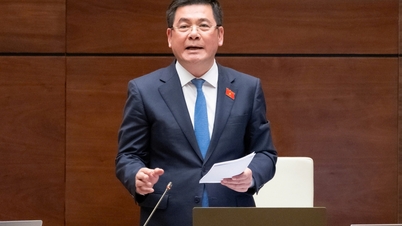
On December 8, Finance Minister Nguyen Van Thang, authorized by the Prime Minister, submitted to the National Assembly a draft resolution on piloting a number of special mechanisms to implement major projects in the capital. The National Assembly is expected to vote on this draft resolution on the afternoon of December 11.
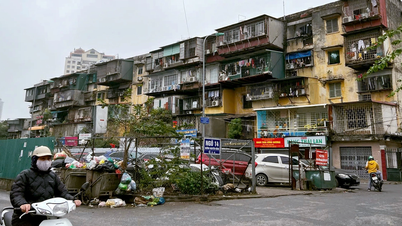
The Government's report clearly stated that in practice, the renovation of old apartment buildings and urban beautification still has many shortcomings and delays, affecting the safety and lives of the people. To remove this bottleneck, the drafting agency proposed that Hanoi be allowed to decide on compulsory demolition measures when more than 75% of homeowners and landowners agree, equivalent to at least 75% of the land area in the renovation area.
According to the 2023 Housing Law, the project to renovate a dilapidated apartment building can only be implemented when 80% of homeowners and landowners agree to the compensation, resettlement, and reconstruction plan. For dangerous apartment buildings of level D (severely damaged, unsafe, at risk of collapse), the Provincial People's Committee can decide on the optimal plan.
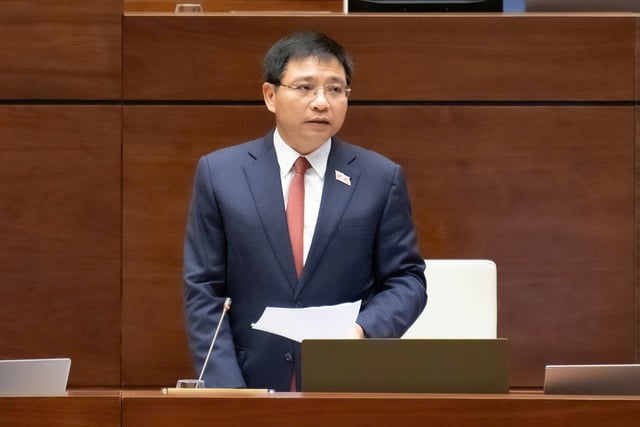
Minister of Finance Nguyen Van Thang
In fact, achieving this almost absolute consensus rate is difficult in projects to rebuild old apartments. For investors, it is also difficult for them to implement the project when the construction density is controlled, not being allowed to build too many floors, so there is not enough commercial fund to cover construction and compensation costs.
According to reports, Hanoi began renovating old apartment buildings in 2005. However, by the middle of last year, the city had only completed 19 projects and put them into use, with more than a dozen projects still underway.
Proposal to loosen regulations on renovating old apartments, review historical inner city boundaries
Commenting on the discussion at the meeting, Professor Hoang Van Cuong, concurrent member of the Economic and Financial Committee, said that it is necessary to "loosen" the regulations on renovating old apartment buildings. "Without a 75% consensus mechanism and allowing exceeding planning, architectural and population targets, the city will find it difficult to renovate degraded and unsafe apartment buildings," he said.
"Developing the space above ground is for residential purposes; the entire underground space is for business, services and underground transportation. The space above ground is for greenery and public space," said the delegate.
In addition, Mr. Hoang Van Cuong suggested that it is necessary to review the planning of the historical inner city area to only include areas that need to be preserved and maintain historical values, such as Ba Dinh area, West Lake and the Old Quarter area. These areas are not allowed to build high-rise buildings, so it is impossible to increase population density.
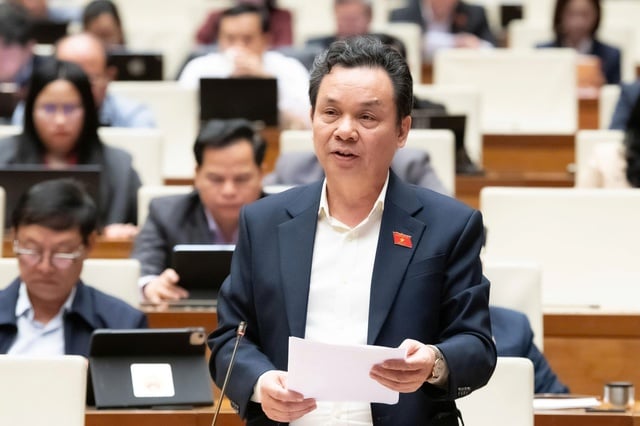
Professor Hoang Van Cuong, concurrent member of the Economic and Financial Committee
The delegate also said that the planning of the entire Hai Ba Trung and old Dong Da districts, where there are many old apartment buildings and low-rise buildings that need to be renovated, into the historic inner city has many shortcomings. "Not only is it tying itself up to have to ask for a mechanism for renovation today, but it is also tying up the people in this area who have difficulty renovating and building houses because it is located in the historic inner city area," the delegate expressed his opinion.
Meanwhile, Mr. Trinh Xuan An, a full-time member of the National Defense and Security Committee, proposed reducing the consensus rate to 50%, instead of 75%, to make rebuilding old apartment buildings more feasible.
Proposal for Hanoi to be compensated for resettlement projects twice as much as prescribed
Also according to the draft resolution, the Government proposes to assign the investor to make a detailed plan for the project to renovate, embellish and rebuild the urban area. After approval, the management agency will be allowed to decide on planning, architectural and population criteria exceeding the regulations (for projects in historic inner-city areas).
To speed up the progress of large and important projects, the draft also stipulates that the People's Council or the Chairman of the Hanoi People's Committee decides on the policy, instead of submitting it to the National Assembly or the Prime Minister as is currently the case. Some projects in this group (except for apartment renovations) can also select contractors and investors in special cases.
According to the Government, major and important projects in the capital include public investment, public-private partnership (PPP) investment or projects that need to be implemented immediately under the direction of competent authorities. This group also includes projects using local budgets, or on the list of projects attracting strategic investors with a total investment of VND30,000 billion or more; renovation of old apartments, urban reconstruction.
For projects that need to be implemented according to the direction of competent authorities, the city is allowed to decide on compensation, support, and resettlement levels twice the prescribed level. The project is also allowed to carry out planning steps and start construction at the same time as the approval procedures and investment policy decisions.
Source: https://phunuvietnam.vn/dai-bieu-quoc-hoi-de-xuat-co-che-ha-noi-pha-do-cai-tao-chung-cu-cu-neu-co-50-chu-nha-dong-y-23825120815571521.htm



































































































Comment (0)