

With the guiding principle for economic management in 2025 being to maintain momentum, pace, and accelerate breakthroughs, the Prime Minister emphasized, "targets that have not yet been achieved must be achieved, and those that have been achieved must be improved in quality and efficiency," striving to the highest possible level to complete the set goals.
With the guiding principle for economic management in 2025 being to maintain momentum, pace, and accelerate breakthroughs, the Prime Minister emphasized, "targets that have not yet been achieved must be achieved, and those that have been achieved must be improved in quality and efficiency," striving to the highest possible level to complete the set goals.
 |
| The National Assembly hears the Government's report on socio-economic development. |
Any targets that have not yet been met must be met.
The 15th National Assembly has just opened its eighth session. Reporting on the main contents of the implementation of the Socio-Economic Development Plan for 2024 and the projected plan for 2025, at the opening session, Prime Minister Pham Minh Chinh stated that it is estimated that 14 out of 15 targets for 2024 will be met or exceeded (the GDP per capita target will be achieved if GDP growth exceeds 7%). “Notably, the labor productivity growth target has exceeded the set plan, after three years of not meeting it,” the head of the government emphasized.
Regarding the economy, the Prime Minister assessed that development investment has yielded positive results. Public investment has been focused and targeted, not spread too thinly. By September 30, 2024, ministries, agencies, and localities had allocated 664,900 billion VND in detail, reaching 98.1% of the plan. The Government has submitted to the National Assembly Standing Committee for consideration the adjustment of 8,400 billion VND from ministries, sectors, and localities that have not yet allocated or disbursed funds to other ministries, sectors, and localities. Estimated payments by September 30, 2024, reached 47.29% of the plan assigned by the Prime Minister.
Focusing on implementing many important and key projects and works with the spirit of "overcoming the sun, conquering the rain, not losing to the wind and storms," "eating quickly, sleeping urgently," "working day and night is not enough," "3 shifts, 4 teams," "working through holidays and Tet"; completing the 500 kV circuit 3 Quang Binh - Hung Yen project after more than 6 months of rapid construction and actively implementing many key power projects and works, completing several sections of expressways, raising the total length to 2,021 km.
"Business development continues its positive trend. Attracting foreign investment is a bright spot, with implemented capital reaching US$17.3 billion, an increase of 8.9%, the highest in many years, while global investment declined," the Prime Minister reported to the National Assembly.
Regarding the Socio-Economic Development Plan for 2025, the Prime Minister clearly stated the guiding principles for direction and management: “Thoroughly analyze and closely assess the implementation of the 5-year Socio-Economic Development Plan 2021-2025, and from there develop breakthrough solutions based on the principle of ‘targets that have not been achieved must be achieved, and targets that have been achieved must be improved in quality and efficiency,’ striving to achieve the highest possible results in fulfilling the set objectives.”
The Prime Minister's next point was to maintain momentum, keep pace, and accelerate breakthroughs. He emphasized staying close to reality and promptly responding to emerging issues in the spirit of "daring to think, daring to act, and daring to innovate for the common good," "what is said must be done, what is committed must be fulfilled; what is done must be effective," and "the Party has directed, the Government has agreed, the National Assembly has consented, we only discuss action, not retreat."
The government has also identified 11 key tasks and solutions for 2025. Prioritizing growth, continuing to renew traditional growth drivers, and strongly promoting new growth drivers is the first task.
“Promoting new growth drivers, especially digital transformation, green transformation, circular economy, sharing economy, knowledge economy; regional economy, regional linkages, urban development; building financial centers, free trade zones and new, high-tech industries and sectors (such as semiconductor chips, artificial intelligence, cloud computing, Internet of Things…). Effectively implementing the Semiconductor Industry Development Strategy,” the Prime Minister reported to the National Assembly.
Prime Minister Pham Minh Chinh also mentioned more specific information on several areas, such as increasing the capacity to absorb and access credit; striving for credit growth of over 15%; and aiming for state budget revenue in 2025 to be at least 5% higher than in 2024…
Reviving the capital market
According to the assessment of the National Assembly's Economic Committee (the body in charge of reviewing and evaluating the results of the implementation of the National Assembly's Resolution on the Socio-Economic Development Plan for 2024; and the projected plan for 2025), both the corporate bond market and the real estate market are facing difficulties.
The size of the corporate bond market is still small compared to the long-term capital needs of businesses. The total outstanding corporate bond debt at the end of August 2024 was only about 1,025 trillion VND, equivalent to 10% of GDP. The auditing agency emphasized that this figure is still low compared to countries in the region such as Malaysia (54% of GDP), Singapore (25%), and Thailand (27%).
In the 2025 plan, the Government projects state budget revenue of approximately VND 1,966.8 trillion, an increase of 15.6% compared to the 2024 estimate and a 5% increase compared to the estimated actual revenue in 2024. State budget expenditure is projected at approximately VND 2,527.8 trillion, an increase of approximately VND 408,400 billion compared to the 2024 estimate, ensuring investment needs for nationally important infrastructure projects, key projects, public sector salaries, and existing policies and regulations. The projected state budget deficit for 2025 is approximately VND 471,500 billion (approximately 3.8% of GDP), ensuring that indicators for public debt, government debt, and national foreign debt remain within permissible limits.
Furthermore, according to the National Assembly's Economic Committee, the real estate market remains challenging, especially regarding regulations and procedures for developing social housing projects. Real estate businesses continue to face difficulties with liquidity and cash flow. The imbalance in the market's product structure has driven up apartment prices in both the primary and secondary segments, making it difficult for those with genuine housing needs to access housing. The phenomenon of "abandoning deposits" after winning land use rights auctions is recurring, negatively impacting price levels and the housing market.
The situation of manipulation, price manipulation, speculation, and land speculation has driven up land prices, making buying and selling almost exclusively among speculators, while people and businesses find it difficult to access land due to high prices that exceed their ability to pay. "In addition, despite many efforts, the issuance of guiding documents for the implementation of the Land Law, the Real Estate Business Law, and the Housing Law has not yielded the expected results," reported Vu Hong Thanh, Chairman of the National Assembly's Economic Committee.
Regarding the projected Socio-Economic Development Plan for 2025, the review committee added and emphasized several key tasks and solutions, including focusing on removing obstacles, reviving the capital market, and creating favorable conditions for people and businesses to borrow capital to recover and develop production and business.
Implement a proactive, flexible, timely, and effective monetary policy; carefully consider the impact and effectiveness of managing interest rates and exchange rates; regulate monetary policy and market liquidity appropriately to stabilize the credit system, strictly control credit quality and bad debts; ensure smooth, efficient, and lawful operation, and control risks in the stock, gold, corporate bond, and real estate markets.
Speaking on the sidelines of the National Assembly, economist Tran Hoang Ngan (a delegate from Ho Chi Minh City) said that this year's budget revenue figures show a widespread economic recovery across all sectors. "Ensuring financial and monetary security means creating an important foundation. A strong financial foundation is necessary to create room for fiscal expansion, to continue reinvesting and building upon that foundation, especially investing in economic and social infrastructure for development," Mr. Ngan analyzed.
Still focusing on growth drivers, this expert believes that in recent years, a significant amount of capital has been invested in public sector development, thereby creating a foundation for infrastructure, especially transportation infrastructure. When infrastructure is synchronized, logistics costs will be reduced, thus creating a sustainable growth driver in the future. In particular, infrastructure in healthcare and education contributes to improving the quality of life for the people.
Besides infrastructure, the representative from Ho Chi Minh City also emphasized the importance of institutions. This session has a large volume of work on institutions, not only the foundation of a market economy, but also institutions related to culture, science and technology, and innovation.
"The economic recovery to pre-pandemic levels will create further foundations for entering a new era, as General Secretary To Lam has stated. It can be said that Vietnam is now fully prepared to enter a new era, an era in which the country develops and becomes a high-income nation," said Mr. Tran Hoang Ngan.
According to the agenda, the National Assembly will dedicate most of October 26th to group discussions on the results of the implementation of the 2024 Socio-Economic Development Plan and the projected 2025 Socio-Economic Development Plan (combined with discussions on some other budgetary matters).
Source: https://baodautu.vn/kinh-te-nam-2025-giu-da-giu-nhip-tang-toc-but-pha-d228076.html
![[Photo] General Secretary and President To Lam and his wife, along with General Secretary and President Xi Jinping and his wife, attending a tea party.](https://vphoto.vietnam.vn/thumb/1200x675/vietnam/resource/IMAGE/2026/04/15/1776245678527_vna-potal-tong-bi-thu-chu-tich-nuoc-to-lam-va-phu-nhan-cung-tong-bi-thu-chu-tich-nuoc-tap-can-binh-va-phu-nhan-du-tiec-tra-8702812-9829-jpg.webp)
![[Image] Overview of the Tam Trinh-Giai Phong connecting road section after land clearance is completed.](https://vphoto.vietnam.vn/thumb/1200x675/vietnam/resource/IMAGE/2026/04/15/1776245679644_ndo_br_dji-0195-jpg.webp)
![[Photo] General Secretary and President To Lam and General Secretary and President Xi Jinping meet with youth from both countries.](https://vphoto.vietnam.vn/thumb/1200x675/vietnam/resource/IMAGE/2026/04/15/1776245687540_vna-potal-tong-bi-thu-chu-tich-nuoc-to-lam-va-tong-bi-thu-chu-tich-nuoc-tap-can-binh-gap-go-thanh-nien-hai-nuoc-8702371-jpg.webp)
![[Image] Current status of the land area of over 5.5 hectares that Ho Chi Minh City is considering reclaiming.](https://vphoto.vietnam.vn/thumb/1200x675/vietnam/resource/IMAGE/2026/04/15/1776245690095_1-3102-8409-jpg.webp)
![[Photo] Capturing each moment at the "People We Meet" photography exhibition.](https://vphoto.vietnam.vn/thumb/1200x675/vietnam/resource/IMAGE/2026/04/15/1776245695648_1-8944-jpg.webp)
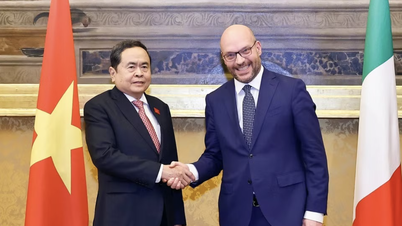
![[Photo] National Assembly Chairman Tran Thanh Man concludes official visit to Italy, departs for IPU-152](https://vphoto.vietnam.vn/thumb/1200x675/vietnam/resource/IMAGE/2026/04/15/1776253436109_vna-potal-chu-tich-quoc-hoi-ket-thuc-tham-chinh-thuc-italy-len-duong-du-ipu-152-tai-tho-nhi-ky-8702876-7969-jpg.webp)


































































Comment (0)