

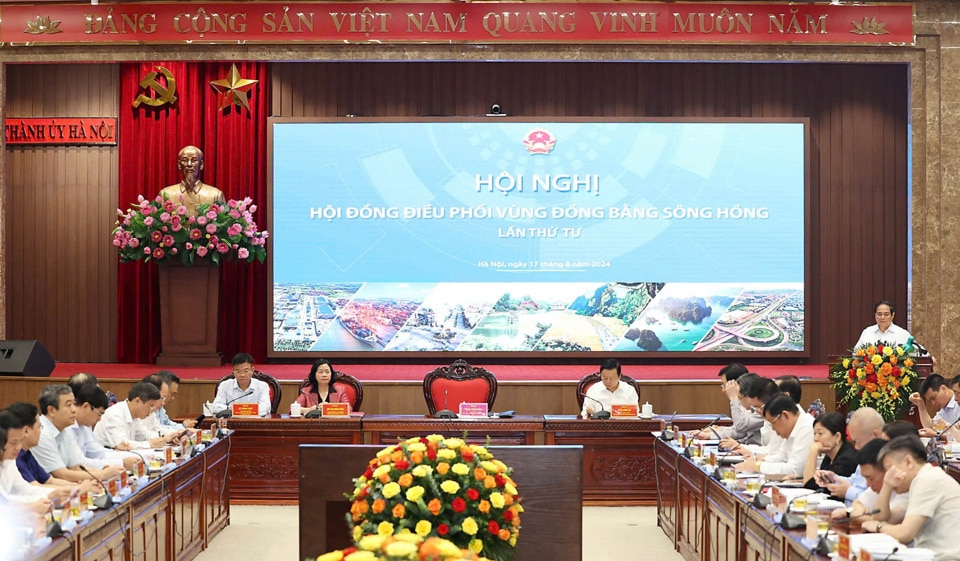
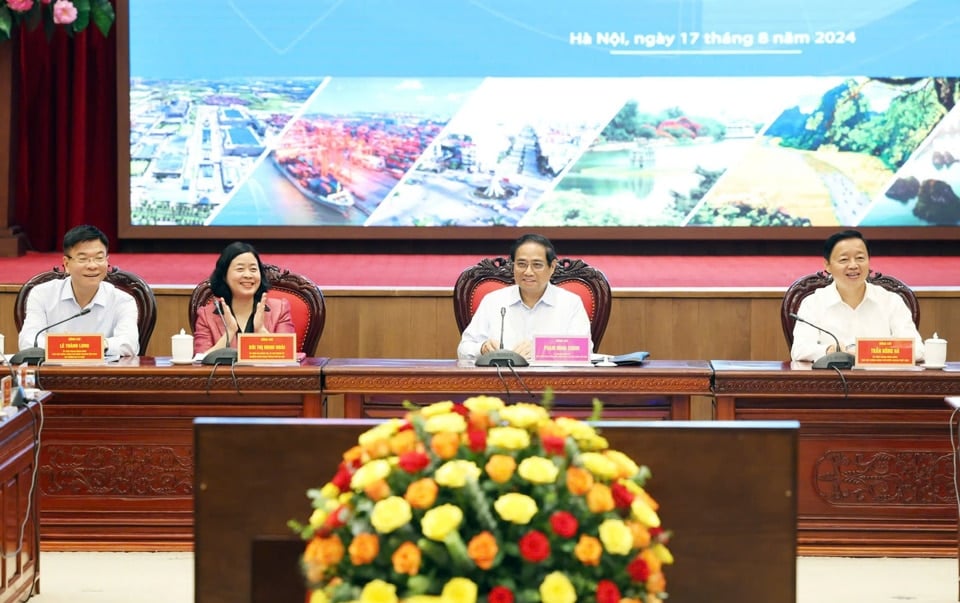
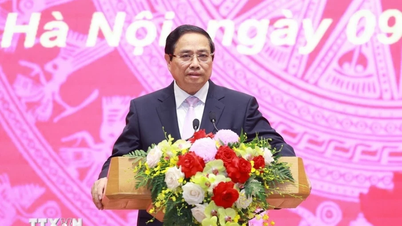
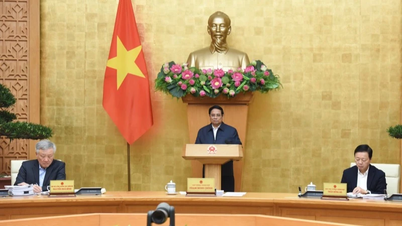
On the morning of August 17th, in Hanoi , Prime Minister Pham Minh Chinh – Chairman of the Red River Delta Regional Coordination Council – chaired the fourth meeting of the Council.
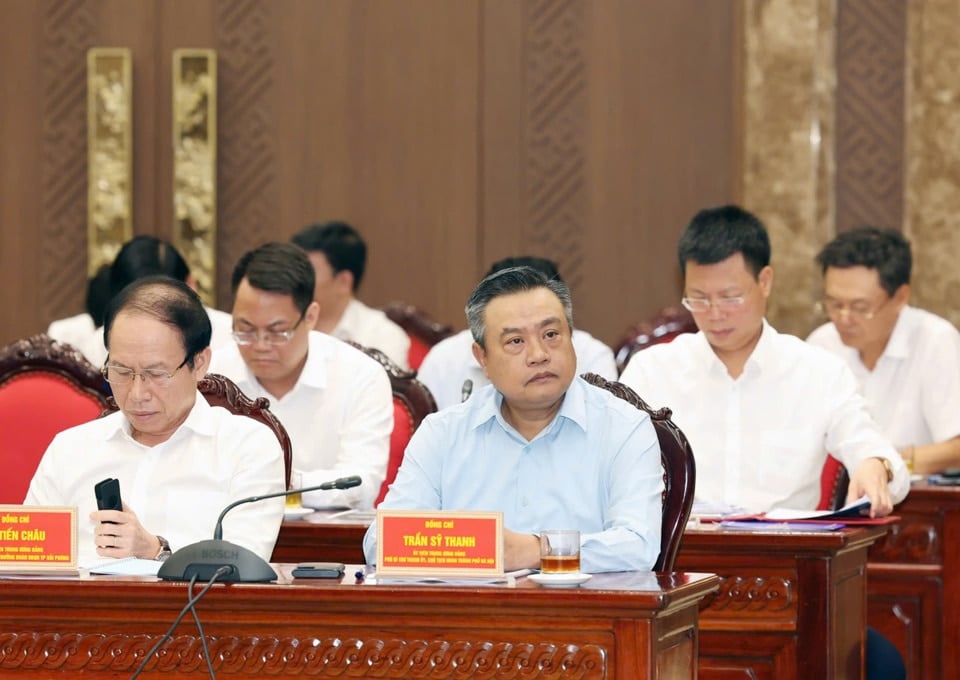
At the conference, Vice Chairman of the Hanoi People's Committee Duong Duc Tuan presented a report assessing several aspects related to the plan for completing Hanoi's urban railway network – a key area of development for Hanoi in the coming period.
Operate 10 urban railway lines by 2035.
Recently, Hanoi put into operation Metro Line 2A (Cat Linh – Ha Dong) and the Hanoi Metro Pilot Line, Nhon – Hanoi Station section (elevated section) on August 8, 2024. These projects have been highly appreciated and welcomed by the people of Hanoi and are also memorable milestones for the city.
Hanoi has proactively coordinated with neighboring localities to agree on the scale and alignment of connecting transportation routes, especially urban railway lines (updated in the revised Master Plan for the Capital), serving transportation connectivity and regional linkages to create momentum, urban development space, and a new, continuously smooth transportation corridor between Hanoi and localities in the region.
He chaired the development and coordinated with central ministries and agencies to finalize the overall plan for investment and construction of the Hanoi urban railway system, as directed by the Politburo in Conclusion No. 49-KL/TW dated February 28, 2023.
Specifically, the goal is to complete the investment, construction, and operation of 10 urban railway lines by 2035, with a total length of approximately 410.8 km (including lines already in operation: Line 2A Cat Linh – Ha Dong and the elevated section of Line 3.1 Nho Son – Cau Giay); with capital requirements as follows: 2024-2030, construction of 96.8 km, preliminary capital requirement of approximately 14.6 billion USD; 2031-2035: construction of 301 km, preliminary capital requirement of approximately 22.5 billion USD. The total capital requirement by 2035 is approximately 37.2 billion USD. After reviewing public investment sources and summing up the city's ability to balance other mobilized capital sources by 2035, the total is approximately 28.56 billion USD. Therefore, by 2035, the city will need approximately over 8.6 billion USD in support from the central government.
By 2045, the city will invest in and complete the construction of the remaining 5 lines (201km), completing and putting into operation the entire urban railway system of the capital (15 lines, adjusted and supplemented sections with a total length of approximately 616.9km, with a capital requirement of approximately 18.252 billion USD for this phase).
Currently, Hanoi is conducting research and implementing investment projects to build urban railway lines: Line 2.1 (Nam Thang Long – Tran Hung Dao), Line 3.2 (Hanoi Station – Hoang Mai), Line 5 (Van Cao – Hoa Lac), Line 2A extension (Ha Dong – Xuan Mai),… On June 28, 2024, the National Assembly passed and promulgated the Law on the Capital City; accordingly, investment in urban railway development in the city is prioritized to apply the TOD model, ensuring modernity, synchronization, and sustainability.
Besides the achievements mentioned above, the development of Hanoi's urban railway system still faces many challenges. According to the Vice Chairman of the Hanoi People's Committee, in order to approach the goals set by the Politburo for the development of the Capital City in the coming period in Conclusion No. 49-KL/TW dated February 28, 2023; which requires "Completing the urban railway network in Hanoi (with connectivity to the Capital Region) and Ho Chi Minh City by 2035)" and researching connections with neighboring provinces through urban railway lines.
Specifically, (1). Hung Yen Province (via urban railway line No. 1: Gia Lam – Lac Dao section at Lac Dao station); (2). Bac Ninh Province (via urban railway line No. 1: Yen Vien – Ngoc Hoi section at Yen Vien station); (3). Hoa Binh Province (via urban railway line No. 5 at Thach Binh station and urban railway line No. 2A extended to Xuan Mai at Xuan Mai station); (4). Vinh Phuc Province (via urban railway line No. 3 extended to Son Tay at the planned Son Tay station and via the Me Linh – Co Loa – Duong Xa urban railway line at Me Linh station); (5). Ha Nam province (via urban railway line 1A: the extension to the second southern airport) aims to spread socio-economic activities concentrated in the inner city to new urban areas in accordance with the planning orientation of the Red River Delta region for the period 2021-2030, with a vision to 2050, approved by the Prime Minister in Decision No. 368/QD-TTg dated May 4, 2024, which is also a top priority in the development strategy of Hanoi City.
Expedite the progress of the overall plan for investment and construction of the Hanoi urban railway system.
To further build upon the achievements, promptly address the shortcomings and limitations mentioned, and resolve emerging issues in the new context and situation of the country, in the coming period, Vice Chairman of the Hanoi People's Committee Duong Duc Tuan stated that Hanoi will continue to implement the following breakthrough solutions to develop the urban railway system:
Firstly, continue researching and refining the policy mechanisms outlined in the amended Capital City Law to encourage investment, aiming to attract investors to participate in the development of transportation infrastructure, reduce budget pressure, and accelerate the completion of infrastructure investment according to the approved plan.
Secondly, expedite the completion of the overall plan for investment and construction of the Hanoi urban railway system, reporting it to the competent authorities for submission to the Politburo and the National Assembly for consideration and approval of specific mechanisms and policies as a basis for implementation.
Thirdly, focus investment resources on urban railway lines in the central urban area to address the increasingly serious traffic congestion problem. Priority should be given to implementing lines that have already undergone investment preparation studies and detailed design (Line 1, Ngoc Hoi – Yen Vien section; Line 2, Nam Thang Long – Tran Hung Dao section; Line 3, Cau Giay – Hanoi Station – Hoang Mai section; Line 5: Van Cao – Hoa Lac).
Fourth, focus on developing the Ngoc Hoi station complex – a central station integrating the national railway, high-speed rail, and urban rail. For the development of large logistics centers, a prerequisite is the presence of railway branches to minimize transportation costs. Simultaneously, appropriate policies should be implemented to train and develop high-quality human resources to improve investment efficiency and proactively develop the urban rail network.
Fifth, there should be a specific strategy for the TOD model, viewing it as a central and priority solution for sustainable urban development. TOD must be viewed from the perspective of overall urban development/redevelopment and urban structure/restructuring, not just from the perspective of the transportation sector; planning and fully utilizing the underground space of stations and depots of urban railway lines in the historical inner city area (from Ring Road 3 inwards) because this area has essentially exhausted its above-ground space and has a high urban density.
Sixth, closely coordinate with neighboring provinces to concretize connectivity guidelines, unify applicable regulations and standards for urban railway systems between localities based on implementation guidelines in planning projects approved by the Prime Minister; strengthen connectivity between urban railway lines and logistics centers, new urban areas, etc.
Hanoi City proposes that the Prime Minister promptly decide on the technology to be implemented synchronously nationwide; ensuring that the urban railway system is synchronized in terms of technical infrastructure, locomotives, carriages, tracks, etc., and especially in terms of system connectivity and inter-regional connectivity between provinces and cities in the future.
Source: https://kinhtedothi.vn/ha-noi-dua-ra-giai-phap-dot-phat-trien-he-thong-duong-sat-do-thi.html


![[Image] Nearly 125,000 Hanoi students completed the Literature exam for the 10th grade entrance exam.](https://vphoto.vietnam.vn/thumb/1200x675/vietnam/resource/IMAGE/2026/05/30/1780117233041_ndo_br_thiet-ke-chua-co-ten-2-png.webp)



















































































Comment (0)