

The province has many key transportation projects that are currently being implemented or will be implemented in the future, such as: the coastal road connecting the East-West Economic Corridor, the Cam Lo-Lao Bao expressway, National Highway 15D, the eastern bypass of Dong Ha city... When operational, these transportation routes will contribute significantly to promoting socio-economic development and ensuring national defense and security.

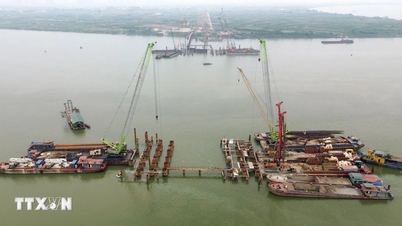
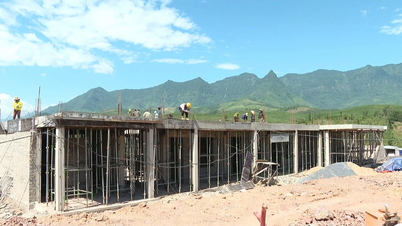
The construction unit is building the Thach 1 Bridge, part of the coastal road project connecting the East-West Economic Corridor - Photo: TU LINH
The Coastal Road Project connecting the East-West Economic Corridor in Quang Tri province - Phase 1 received investment approval in Resolution No. 40/NQ-HĐND dated May 12, 2021; and the technical study report was approved in Decision No. 4282/QĐ-UBND dated December 17, 2021. The project has a total investment of VND 2,060 billion for Phase 1, with an implementation period from 2021 to 2026.
Upon completion, the project will seamlessly connect with the national coastal road network, linking seaports and economic zones, and enhancing disaster prevention and rescue capabilities. Simultaneously, it will facilitate the development of coastal urban areas and tourism services, connecting the Southeast Quang Tri Economic Zone with the East-West Economic Corridor.
Currently, four construction packages of the project are underway on sections where land has been handed over. Specifically, package VB-XL01 is constructing two bridges (Km7 + 254 and Km10 + 729); package VB-XL02 is constructing a 2km roadbed; package VB-XL03 has completed the Trieu Trach bridge, with the road section awaiting land handover from the local authorities; and package VB-XL04 is constructing Thach Han 1 and Thach Han 2 bridges.
According to statistics, approximately 2,541 households are affected by the project. Currently, the Provincial Investment and Construction Project Management Board is actively coordinating with Dong Ha City and the districts of Trieu Phong, Gio Linh, and Vinh Linh to implement compensation, support, and resettlement work. The goal is to hand over the entire site to the contractor for construction in 2024.

National Highway 9 intersects with the Eastern Bypass of Dong Ha City, passing through Gio Quang commune, Gio Linh district - Photo: TT
The Cam Lo - Lao Bao Expressway Project was identified by the Prime Minister in the National Expressway Network Development Plan to 2020, with a vision to 2030, in Decision No. 326/QD-TTg dated March 1, 2016; and was approved by the Prime Minister for investment under the public-private partnership (PPP) method, with the Quang Tri Provincial People's Committee as the competent authority.
The Provincial People's Committee has approved Son Hai Group Co., Ltd. (Son Hai Group) as the investor to prepare the pre-feasibility study report. Son Hai Group Co., Ltd. has completed the pre-feasibility study report for the Cam Lo-Lao Bao Expressway Project under the PPP method, with a length of 56km, a scale of 4 lanes, and a total investment (excluding interest during construction) of VND 13,726 billion.
The investment in the construction of the Cam Lo-Lao Bao Expressway opens up possibilities for connectivity and strongly promotes development in Quang Tri province. It is a strategically important transportation project that will transform the East-West Economic Corridor from a purely transportation corridor into a true economic corridor, facilitating convenient connections between Vietnam and other countries in the region, linking the Pacific and Indian Oceans, and shortening the distance for goods transportation by over 200 km compared to other corridors. In particular, it will provide strong support for rescue and relief efforts during natural disasters, storms, and floods, and minimize traffic accidents.

Overpass on National Highway 15D, section crossing the Cam Lo - La Son expressway - Photo: T.TUYEN
Currently, the Department of Transport is coordinating with relevant units to advise the Provincial People's Committee to report to the Prime Minister for consideration of support and allocation of state capital from the central budget to participate in the project in order to complete the pre-feasibility study report, and submit it to the competent authority for appraisal and approval.
Regarding the National Highway 15D Project (section from National Highway 1 to the Ho Chi Minh Highway, Western Branch), the Prime Minister has agreed in principle to assign the Quang Tri Provincial People's Committee as the competent authority to attract investment through the Public-Private Partnership (PPP) method. Currently, the Provincial People's Committee has assigned the consortium of Hoanh Son Group Joint Stock Company, Phonesack Vietnam Co., Ltd., and Nam Tien Co., Ltd. to conduct research and prepare a pre-feasibility study report for the project.
Specifically, the section from the Cam Lo-La Son expressway to the Ho Chi Minh Highway has had its proposal completed by the consortium of investors. It is designed as a mountainous Class III road, with a roadbed width of 9 meters, a road surface width of 7 meters, and includes two tunnels with a total length of 4.37 km; the total investment is 6,778 billion VND.
Regarding the section of National Highway 15D from National Highway 1 to the Cam Lo-La Son Expressway, the Provincial People's Committee has assigned a consortium of investors to conduct research and surveys, and supplement the proposal to complete the overall investment project dossier for the construction of National Highway 15D from National Highway 1 to the Ho Chi Minh Highway. Currently, the consortium of investors is implementing the project and is expected to complete the dossier in March 2024.
Upon completion, this project will create an additional corridor parallel to the East-West Economic Corridor, aiming to enhance trade through the La Lay International Border Gate; connect the North Central and Central Coastal regions with Southern Laos and Northeastern Thailand, forming a Vietnam-Laos-Cambodia development triangle; shorten the journey from the La Lay International Border Gate to the seaport by an estimated 92 km; support the transportation of approximately 10 million tons of coal from Laos to Vietnam annually; and connect the Southeast Economic Zone of Quang Tri province.
The Eastern Bypass Project of Dong Ha City has a total length of 17.56 km. Of this, the section from Doc Mieu to National Highway 9 (in Gio Linh district) is 13.3 km long with a total investment of VND 399.96 billion; the section from the south of Song Hieu Bridge to Nguyen Hoang Street (in Dong Ha City) is 4.26 km long with a total investment of VND 230 billion. The road is designed as a Class III road in a flat area, with a 12m wide roadbed and an 11m wide asphalt concrete surface.
Regarding the implementation progress, the section from Doc Mieu to National Highway 9 commenced construction on January 6, 2024, and is expected to be completed by December 31, 2024. The construction unit is a consortium of Thanh An Joint Stock Company, Manh Linh Construction Co., Ltd., 873-Construction and Transportation Joint Stock Company, and Truong Danh Joint Stock Company. The total capital allocated for the project until the end of 2024 is over 247 billion VND, with cumulative disbursements reaching over 129 billion VND.
Currently, contractors are carrying out excavation and embankment work for the roadbed sections from km10+300 to km10+700 and from km11+131 to km13+294. The section from the south of Song Hieu Bridge to the Nguyen Hoang intersection is in the process of completing the procedures for approval of the construction drawings and cost estimates, and the contractor selection plan is being evaluated.
This is a significant transportation project that creates a bypass route through the urban areas of Dong Ha and Gio Linh, diverting and limiting traffic flow through the city center, making an important contribution to ensuring traffic safety; gradually completing the province's transportation infrastructure system, promoting socio-economic development, and ensuring national defense and security.
Tran Tuyen
Source



![[Photo] General Secretary and President To Lam presides over a meeting on preparations for the review of one year of operation of the three-tiered government system.](https://vphoto.vietnam.vn/thumb/1200x675/vietnam/resource/IMAGE/2026/06/02/1780391821195_a1-bnd-4595-9717-jpg.webp)









































































Comment (0)