

In the weeks leading up to the Lunar New Year, when market demand for food increases, the pressure on the livestock industry is greater than ever. This is a sensitive time, because even a single outbreak can cause severe losses for livestock farmers and affect the food supply for the Tet holiday.
In this context, many livestock farming models in Ho Chi Minh City have shifted strongly towards controlling diseases from the outset, instead of reacting passively as before.
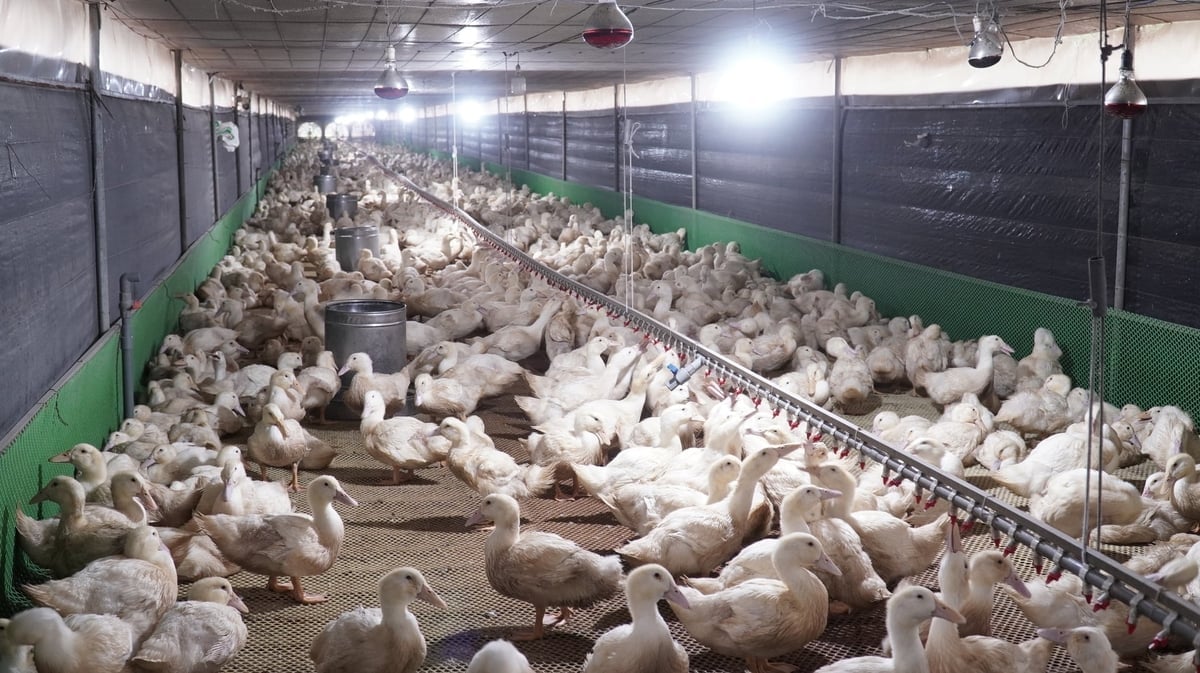
Ducks raised in enclosed pens with controlled environments help limit disease outbreaks during the period leading up to Tet (Lunar New Year). - Tran Phi.
In Phuoc Thanh commune, Mr. Nguyen Huu Duan's family's model of raising ducks in enclosed, cool-storage pens is entering its peak selling season. The farm currently maintains a flock of over 10,000 ducks, raised entirely indoors, isolated from the outside environment. The ducks are raised on elevated plastic mesh floors, and a continuously operating ventilation and cooling system helps control temperature and humidity – factors that easily lead to disease outbreaks at the end of the year.
According to Mr. Duan, the period leading up to Tet (Lunar New Year) is always the most worrying time for farmers. "Previously, with traditional farming methods, we were constantly worried about disease outbreaks at the end of the year. Now that we can control the farms and proactively prevent and control diseases, we feel more secure during the Tet season," he shared.
Thanks to stable rearing conditions, the ducks grow uniformly, and the mortality rate is significantly reduced. More importantly, limiting contact with external water sources and the environment helps the farm reduce the risk of disease outbreaks during peak consumption periods.
Not only in Phuoc Thanh, but also in Phu Giao commune, the dairy farm of Anova Agri Joint Stock Company is maintaining a stable production pace to serve year-end consumer demand. The farm currently raises more than 1,000 dairy cows using a closed-loop process, managing the herd with data and monitoring the health of each individual cow.
Mr. Phung Huy Binh, the farm manager, said that disease control is tightened during the period leading up to Tet (Lunar New Year). "Milk production must be stable every day, so if even one individual has a health problem, it must be dealt with immediately to avoid affecting the entire herd," he said.
Here, each cow is monitored for indicators such as body temperature, activity level, milk yield, and milk quality. If any abnormalities appear, the cow is examined and moved to a separate area for monitoring and timely treatment. This method helps prevent the spread of disease, especially during the end of the year when milk consumption increases sharply.
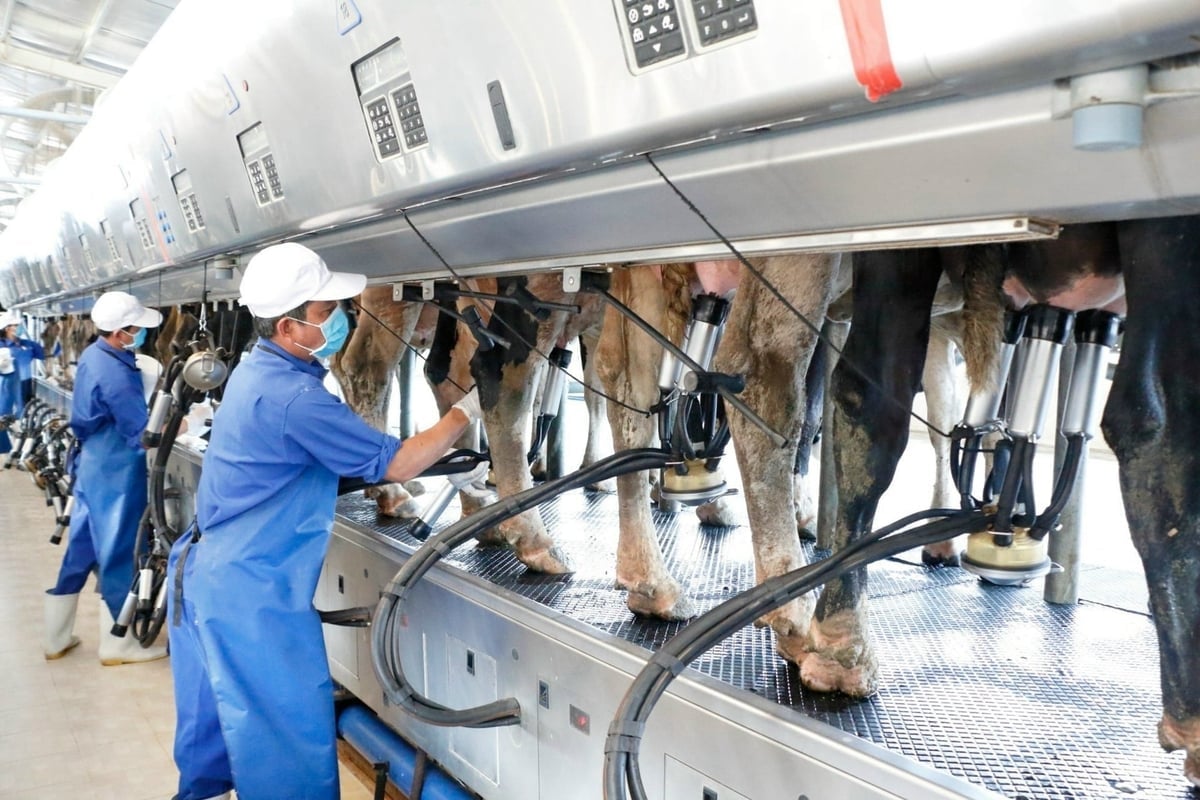
Automated milking process at the dairy farm, ensuring hygiene and disease safety. Photo: Tran Phi.
Thanks to the synchronized application of disease control and veterinary hygiene measures, Anova Agri dairy farm maintains a healthy herd and a stable milk production of approximately 8 million liters per year, meeting food safety requirements during the Tet holiday.
Mr. Tran Phu Cuong, Head of the Department of Livestock and Veterinary Medicine of Ho Chi Minh City, said that modern livestock farming models are proving to be very effective, especially during the peak period at the end of the year. "Controlling diseases before they even develop is a key factor in ensuring the safety of livestock and the food supply during Tet," Mr. Cuong stated.
According to Mr. Cuong, good control of breeding stock, breeding environment, and care procedures helps reduce the risk of disease outbreaks, limit losses, and reduce pressure on local veterinary services during this sensitive time.
Mr. Vo Thanh Giau, Deputy Director of the Department of Agriculture and Environment of Ho Chi Minh City, believes that the reality from livestock farming models in Phuoc Thanh and Phu Giao communes shows the important role of systematic investment from the beginning. When barns, care procedures, and veterinary work are implemented synchronously, the risk of disease outbreaks during peak periods such as the period leading up to Tet will be significantly reduced.
"Currently, the city is continuing to encourage livestock farming models that prioritize safety, good disease control, and environmental protection, in order to ensure a stable and safe food supply for the people during holidays and Tet (Lunar New Year)," Mr. Giau emphasized.
Source: https://nongnghiepmoitruong.vn/kiem-soat-dich-benh-tu-goc-trong-chan-nuoi-d789353.html
![[Photo] Prime Minister Pham Minh Chinh receives the Governor of Tochigi Province (Japan)](/_next/image?url=https%3A%2F%2Fvphoto.vietnam.vn%2Fthumb%2F1200x675%2Fvietnam%2Fresource%2FIMAGE%2F2025%2F12%2F16%2F1765892133176_dsc-8082-6425-jpg.webp&w=3840&q=75)

![[Photo] Prime Minister Pham Minh Chinh receives Lao Minister of Education and Sports Thongsalith Mangnormek](/_next/image?url=https%3A%2F%2Fvphoto.vietnam.vn%2Fthumb%2F1200x675%2Fvietnam%2Fresource%2FIMAGE%2F2025%2F12%2F16%2F1765876834721_dsc-7519-jpg.webp&w=3840&q=75)

![[Image] Leaked images ahead of the 2025 Community Action Awards gala.](/_next/image?url=https%3A%2F%2Fvphoto.vietnam.vn%2Fthumb%2F1200x675%2Fvietnam%2Fresource%2FIMAGE%2F2025%2F12%2F16%2F1765882828720_ndo_br_thiet-ke-chua-co-ten-45-png.webp&w=3840&q=75)
![[Live] 2025 Community Action Awards Gala](/_next/image?url=https%3A%2F%2Fvphoto.vietnam.vn%2Fthumb%2F1200x675%2Fvietnam%2Fresource%2FIMAGE%2F2025%2F12%2F16%2F1765899631650_ndo_tr_z7334013144784-9f9fe10a6d63584c85aff40f2957c250-jpg.webp&w=3840&q=75)








































![[Photo] Prime Minister Pham Minh Chinh attends the Vietnam Economic Forum 2025](https://vphoto.vietnam.vn/thumb/402x226/vietnam/resource/IMAGE/2025/12/16/1765893035503_ndo_br_dsc-8043-jpg.webp)





















Comment (0)