

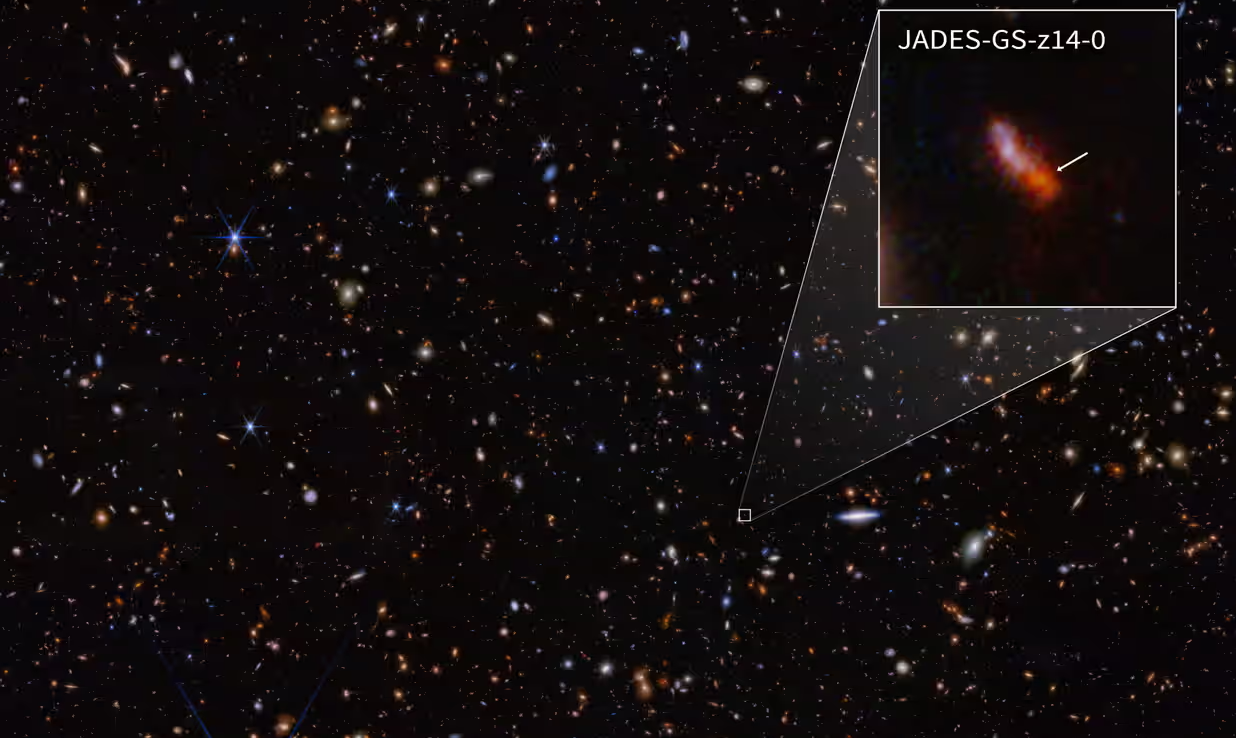
Location of the galaxy JADES-GS-z14-0
The galaxy, named JADES-GS-z14-0, was discovered just 290 million years after the Big Bang, also known as the "Dawn of the Universe." The previous record held by the James Webb telescope was for a galaxy approximately 325 million years after the Big Bang.
Early galaxies can provide researchers with a wealth of important information, such as how gas, stars, and black holes formed and changed during the early stages of the universe.
According to NASA, the first galaxy, JADES-GS-z14-0, offers a truly unique observational opportunity.
"The universe in its early stages was very different from what it is today," The Guardian quoted Dr. Francesco D'Eugenio of the University of Cambridge (UK), one of the teams behind the new discovery.
JADES-GS-z14-0 emitted a brighter light than expected, suggesting that the universe's first generation of stars shone much brighter than they do now, or formed at a faster rate than previously predicted.
The lead author of the report, Dr. Stefano Carniani of the Scuola Normale Superiore University (Italy), stated, "JADES-GS-z14-0 has now become the prototype of this phenomenon. It's amazing that the universe could create such a galaxy when it's only 300 million years old."
The unusual brightness of these early galaxies means the James Webb telescope will likely be able to detect many more galaxies.
Professor Brant Robertson of the University of California-Santa Cruz (USA) said that the research team would still be able to find the galaxy even if the light emitted were ten times weaker. He believes that in the not-too-distant future, humanity may be able to look back to a time when the universe was about 200 million years old.
Source: https://thanhnien.vn/kinh-james-webb-chup-duoc-anh-thien-ha-xuat-hien-som-nhat-va-xa-nhat-185240601105739911.htm

![[Photo] Two flights successfully landed and took off at Long Thanh Airport.](/_next/image?url=https%3A%2F%2Fvphoto.vietnam.vn%2Fthumb%2F1200x675%2Fvietnam%2Fresource%2FIMAGE%2F2025%2F12%2F15%2F1765808718882_ndo_br_img-8897-resize-5807-jpg.webp&w=3840&q=75)






























































































Comment (0)