

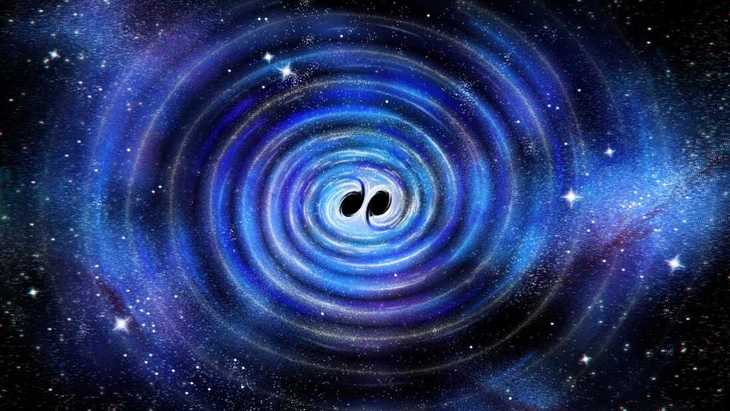
When two black holes merge, they create ripples in space called gravitational waves. Detectors on Earth can "capture" these signals, helping scientists better understand the universe. - Photo: Maggie Chiang/Simons Foundation
Black holes, these "cosmic monsters" with such immense gravitational pull that even light cannot escape, have long been a fascinating subject for scientists.
Despite appearing in Albert Einstein's theoretical works more than a century ago and being extensively studied by Stephen Hawking in the 20th century, black holes remain the most inaccessible topic in the universe due to their "invisible" nature.
Gravitational waves: the key to unlocking the study of black holes.
In 2015, the LIGO Gravitational-Wave Observatory (USA) for the first time detected gravitational waves—ripples in space and time caused by the collision of two black holes in the distant universe. This discovery was likened to "opening a new sense" for observing the universe and also provided an opportunity to directly test theories about black holes.
However, the initial data is not detailed enough to confirm these two key predictions.
One is Einstein's Kerr theory . According to general relativity, black holes can only be described by two fundamental properties: mass and spin. All other characteristics "disappear" when falling into a black hole, a phenomenon known as the "hairless theorem".
Secondly, there is Hawking's Area Theorem . In 1971, Stephen Hawking predicted that the area of the event horizon of a black hole, the boundary from which nothing can escape, can only remain constant or increase over time, never decrease.
This is seen as a principle similar to the second law of thermodynamics, which states that the entropy (the degree of disorder) of the universe is always increasing.
A breakthrough after a decade
According to Sciencedaily , the international collaboration LIGO-Virgo-KAGRA recently published new research results in the journal Physical Review Letters . They recorded the most detailed gravitational wave signals ever, originating from the collision of two black holes (event GW250114), creating a supermassive black hole with a mass 63 times that of the Sun and rotating at 100 revolutions per second.
Thanks to groundbreaking technological advancements, scientists have for the first time obtained a "complete picture" of both the events before and after the merger of two black holes. From this data, they have simultaneously confirmed two hypotheses:
Black holes are accurately described by their mass and rotation, just as predicted by Einstein's theory of general relativity.
The area of the event horizon only increased after the merger, in accordance with Hawking's area theorem.
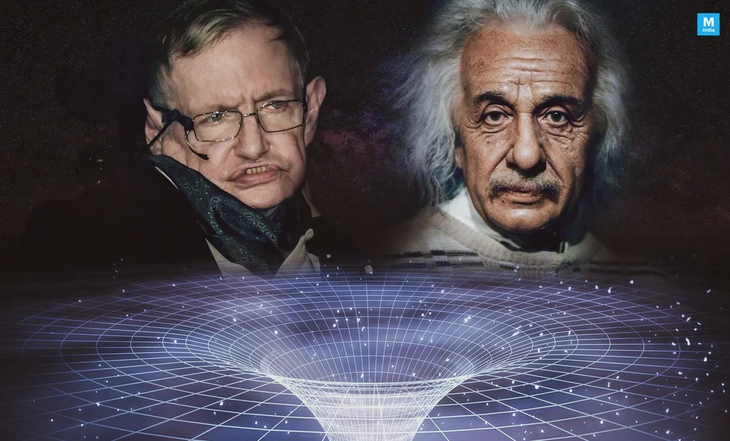
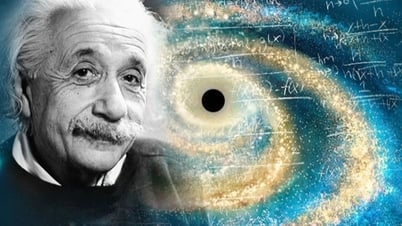
Einstein (right) and Hawking (left) made accurate observations about the nature of black holes - Photo: MashableIndia
From black holes to the nature of the universe
The proof of Hawking's theorem reveals a striking parallel between black holes and thermodynamics. In other words, the growth of a black hole's surface area is similar to the increase in entropy, implying that black holes could be a "mathematical window" that allows us to gain a deeper understanding of the nature of space, time, and even the greatest effort of modern physics: unifying general relativity and quantum mechanics into quantum gravity.
Maximiliano Isi, a member of the research team, stated: "This is the clearest evidence to date that black holes in space truly resemble what Einstein described in his theory. The fact that the surface area of a black hole follows a similar entropy pattern has very profound implications for the nature of the universe."
Over the next decade, gravitational wave detectors will be 10 times more sensitive than they are today. The successor project to the Laser Interferometer Space Antenna is under construction, promising to capture vibrations from supermassive black holes at the center of galaxies.
More than 100 years after Einstein predicted black holes using mathematical equations, and more than half a century after Hawking theoretically proved it, humanity has now begun to directly "hear" and "see" the signals that prove them right.
Black holes, which previously existed only in science books, are gradually becoming a "real" entity before the eyes of astronomers, and each recorded gravitational wave signal is a step forward in helping humanity better understand the mysterious universe we live in.
Source: https://tuoitre.vn/phat-hien-song-hap-dan-xac-nhan-tien-tri-cua-einstein-va-hawking-ve-ho-den-20250913075131812.htm

![[Photo] Prime Minister Pham Minh Chinh receives Lao Minister of Education and Sports Thongsalith Mangnormek](/_next/image?url=https%3A%2F%2Fvphoto.vietnam.vn%2Fthumb%2F1200x675%2Fvietnam%2Fresource%2FIMAGE%2F2025%2F12%2F16%2F1765876834721_dsc-7519-jpg.webp&w=3840&q=75)

![[Photo] Prime Minister Pham Minh Chinh receives the Governor of Tochigi Province (Japan)](/_next/image?url=https%3A%2F%2Fvphoto.vietnam.vn%2Fthumb%2F1200x675%2Fvietnam%2Fresource%2FIMAGE%2F2025%2F12%2F16%2F1765892133176_dsc-8082-6425-jpg.webp&w=3840&q=75)
![[Live] 2025 Community Action Awards Gala](/_next/image?url=https%3A%2F%2Fvphoto.vietnam.vn%2Fthumb%2F1200x675%2Fvietnam%2Fresource%2FIMAGE%2F2025%2F12%2F16%2F1765899631650_ndo_tr_z7334013144784-9f9fe10a6d63584c85aff40f2957c250-jpg.webp&w=3840&q=75)
![[Image] Leaked images ahead of the 2025 Community Action Awards gala.](/_next/image?url=https%3A%2F%2Fvphoto.vietnam.vn%2Fthumb%2F1200x675%2Fvietnam%2Fresource%2FIMAGE%2F2025%2F12%2F16%2F1765882828720_ndo_br_thiet-ke-chua-co-ten-45-png.webp&w=3840&q=75)

























































![[Photo] Prime Minister Pham Minh Chinh attends the Vietnam Economic Forum 2025](https://vphoto.vietnam.vn/thumb/402x226/vietnam/resource/IMAGE/2025/12/16/1765893035503_ndo_br_dsc-8043-jpg.webp)





































Comment (0)