

The officials, engineers, and workers of Department C, under the former Ministry of Water Resources of Thanh Hoa province, who once worked in Laos, now have graying hair; some are still alive, others have passed away. But they – an army without ranks or insignia – represent thousands of Vietnamese volunteers and experts who dedicated their youth to the cause of liberation and development of our friend Laos.
A time to remember
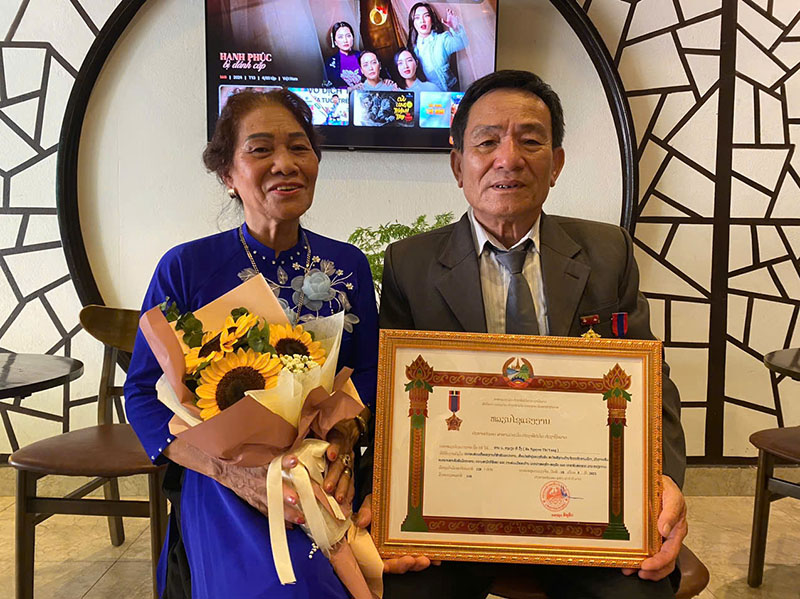
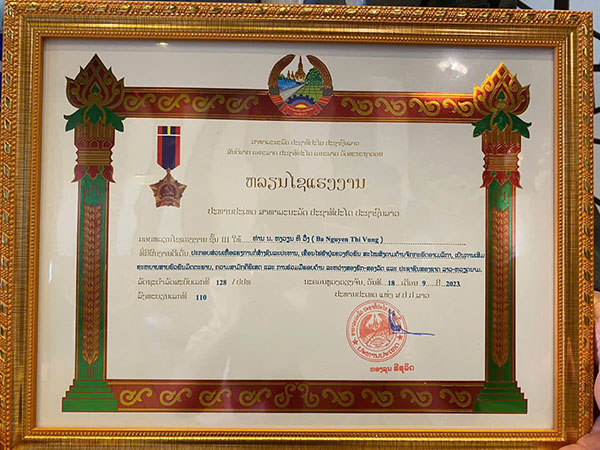
Late in the afternoon, the Ma Giang River was shrouded in mist, and the roads on the other side were lit up. In a small café on Vo Nguyen Giap Street, Dong Ve Ward, Thanh Hoa City, we were transported back to the old forest – a place that holds the enduring bond between Vietnam and Laos – through the stories of Mr. Dinh Phi Son, born in 1946, a former technical officer who helped build the basic irrigation system for our Lao friends from 1968 to 1974. I first met him at the ceremony where the President of the Lao People's Democratic Republic awarded the Labor Medal to individuals from Department C, under the former Ministry of Irrigation of Thanh Hoa province, for their contributions of effort and intellect to the construction and development of Hua Phan province during the resistance war and the period of national construction and development.
Imbued with the teachings of beloved President Ho Chi Minh: "Helping a friend is helping oneself," and with selfless and pure international sentiment, throughout the years of resistance against the common invading enemy, despite countless difficulties and shortages, Thanh Hoa dedicated its best efforts to fulfilling its mission as a direct rear base, providing manpower and resources to the battlefields in Laos in general, and Hua Phan province in particular. Tens of thousands of outstanding sons and daughters of Thanh Hoa left their homeland, volunteered to fight, and bravely sacrificed their lives in Laos. In the trenches, the sweat and blood of Vietnamese soldiers and experts mingled with the blood and sweat of Laotian soldiers and people, contributing to the complete victory of the national liberation revolutions of both countries in 1975.
During those difficult and arduous years, Thanh Hoa province provided Hua Phan province with thousands of tons of food and supplies, as well as many tools and materials to support production and combat. Many infrastructure projects, bridges, roads, factories, and enterprises were built in Hua Phan by the hands and minds of cadres, experts, volunteer soldiers, and over 10,000 young volunteers from Thanh Hoa province. Many agricultural and irrigation support and cooperation programs from Thanh Hoa helped Hua Phan province not only stabilize food security but also gradually improve the lives of its people. In particular, the cadres, engineers, and workers of the Central Committee volunteered to participate in the construction of numerous irrigation, hydroelectric, agricultural, and transportation projects, serving the resistance and supporting the lives of the people of the ethnic groups in Hua Phan province. This was an unranked, insignialess force that fought and contributed no less than the regular armed forces...
Mr. Dinh Phi Son began his story with a tone full of pride: For him, the seven years working in Hua Phan province were a "time to remember." During those years, Hua Phan was divided into two zones: the free zone and the occupied zone. Ban Phuc, Xop Xang commune, Xop Kho district – where Mr. Son lived and worked – belonged to the free zone. Although he didn't have to "take the brunt" of bombs and bullets, the malignant malaria, the dangers of stray bullets, falling trees, tiger attacks... were terrifying nightmares for volunteer cadres like Mr. Son.
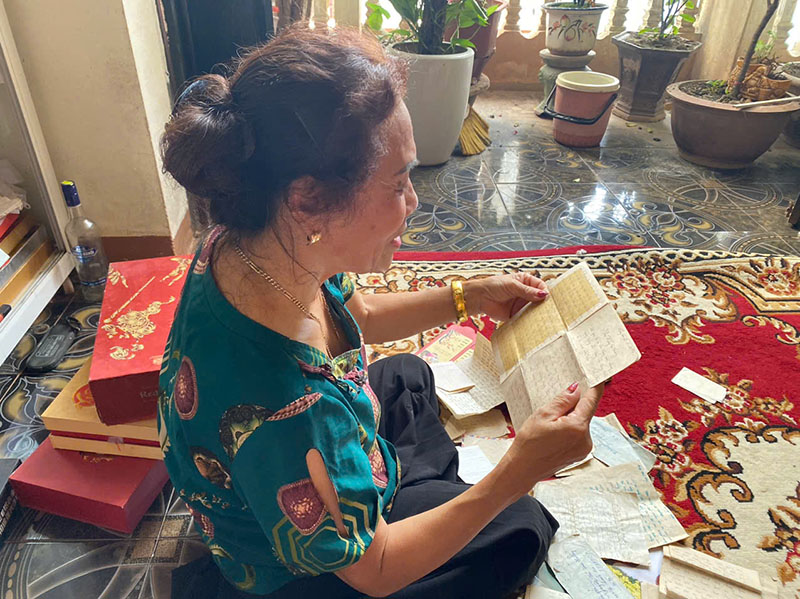
Half a century has passed, yet Mr. Son can still recall the names of the rivers and streams – places associated with the arduous journeys through the jungle, braving the mist, stepping on snakes, and defecating on landmines, that he and his colleagues undertook to survey and construct infrastructure projects serving the stabilization of production and the development of Laos. Living and working amidst the sacred jungle and its treacherous waters, they could "touch" death at any moment. During the months without rain, there was no water for bathing; then there were the weeks-long downpours, leaving everyone with wet clothes. As a result, almost everyone suffered from skin and digestive diseases, and many died from these illnesses. Mr. Son confided: "Life and death are always intertwined, sparing no one. It's fragile, impossible to hold onto. Just keep going, live, and work, without worrying about anything else..."
In Mr. Son's memory, meals consisting only of cassava, dried fish, fish sauce, wild vegetable soup, and pickled figs still evoke strong emotions whenever he recalls those days. But what Mr. Son always remembers most is the kindness of the Lao people. Since there were no vegetables in the forest, seeing that the officials liked to eat them, the Lao people would plant many vegetables in the forest, adding the message, "Feel free to take these vegetables." When villagers heard that an official had malaria, they would go into the forest together to gather medicinal leaves, grind them into a paste, and give it to the sick. Especially during the days leading up to the Vietnamese Lunar New Year, the Lao people would discreetly deliver supplies by putting candy and medicine in bags and throwing them along the paths they usually traveled, with a note saying, "Gifts for the Vietnamese New Year." "The Lao people are honest, simple, gentle, and amiable; this is clearly reflected in their eyes, smiles, and behavior. They highly value friendship and trustworthiness," Mr. Son shared.
"The story of you helping me and me helping you is quite long," Mr. Son recounted. "Once, near a water management project under construction, a woman who had just given birth suffered from postpartum hemorrhage. Her family called a shaman, but the shaman insisted she sit and hold sticky rice and chicken for the ritual. After half a day of worship, due to excessive blood loss, the woman was exhausted and fainted. Hearing the news, a few members of the rescue team brought medicine. From evening until the next morning, they injected the woman with more than a dozen vials of Vitamin K, B1, B12, and other tonics. They also instructed the family to roast rice and salt to make a hot compress for her abdomen. The woman gradually regained consciousness, and all the medicine the rescue team had brought was left for her family..."
A wedding in the forest amidst the ripening fruit...
Overcoming hardships and dangers, the officers and soldiers always remained optimistic and cheerful. Amidst countless shortages, love and camaraderie always remained strong. The spring of 1974 was perhaps the most special spring for Mr. Son. Because that spring, he got married. The wedding was held in the forest, in neighboring Laos. A small patch of forest was decorated with lanterns and flowers, overflowing with happiness.
Working alongside her husband at the construction site, worker Nguyen Thi Huong always received love and protection from her fellow countryman. Fifty years have passed, but the memories remain as vivid as if it were yesterday. She enthusiastically expresses her joy and happiness with her eyes, mouth, and even her hands and feet. In contrast to his wife, Mr. Son possesses the calm, polite, and refined demeanor of a civil servant. These two seemingly contrasting personalities perfectly complement each other. Seeing how he cares for her, one understands the immense vitality of the love that blossomed amidst the flames of war. “We met and fell in love in the most difficult circumstances, but that also gave us the motivation to continue our mission so we could return and be reunited… I can only say it was destiny…,” Mrs. Huong said emotionally.
After half a century of marriage, Mrs. Huong can be proud that she and her husband have shared hardships and overcome the most difficult times of the country in the post-war era. Their children have grown up and have stable lives. At over 76 years old, her joints are beginning to ache, perhaps a consequence of the years spent traversing mountains and forests. Her legs feel weary and tired upon waking, but whenever she has the chance, she accompanies her husband, seeking out and reconnecting with former colleagues and comrades.
In 2000, after retiring, Mr. Son established the Branch of Section C, Vietnam-Laos Friendship Association of Thanh Hoa - Hua Phan province. The branch has 100 members, including retired civil servants, farmers, and others. Although their time serving on international missions in Laos varied, the memories of a time of bombs, bullets, hardship, and fierce fighting, yet filled with deep affection, remain vivid in the hearts of these former officers, engineers, and workers of Section C living in Thanh Hoa.
Text and photos: Tang Thuy
Source: https://baothanhhoa.vn/ky-uc-hua-phan-nbsp-mau-va-hoa-227995.htm









![[Photo] Reception to welcome General Secretary and President To Lam and his wife on their State visit to the Philippines](https://vphoto.vietnam.vn/thumb/1200x675/vietnam/resource/IMAGE/2026/06/01/1780295488620_vna-potal-chieu-dai-chao-mung-tong-bi-thu-chu-tich-nuoc-to-lam-va-phu-nhan-tham-cap-nha-nuoc-toi-philippines-8798060-7855-jpg.webp)










































Comment (0)