The Liberation Radio Station was established on February 1, 1962, in the Ma Da forest of the Zone D war zone and operated continuously until the reunification of the country. Our team of editors and reporters worked directly in the forest from May 1971, nine years after the establishment of the Liberation Radio Station. We can be considered the youngest and last generation of reporters at the station.
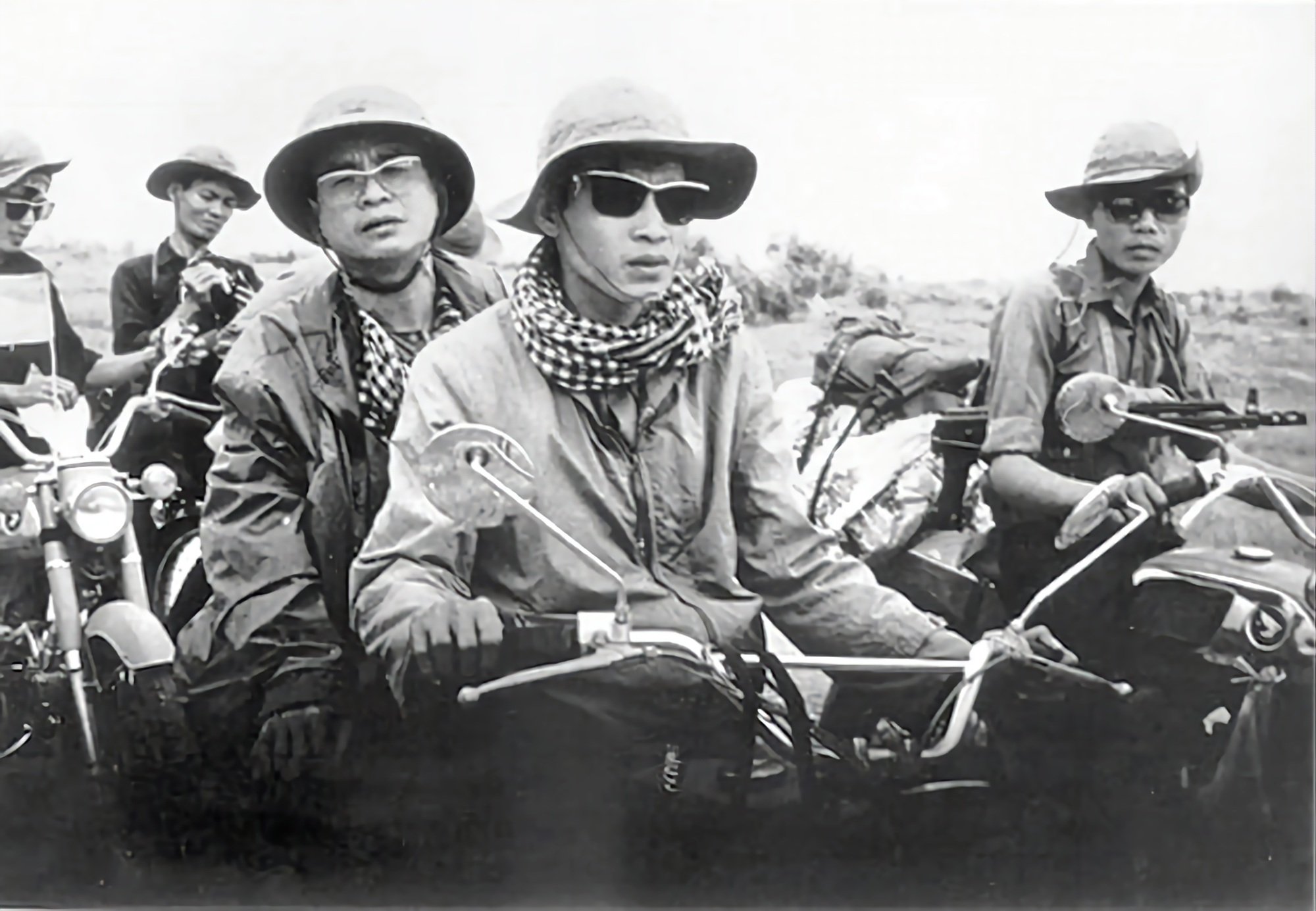
A1.jpg Journalists marching from the battlefield to prepare for the takeover in Saigon.
PHOTO: ARCHIVE
Talking about the daily work of the radio station in the jungle, it was very systematic. Every task was done meticulously. Early in the morning, we reporters would wake up, have a quick breakfast, and then drink tea. The tea back then was bamboo shoot tea, which the manager bought at the border crossing and distributed to us tea-loving crew. Actually, back then, all the reporters and editors were tea addicts.
The tea tables that were "set up" every morning in the forest were a unique feature of the war zone back then. After the reporters finished their tea, the station director would call them to a meeting. Every morning there was a serious briefing like that. The director at the time was Mr. Hai Xuyen, but Mr. Sau Ha was the one in charge of professional matters. Mr. Sau Ha was very skilled professionally and had many years of experience, so his suggestions for our reporters' articles were very well received.
The most important part of each morning briefing was assigning skilled reporters to write news commentary. I was also selected from among those news commentators. I specialized in commentary on military affairs and was highly trusted by the heads of the military propaganda subcommittees.


The morning meeting ended, and everyone went back to their tents to start working. Those who wrote quickly had their articles submitted to Mr. Sau Ha for approval by lunchtime. Approved articles would be telegraphed to Hanoi for broadcast. I and writer Le Diep (from the Southern Urban Affairs Department) usually finished work early, and after lunch, we would grab our fishing rods and head to the stream behind the station.
Le Diep and I were two lucky anglers. The stream was relatively deep, so there were quite a lot of fish, mostly red-tailed fish. We patiently sat and cast our lines, not to relax or think about big things, but to focus on catching fish for our evening meal. Back then, food in the kitchen was scarce, and both Le Diep and I were pale from malaria and malnutrition, so fishing to improve our diet was "something we needed to do immediately."
We'd often sit there all afternoon, and each of us would catch a few red-tailed fish, tiny ones about two or three fingers long, but that was pretty good, enough for dinner. Even better than food, it could be a great snack, if we had money for some local liquor. To get money, Le Diep and I had to go to the station's medical room to ask for malaria medication and "honestly declare" that we were severely emaciated.
The female doctor was quite easygoing, giving us medicine and even including a prescription for a ration check. Le Diep and I each received 100 riel (Cambodian currency). That was great! 200 riel could buy more than two liters of "local liquor." We spent it slowly, buying half a liter each time we went to the village. That way, every evening we'd invite a few more friends over, the snacks were the fish we'd caught, and half a liter of "local liquor" was enough for a leisurely drink. After drinking, we'd sleep in the bunker to avoid the B52 bombs.
Back then, B52 and B57 bombs were dropped frequently on the forests of the war zone. They were dropped haphazardly, never hitting anything, but we still had to sleep in bunkers for safety. It was in one of those bomb shelters that I wrote my long poem, "Trying to Talk About Happiness." This poem, now in 2025, is 53 years old.
The bunker where I wrote that poem belonged to Mr. Dien, a "teacher stationed... in the forest." The bunker was very sturdy; its owner was from Thanh Hoa province, so it was very well-maintained.
Working at the Liberation Radio Station, we had a close-knit group of friends, including Le Diep, Vu An Thy, and myself from Hanoi, and Kha Luong Ngai and Tuyet Nga from Saigon. Each of us was in a different sub-department, but our houses were close together in the jungle, and since we were all reporters, we were very close. To add more about Tuyet Nga: She is the younger sister of To Nga, who in recent years has become world-famous for a sensational lawsuit against the companies and the US government that produced and sprayed Agent Orange throughout South Vietnam during the war, causing immense suffering to both sides and civilians.
Ms. Tuyet Nga was the first announcer of the Liberation Radio Station in 1962. Afterwards, she went underground in Saigon, but was exposed and had to return to the war zone, working as a reporter for the Women's Subcommittee of the station. We worked together for more than a year, until the "Summer of Red Fire" in 1972, when we said goodbye to the Liberation Radio Station and went to work as reporters directly on the battlefields.

Although I only "worked as a journalist in the jungle" for a little over a year, those were unforgettable memories for me. I truly began to mature from that time. After returning from the My Tho battlefield to the resistance zone, I became a poet and a decent journalist. This shows that for a journalist, circumstances are only one factor; no matter how difficult the situation, as long as you overcome it, quality articles can still be produced.
The war shaped journalists like me, and luckily, even now, 55 years later, I can still write articles that get published.
Source: https://thanhnien.vn/lam-bao-trong-rung-185250619011434313.htm



![[Photo] General Secretary and President To Lam working with the Technical and Professional Center, Ministry of Public Security](https://vphoto.vietnam.vn/thumb/1200x675/vietnam/resource/IMAGE/2026/07/06/1783318005842_a1-bnd-1129-2263-jpg.webp)