

Handing over the letter, Ms. Thu explained: “I just found this letter in my father’s stack of documents. I send it to you…”. I called to show off to Poet Tran Dang Khoa… What a surprise! He shouted into the phone and said emotionally: “So precious. That letter is very special to me. The most special, among the letters I have sent to my poetry lovers for more than half a century – Special, not because of the letter I wrote, but because the recipient of the letter – Uncle Nhu was the first reporter in the country to come to my house, ask questions, write an article introducing me to the public, and publish it in the People’s Army Newspaper. And what is even more special, he is a martyr, and I know very well about his sacrifice. I know that the letter I wrote did not reach Uncle Ngoc Nhu. Because by the time the letter reached the People’s Army Newspaper’s editorial office, Uncle Nhu had already gone to the battlefield. Uncle Kim Dong, probably Uncle Nhu’s friend, still has that memory of him. I really want to look back at the letter I wrote.”
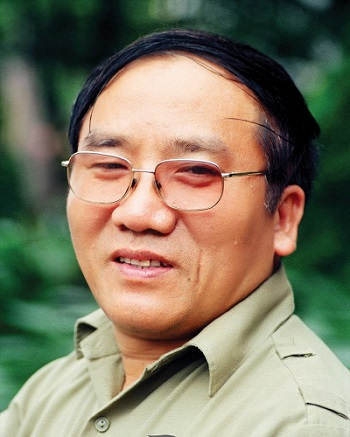 |
| Poet Tran Dang Khoa. Illustration photo: nhavanhanoi.vn |
Then, very naturally, he remembered almost the entire letter and poem "The Village in Season" he sent to Uncle Nhu, when the poem had just been published but had not yet been published in the newspaper, making me extremely surprised by his memory.
At that time, Tran Dang Khoa was only in third grade at the village school in Truc Tri village, Quoc Tuan commune, Nam Sach district, Hai Duong province (old). He had his poems published in newspapers when he was only in second grade. And what was special was that the first poems of that young poet were about the soldiers. According to Tran Dang Khoa, the soldiers marching to the battlefield often stayed in his village, in his house. And the first people to listen to his poems were also the soldiers.
The first journalist to meet Khoa was Mr. Phan Huynh, also a reporter for the People's Army Newspaper. But the first journalist to write about Khoa and introduce him to the public was Mr. Ngoc Nhu in the People's Army Newspaper. That article was not directly about Khoa, but about the fight of the army and people on Route 5, the strategic road connecting Hai Phong port with Hanoi , running through Khoa's hometown. Among them were two bridges, Lai Vu and Phu Luong, which were the main targets of the American imperialists' bombardment. Journalist Nguyen Ngoc Nhu wrote: "And especially, in the smoke and fire of enemy bombs and bullets, a simple and clear poetic voice of a boy in second grade rose up. That was also the voice that drowned out the sound of bombs in this land. That was the tiny poet Tran Dang Khoa." In the article, the author only dedicated those few lines to Khoa, which he always remembered.
In Khoa's memory, journalist Ngoc Nhu was a skinny but very agile and cheerful soldier. He returned at noon in the hot sun, in May or June. He rode an old Phoenix bicycle. He had a backpack tied to the back of the bike. He had a bag of rice slung across his shoulder. It was noon. His mother told Khoa to go to the garden to pick Malabar spinach and amaranth, then she hurried out to the field to catch crabs. The meal consisted of only crab soup with mixed vegetables and a few fried eggs. But it was very fun. When he left, Uncle Nhu filled a bowl of rice and left it with his family. Khoa's mother did not accept it. There was no shortage of rice in the countryside. But he insisted on leaving it behind, saying the rice was too heavy and sagged his shoulders. Then he left.
Khoa even had time to read to his uncle the poem “Pomegranate Flower” he had just finished writing: “I planted a green pomegranate tree - The pomegranate heard the sound of the hoe and its branches were full of flowers”. Uncle Nhu said: “If you write like this, readers will easily misunderstand. It’s not that the pomegranate tree hears the sound of the cuckoo, but the sound of the hoe, so how could the pomegranate tree have already bloomed?” Khoa immediately corrected it: “The cuckoo hasn’t stopped calling yet but its branches are full of flowers”. And then: “This afternoon, I suddenly heard cicadas chirping/ The cicadas chirping in the hot afternoon, the fruit gradually turning bright yellow/ I ate it and found it sweet and rich? I gave it to my uncle, did he smile at me? At night, when the bullets he shot up? Red as pomegranate flowers against the blue sky”.
Uncle Nhu's comments seemed to urge Khoa to write poems about the soldiers. Every new poem he wrote, Khoa would copy and send to Uncle Nhu. Then he would write letters to Khoa, commenting and giving his opinions. The poem "Pink Candy, Green Candy", about the time the children visited the soldiers in the anti-aircraft artillery unit on Tet holiday, was praised by Uncle Nhu with a surprising ending: "The artillery stood there watching / It seemed like it also wanted pink candy, green candy".
In the letter to Uncle Nhu, Khoa wrote: “I received your letter. I enjoyed reading it, but you are not Uncle Huynh, so I am greedy, please don’t be angry with me…”. “Greedy” is a mistake, a colloquialism of Khoa’s hometown. At first, Khoa thought Ngoc Nhu was the pen name of journalist Phan Huynh. But they are two different journalists.
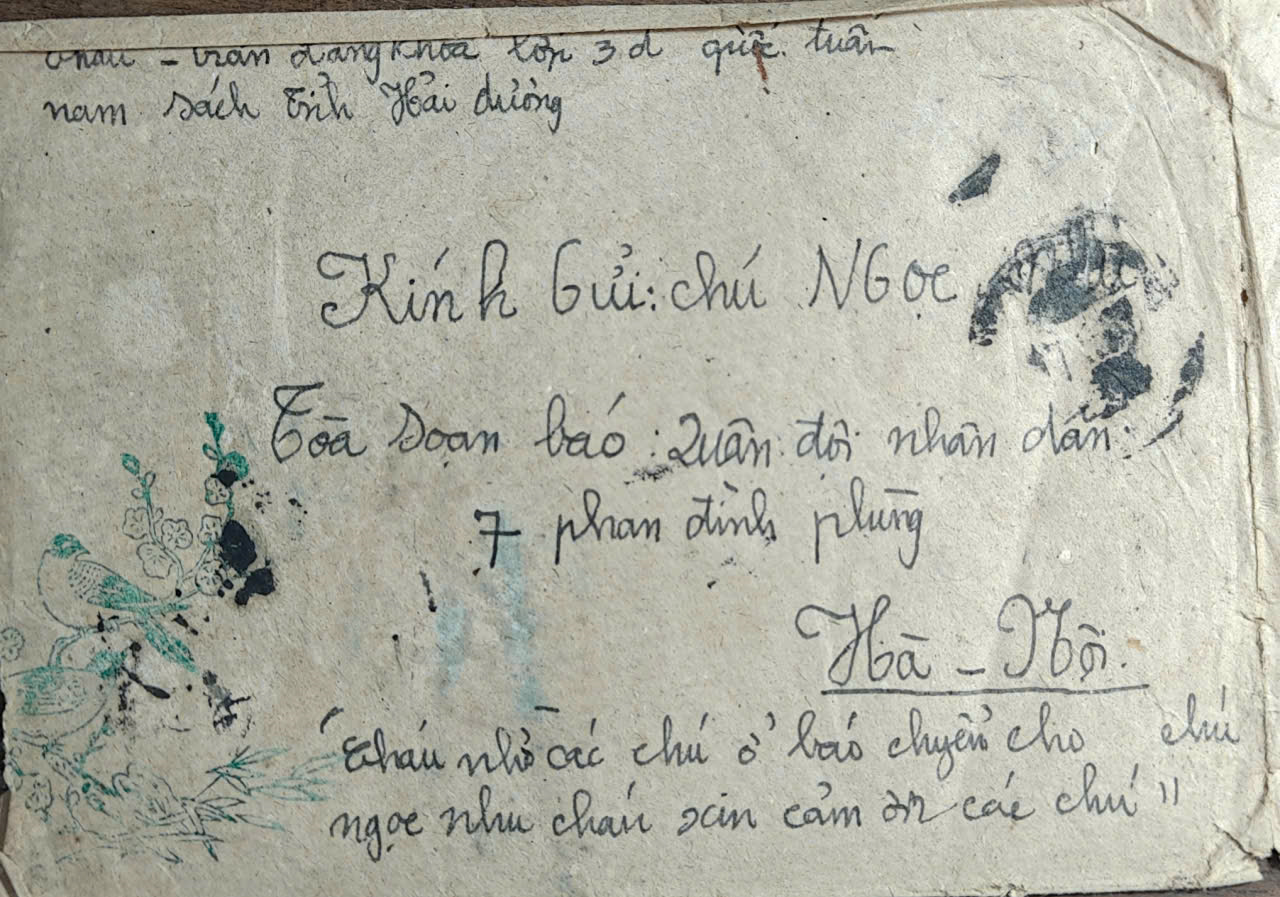 |
| Letter from Tran Dang Khoa to journalist Nguyen Ngoc Nhu. |
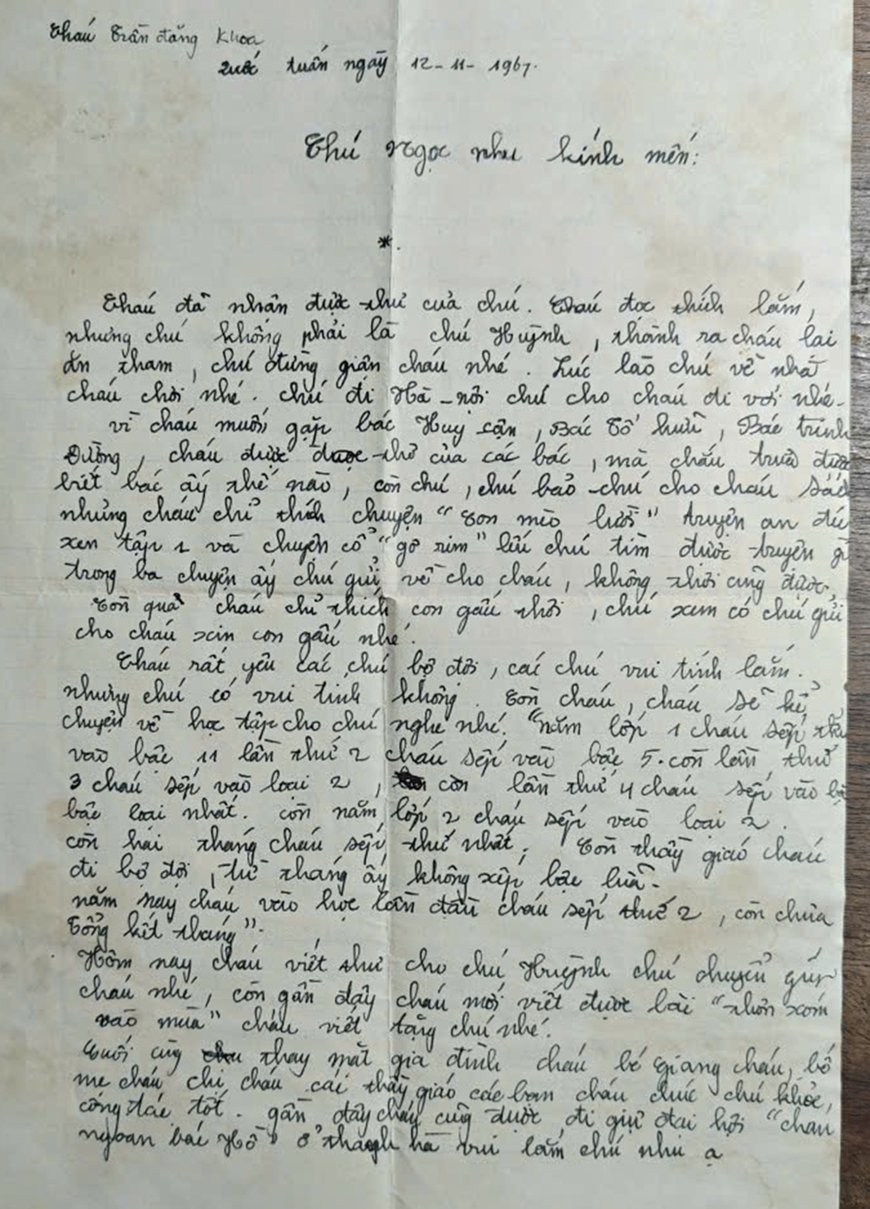 |
| Letter from Tran Dang Khoa to journalist Nguyen Ngoc Nhu. |
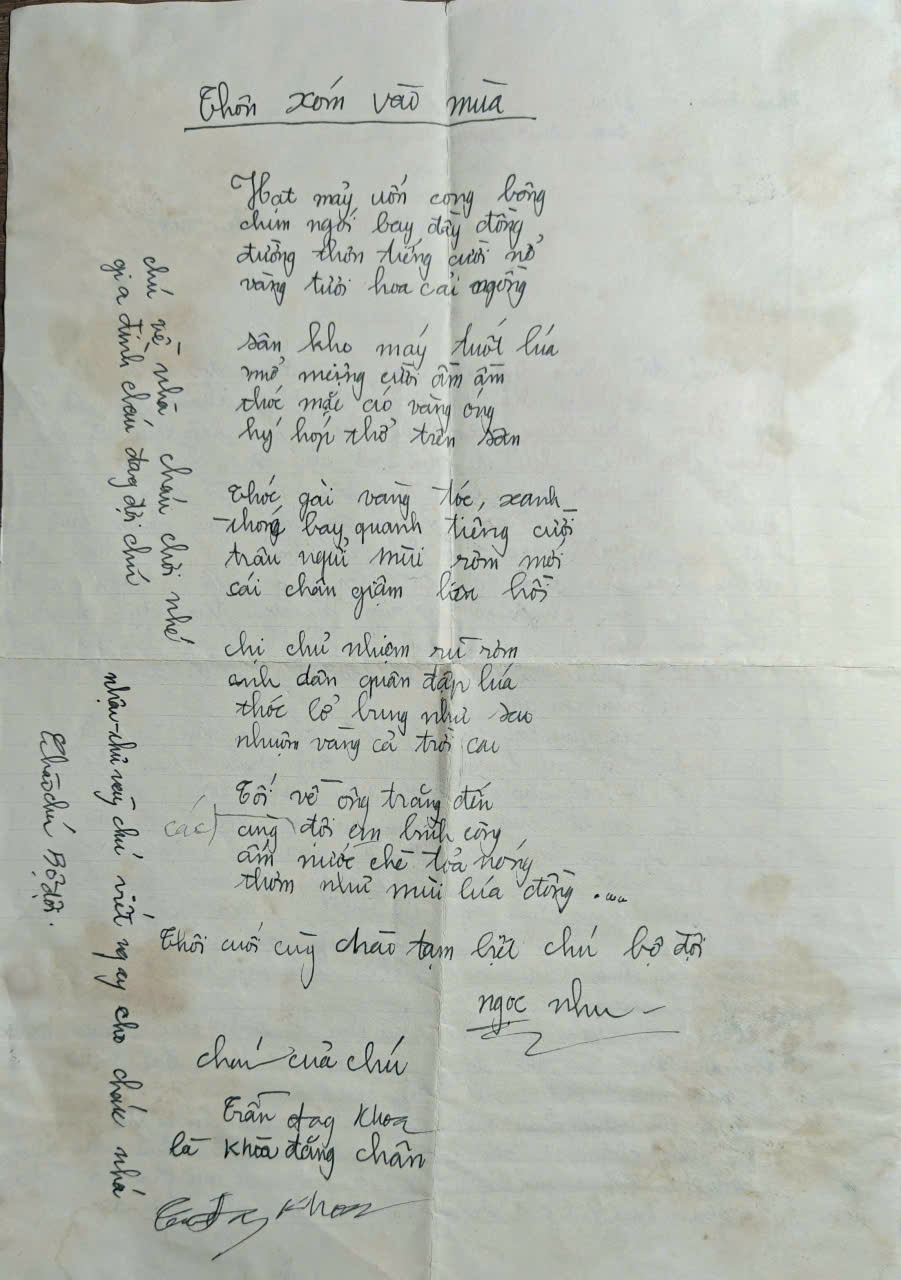 |
| Poem by Tran Dang Khoa to journalist Nguyen Ngoc Nhu. |
Tran Dang Khoa said that just a few days after Uncle Nhu returned, he received a letter from Uncle Nhu. In the letter, Uncle Nhu promised to buy books and toys “for little Khoa”. But before he could send it, Uncle Nhu died! Not one, but many letters that Khoa sent to the editorial office for Uncle Nhu did not reach him.
During a special mission to the Southern battlefield that year, the People's Army Newspaper sent three reporters: Nguyen Duc Toai, Nguyen Ngoc Nhu and Le Dinh Du. At the battle on the southern bank of the Ben Hai River, Gio Linh, Quang Tri , on the afternoon of January 21, 1968, Journalist Nguyen Ngoc Nhu and Journalist Le Dinh Du heroically sacrificed themselves at a very young age, leaving behind many unfinished plans...
Later, like Uncle Nhu, Khoa joined the army while still in the 10th grade. Then 10 years later, the General Department of Politics summoned writers and poets of the Army who had not yet completed university to study at Nguyen Du Writing School. Khoa shared a room with writer and playwright Xuan Duc. And surprisingly, Xuan Duc was a soldier of Battalion 47 Vinh Linh, who had repeatedly attacked the banks of the Ben Hai River. Nguyen Ngoc Nhu was a journalist and reporter for the People's Army newspaper, but participated in the battle as a real soldier, fighting with Battalion 47 of Vinh Linh soldiers to attack the Ben Hai River.
Playwright Xuan Duc said: “I knew Khoa through Ngoc Nhu. Ngoc Nhu was bombed, both her thighs were crushed, and she bled a lot. I bandaged her but couldn’t save her. I was the one who buried Ngoc Nhu and two other comrades. In Ngoc Nhu’s bag, there was Khoa’s letter, three poems, and a letter from Ngoc Nhu’s younger sister, named Mai. I intended to keep it, but the brothers in the martyr collection team said it was a martyr’s treasure and couldn’t be taken. I rolled it up, put it in a plastic bag, and buried it with Nhu’s dismembered body! Now I feel regretful.”
Many martyrs have passed away like that. Along with Uncle Ngoc Nhu, poet Tran Dang Khoa also remembers another soldier, named Vu Lien, whom Khoa had not met. Khoa only knew him through the People's Army Newspaper. It was a long time ago. At that time, Khoa was in 7th grade, the Commune Captain brought Khoa a copy of the People's Army Newspaper which had two poems printed on it, one by Khoa and one by Uncle Vu Lien (Southern Liberation Army).
In the poem “Sent to the soldiers” by Tran Dang Khoa: I hear you fighting somewhere / Warships burning, planes falling / When I get here, I only see you smiling / You go to fetch water, you sit and play marbles / Then from my house, you leave / The winter rice is ripe, the birds fly back / The banana bunches on the sidewalk tilt / Bamboo groves, sugarcane fields wave after you on all sides ... / You have crossed many streams and passes / Until now, you must have had many more victories / Out here, I stand and watch / On nights when guns explode, the sky is red with fire / I return to my old class, the walls are built / Trenches run under the shade of green trees / You go and destroy the last outpost / As long as the enemy is still in the sky, you are still on the go / Still waiting for the day you return / To sit with me on the sidewalk and play marbles... (1968).
And the poem "To my nephew Khoa" by Vu Lien: Uncle went to destroy the last of the military posts / To make your school beautiful under the high sky / Uncle marched over the pontoon bridge / Received all of your poems, I love all of them / Marched over the mountain passes / Hesitantly remembering you on the afternoons playing marbles / Glancing at the forest birds, remembering the nightingales / The trenches of my hometown are no different from the trenches / The red fire of victory rose high / I heard how many military posts were destroyed / Uncle is still liberating Saigon / If the enemy is still there, uncle will still go / When the enemy is over, uncle will return / Will sit with you on the sidewalk playing marbles...
Tran Dang Khoa told me that until now he still doesn't know where Uncle Vu Lien is! Is he still alive, or like Uncle Ngoc Nhu, has he sacrificed himself in a forest somewhere? He emotionally said: "Let me respectfully thank the People's Army Newspaper for not only introducing, encouraging, and supporting me in writing poetry, but also letting me meet and get to know the soldiers who work as journalists, like Uncle Phan Huynh, Uncle Ngoc Nhu... And many more soldiers that I only met in newspapers like Uncle Vu Lien...
Source: https://www.qdnd.vn/van-hoa/doi-song/liet-si-nguyen-ngoc-nhu-phong-vien-dau-tien-viet-ve-than-dong-tho-tran-dang-khoa-867238


![[Photo] Cat Ba - Green island paradise](/_next/image?url=https%3A%2F%2Fvphoto.vietnam.vn%2Fthumb%2F1200x675%2Fvietnam%2Fresource%2FIMAGE%2F2025%2F12%2F04%2F1764821844074_ndo_br_1-dcbthienduongxanh638-jpg.webp&w=3840&q=75)


























![[VIMC 40 days of lightning speed] Da Nang Port: Unity - Lightning speed - Breakthrough to the finish line](https://vphoto.vietnam.vn/thumb/402x226/vietnam/resource/IMAGE/2025/12/04/1764833540882_cdn_4-12-25.jpeg)
































Comment (0)