

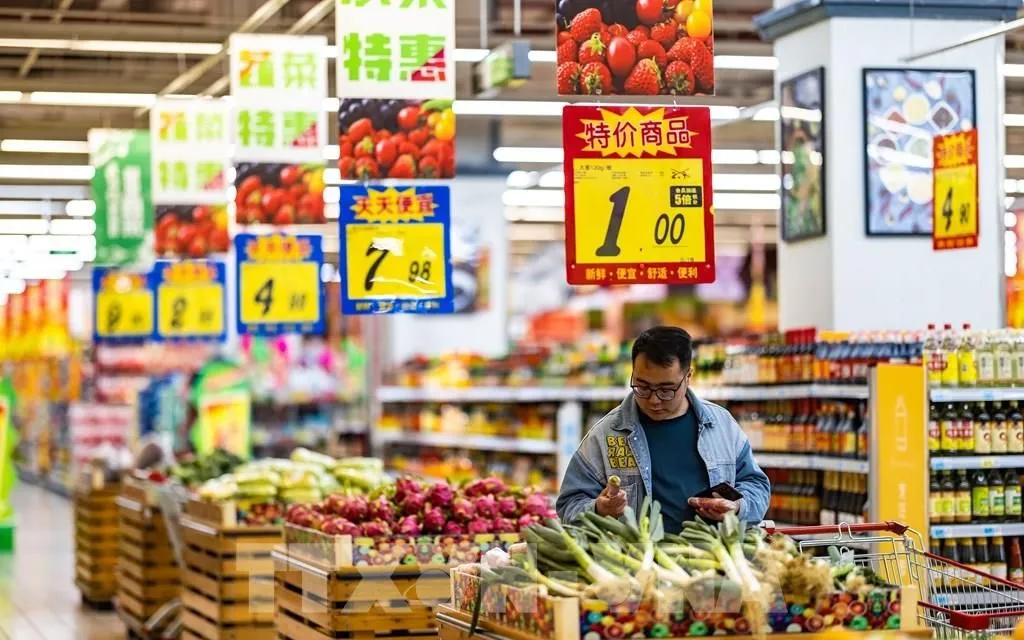
Chinese consumer inflation unexpectedly surged again.
According to China's National Bureau of Statistics, the consumer price index (CPI) in October rose 0.2% year-on-year, marking a recovery after two consecutive months of decline. The core consumer price index (excluding food and energy) increased 1.2%, its highest level in 20 months, driven by holiday demand and policies supporting domestic consumption. Meanwhile, the producer price index (PPI) fell 2.1%, less than in September, but still maintaining a 37-month losing streak. Persistent deflationary pressures are causing Chinese consumers to restrict spending and reducing corporate profits, hindering economic growth.
In the third quarter of 2025, the Chinese economy recorded its slowest growth in a year, while youth unemployment remained high despite a slight decrease in September.
Policymakers remain cautious, avoiding large-scale stimulus packages, with the People's Bank of China (PBoC, the central bank) keeping interest rates unchanged for the past five months – partly thanks to signs of export recovery following a temporary trade agreement with the US.
Analysts believe that the Chinese economy still has the potential to achieve the government's growth target of around 5% for this year. However, persistent deflation in the manufacturing sector, sluggish factory activity, and a gloomy export outlook in the coming months all indicate that the recovery is weakening.
Faced with unsustainable growth prospects, Chinese leaders have signaled a strong shift toward boosting consumption over the next five years, aiming to reduce reliance on investment and exports – two drivers increasingly vulnerable due to international trade tensions and limited investment space. However, these measures will take time to show results.
Source: https://vtv.vn/lam-phat-tieu-dung-trung-quoc-bat-ngo-tang-tro-lai-100251110100949071.htm


![[Image] Pleasant weather helps students enter the 10th grade entrance exam with confidence.](https://vphoto.vietnam.vn/thumb/1200x675/vietnam/resource/IMAGE/2026/05/29/1780034401612_ngay-1-thi-lop-10-minh-duy-8-5009-jpg.webp)
![[Photo] Ba Lang An Lighthouse - the "eye of the sea" amidst the "rock museum" of Quang Ngai province.](https://vphoto.vietnam.vn/thumb/1200x675/vietnam/resource/IMAGE/2026/05/29/1780038698840_anh-man-hinh-2026-05-29-luc-14-10-42.png)

















































































Comment (0)