

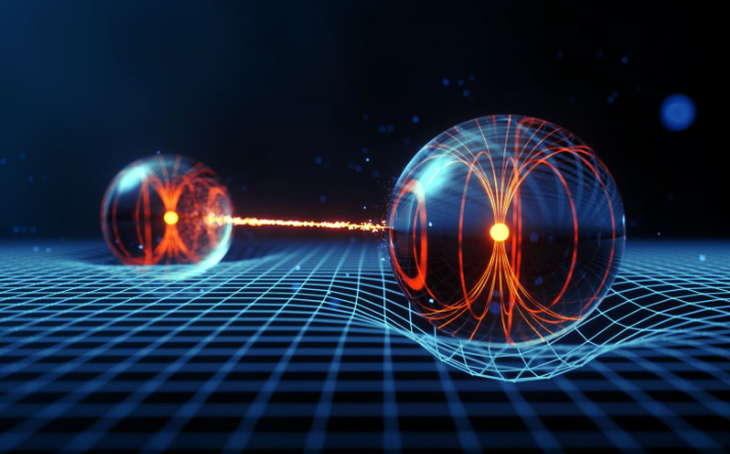
A major step towards the quantum internet has just been taken by German researchers - Illustration photo: news.ucsb.edu
German scientists have taken a major step towards the quantum internet – the ultra-secure communications network of the future – by transferring information between photons emitted from two different quantum dots for the first time. The results were published in Nature Communications .
Quantum dots are tiny structures in semiconductor materials that emit individual photons. In quantum communications, each photon carries a “quantum bit”—for example, the polarization direction of the light. The special thing is that if “eavesdropped,” the photon leaves an immediate trace, helping the system detect interference.
However, to "teleport" quantum information, the photons must be nearly identical in color and time of emission. This is very difficult, especially when they are created from different sources.
The team at the University of Stuttgart solved this problem by creating two nearly identical semiconductor photon sources and using frequency converters to correct the small discrepancies. One source produced single photons, the other produced pairs of “entangled” photons—that is, they shared the same state despite being far apart.
In the experiment, when a single photon meets a photon in an entangled pair, its state is instantly transferred to the other photon in the distance - a phenomenon called quantum teleportation. The two experimental sites are connected by a 10m long optical fiber cable.
The team says it has a success rate of more than 70% and is aiming for much longer distances. Quantum dot entanglement has previously been transmitted 36km over Stuttgart’s fiber optic network.
This achievement is an important step towards creating a quantum repeater - a device that can transmit quantum signals over long distances. Unlike today's internet, quantum signals cannot be amplified or copied, so only a quantum repeater can "refresh" information without losing security.
The project is part of Germany's national program Quantenrepeater.net, which involves more than 40 research institutions and businesses. Scientists hope that foundational experiments like this will pave the way for real quantum networks in the future.
Source: https://tuoitre.vn/lan-dau-dich-chuyen-thong-tin-giua-hai-cham-luong-tu-mo-duong-den-mang-truyen-thong-sieu-an-toan-20251130092845513.htm

![[Photo] Prime Minister Pham Minh Chinh receives President of Cuba's Latin American News Agency](/_next/image?url=https%3A%2F%2Fvphoto.vietnam.vn%2Fthumb%2F1200x675%2Fvietnam%2Fresource%2FIMAGE%2F2025%2F12%2F01%2F1764569497815_dsc-2890-jpg.webp&w=3840&q=75)





























































































Comment (0)