

According to Giuseppe Etiope, a geologist at the National Institute of Geophysics and Volcanology in Rome, Italy, the perpetual flame could be considered a special case of gas leakage from a deep underground reservoir.
When natural gas from deep underground reservoirs escapes through cracks in the rock, it can spontaneously combust for thousands of years.
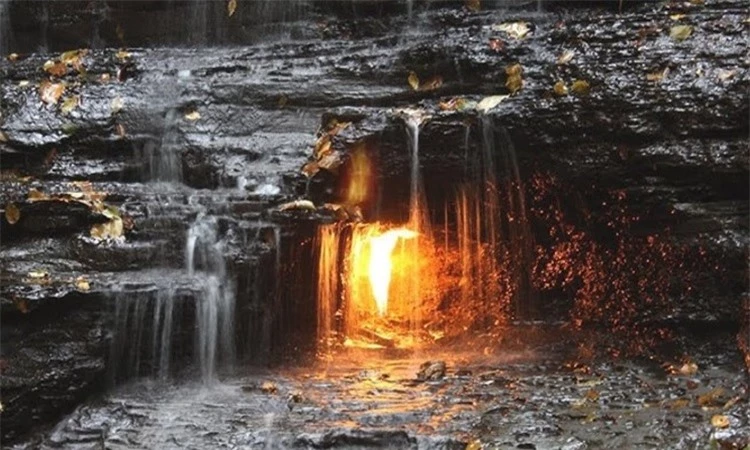
Gas leaks occur when naturally flammable underground gases, primarily methane, ethane, and propane, rise to the surface from pressurized reservoirs through cracks or holes in rock. In specific cases, when the gas reaches a sufficiently high concentration of methane at the surface, it can spontaneously ignite. Fueled by a continuous gas emission source, some flames can burn for thousands of years, hence the name "eternal flames."
Ethiopia estimates there are fewer than 50 perpetual fires globally, often found near oil wells. They exist in countries including the United States, Romania, Italy, Turkey, Iraq, Azerbaijan, Taiwan, China, India, and Australia. Some may have been developing for thousands or tens of thousands of years, even as far back as a million years ago.
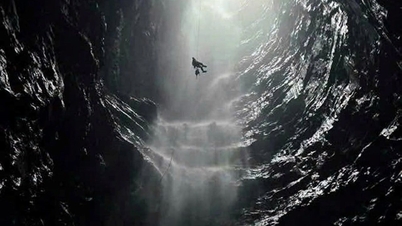
A famous flame lies beneath a 9.8-meter waterfall in Chestnut Ridge Park in New York City. The flame is approximately 7.6 to 20 centimeters tall, depending on the weather and season. "It shines behind the curtain of water," describes Arndt Schimmelmann, an Earth scientist at Indiana University. Etiope also shared that it is the most beautiful natural perpetual flame he has ever seen.
Although some have burned for millennia, eternal flames can be extinguished. "The term 'eternal flame' is misleading because geological history shows that nothing lasts forever on Earth," Schimmelmann explains. Some flames can be extinguished by rainwater, depending on the intensity of the gas leak and ground conditions, and then they may spontaneously reignite.
At Chestnut Ridge, water splashing into small caves can extinguish fires. "I've done it myself a few times when sampling gas for geochemical analysis. Reigniting a fire without being soaked by water from the waterfall is always a big challenge," Schimmelmann shared. In fact, the fire can disappear due to natural erosion as the waterfall recedes. Losing the cave's cover would cause the fire to frequently go out even if the gas flow is uninterrupted.
Geological hydrocarbon leaks, including perpetual flames, are a natural source of greenhouse gases like methane and photochemical pollutants like ethane and propane. The Chestnut Ridge flame releases about one kilogram of methane per day. There are so few perpetual flames that their environmental impact is relatively small compared to the thousands of gas leaks worldwide. Gas drilling can extinguish nearby perpetual flames by lowering the pressure of the gas field that fuels them. The perpetual flame in Chestnut Ridge National Park survives because no drilling has taken place in the area.
According to Intellectual Property
Source: https://doanhnghiepvn.vn/cong-nghe/ly-giai-khoa-hoc-phia-sau-ngon-lua-vinh-cuu/20241201120845994


![[Image] National Assembly discusses the implementation of the socio-economic development plan.](https://vphoto.vietnam.vn/thumb/1200x675/vietnam/resource/IMAGE/2026/04/20/1776696707422_ndo_br_img-20260420-185419-jpg.webp)


![[Photo] General Secretary and President To Lam meets with National Assembly delegates from ethnic minorities.](https://vphoto.vietnam.vn/thumb/1200x675/vietnam/resource/IMAGE/2026/04/20/1776696701056_a1-bnd-8331-3342-jpg.webp)





























































































Comment (0)