

Thanh Hoa is a land with a long and rich historical tradition. Throughout its long history of nation-building and defense, previous generations have left behind a treasure trove of cultural heritage, artifacts, and historical documents of great value. Therefore, the preservation, management, and conservation of these heritages, especially historical artifacts and documents, have been and continue to be a priority for many localities and units in the province, implemented through various flexible and creative approaches.
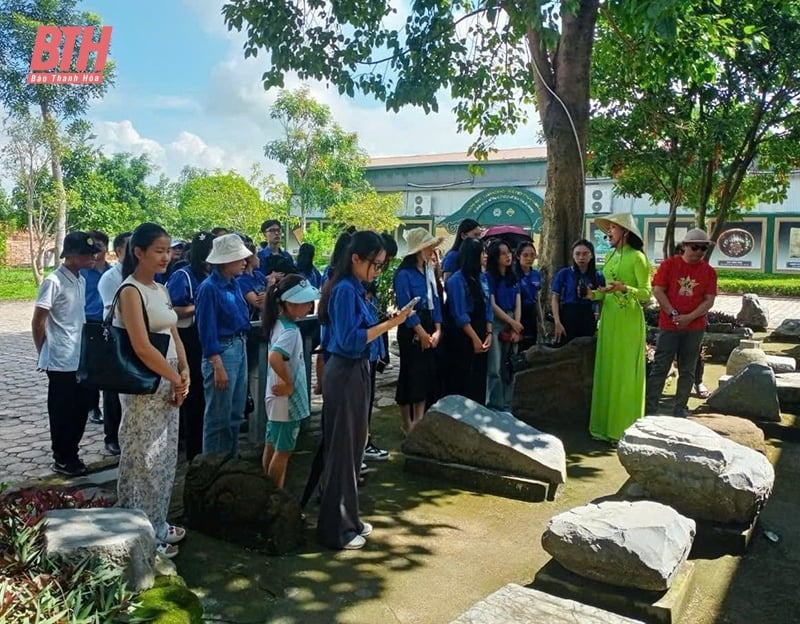
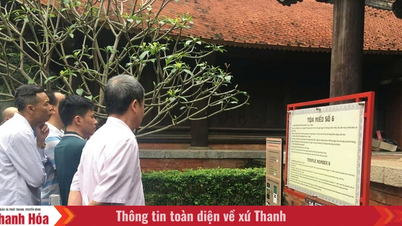
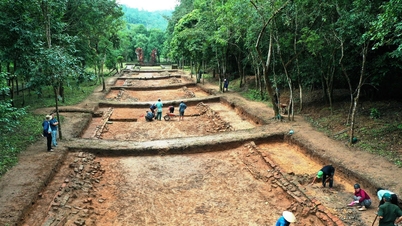
The outdoor exhibition space showcasing artifacts at the Ho Dynasty Citadel (Vinh Loc) attracts a large number of youth union members and young people to visit and learn. Photo: PV
A diverse range of artifacts
Upon arriving at Ho Citadel (Vinh Loc), we were extremely impressed with the artifacts being preserved and displayed there. Trinh Huu Anh, Deputy Director of the Ho Citadel Heritage Conservation Center, said: "The Ho Citadel currently preserves and safeguards approximately 80,000 artifacts excavated in the Ho Citadel area and the Nam Giao Tay Do Altar, or collected from the people. Among them, the most notable are artifacts made of terracotta, stone, bronze, phoenix heads, bricks with inscribed or engraved Han-Nom characters recording the names of the localities that produced the bricks, and stone blocks transported for the citadel construction..."
While guiding us on the tour, Trinh Huu Anh, Deputy Director of the Ho Dynasty Citadel Heritage Conservation Center, meticulously introduced us to the history and value of the artifacts. Among them, the most prominent were the headless stone dragons in the inner citadel area. According to research, the dragons are 3.8 meters long, making them the largest stone dragons discovered from any feudal Vietnamese dynasty. The dragons are exquisitely carved from solid blocks of green stone, their bodies tapering towards the tail, curving in seven sections, and covered in scales. Each dragon has four limbs, with three claws. The spaces under their bellies and the triangular panels forming the steps are intricately carved with chrysanthemum and delicate, flowing floral motifs. Researchers believe these dragons resemble those carved on the steps of the Thang Long Imperial Citadel (Hanoi) and the Lam Kinh Palace (Thanh Hoa). In addition, several other artifacts and relics being preserved are of immense value, not only providing important materials for research on Ho Citadel, but also helping visitors understand and gain a more comprehensive view of this unique world cultural heritage site.
The Thanh Hoa Provincial Museum currently houses and preserves over 30,000 artifacts, displayed in chronological order from the early stages of human life in Thanh Hoa province to the present day. In addition, it also preserves many valuable national treasures such as the Nua Mountain short sword, the Cam Giang bronze drum, and the Cam Thuy bronze cauldron. Among them, the Nua Mountain short sword, dating back approximately 2,000 years, is associated with the place where Lady Trieu launched her rebellion in 248 AD, at the foot of Nua Mountain, Nua town (Trieu Son district). It is considered a masterpiece of culture and art, possessing high aesthetic value and representing the bronze crafting style of the Ma River basin during the Dong Son culture era. The Cam Thuy bronze cauldron holds special value, closely linked to the history of the Le Trung Hung period (16th-18th centuries), serving as vivid evidence of the perfect bronze casting techniques that Vietnam achieved centuries ago...
Most historical and cultural sites, including communal houses, temples, and pagodas in the province, preserve a considerable number of historical artifacts and documents, rich in quantity and variety, ranging from archaeological sites to royal decrees, inscriptions, and ancient architectural structures. These are all precious historical artifacts and documents left by our ancestors, possessing high value in terms of history, culture, science , archaeology, and ethnography. Therefore, the responsibility for future generations is to preserve, conserve, and enhance the effectiveness of exploiting and displaying these historical artifacts and documents.
Flexibility in maximizing value
Since the beginning of 2025, the Thanh Hoa Provincial Museum has welcomed hundreds of groups of students and young people who come to learn, visit, and experience. Here, they gain a deeper understanding of the development of national history through visual observation of historical artifacts and listening to explanations about the origin and significance of these artifacts. This will foster in them a love for their homeland and national pride. According to the Director of the Provincial Museum, Trinh Dinh Duong: "The Provincial Museum has actively coordinated with schools in the province to organize many field trips and educational programs for students and youth union members to enhance the effectiveness of extracurricular education. At the same time, we organize mobile exhibitions on 'The Historical and Cultural Traditions of Thanh Hoa' and historical education programs at schools throughout the province. This creates opportunities for students to visit and learn about the artifacts, and is the best way to bring them closer to the cultural and historical values of their homeland."
Furthermore, to effectively preserve and display artifacts, the Provincial Museum has systematically classified, arranged, and organized artifacts according to their material, dividing them into four storage areas: metal, ceramics, stone, and organic materials. Over the years, artifact preservation has primarily employed two methods: preventive preservation (slowing down the deterioration process or preventing damage to artifacts) and therapeutic preservation (restoring damaged artifacts), ensuring both the security and safety of the artifacts while preventing theft.
Furthermore, keeping pace with the digital transformation trend, the Provincial Museum has also promoted the application of information technology in the inventory and management of artifacts, such as using artifact management software provided by the Department of Cultural Heritage and has entered 10,882 records; digitizing national treasures such as the Nua Mountain short sword, the Cam Thuy bronze cauldron, and the Cam Giang bronze drum. Currently, the unit is continuing to digitize over 200 artifacts to serve scientific research, preservation, and exhibition purposes.
At Ho Citadel, to ensure the effective display and preservation of artifacts, the Ho Citadel Heritage Conservation Center has built a 200m2 exhibition hall since 2012. Currently, 600 representative artifacts are on display for visitors to explore and learn about. Furthermore, in recent years, the center has focused on organizing and presenting artifacts through various rich and diverse forms, such as "Outdoor Artifact Exhibition Spaces," helping visitors gain a deeper understanding of the unique features of the heritage left by our ancestors to Vinh Loc in particular and Thanh Hoa province in general. The exhibition "Cannons and the Reforms of the Ho Dynasty" showcases Ho Quy Ly's comprehensive and bold reform policies across various fields: politics, administration, defense, finance, ideology, culture, society, and education. Alongside this, the center prioritizes the management and preservation of artifacts. Annually, the center's specialized departments effectively create artifact records; organize, clean, and rearrange artifacts; plan and conduct extensive research and collection efforts throughout the core and buffer zones of the heritage site; and organize visits by staff to individual households to introduce and promote awareness among the people about the importance of protecting and their responsibility towards the heritage, especially historical artifacts.
To contribute to the preservation of historical artifacts and documents for future generations, the work of preserving, collecting, and conserving these items plays a crucial role. This is also an activity that has been and continues to be a focus of attention for many years at all levels, sectors, and localities in the province. In particular, the preservation, collection, and conservation of artifacts are increasingly innovative in content and form, keeping pace with the trend of digital transformation. This significantly contributes to preserving the valuable assets left by our ancestors; at the same time, it creates tourism products to attract domestic and international tourists to visit and learn.
Reporters' Team
Lesson 2: Stories of Donors
Source: https://baothanhhoa.vn/bao-ton-phat-huy-gia-tri-hien-vat-viec-khong-de-bai-1-manh-dat-con-luu-giu-nhieu-hien-vat-dac-sac-245585.htm


![[Photo] Two flights successfully landed and took off at Long Thanh Airport.](/_next/image?url=https%3A%2F%2Fvphoto.vietnam.vn%2Fthumb%2F1200x675%2Fvietnam%2Fresource%2FIMAGE%2F2025%2F12%2F15%2F1765808718882_ndo_br_img-8897-resize-5807-jpg.webp&w=3840&q=75)
























































Comment (0)