

Recently, the ENT Center, Tam Anh General Hospital, Ho Chi Minh City, announced that it had just received the case of Mr. Long from Binh Dinh for examination in early August.
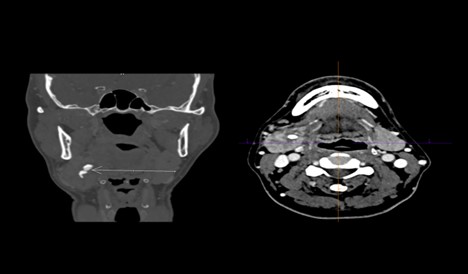
CT scan image of a patient's submandibular stone. (Photo provided by the hospital).
Notably, Master, Doctor Pham Thai Duy said that the patient had a strange mass under his right jaw, swollen as big as a hand, causing facial deformity. This mass was initially as small as a finger, gradually increasing in size over two years, causing pain when eating.
CT scan results showed three stones in the right submandibular salivary gland, the largest 1.5 cm, the smallest 0.8 cm. The stones caused inflammation, hypertrophy, and dilation of the salivary gland duct.
MSc., MD.CKII Tran Thi Thuy Hang, Head of the Department of Otolaryngology, ENT Center, said that the patient's salivary glands were enlarged due to repeated inflammation, making surgery difficult.
The doctor said that if the operation is not done correctly, it can cause sagging lips, weak tongue movement, and taste disorders due to nerve damage. After two hours, the team removed all the stones, preserving important nerve structures.
Salivary gland stones are common in adults, accounting for 50% of salivary gland diseases. Salivary gland stones are usually 0.2-1 cm in diameter, only 7.6% of cases are larger than 1.5 cm. Most salivary gland stones are benign, however, large stones can cause facial deformities, inflammation, salivary gland abscesses, affecting aesthetics.
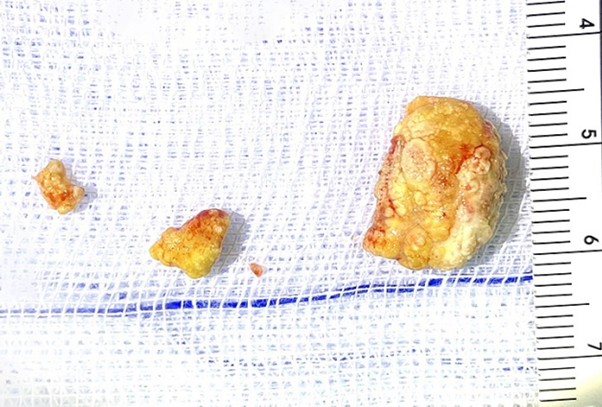
Stones removed after surgery. (Photo provided by the hospital).
According to doctors, Mr. Long's case of submandibular salivary gland stones is large and very rare. Some causes of salivary gland stones include long-term mineral accumulation in the salivary gland ducts, use of certain medications, infections, tumors, and autoimmune diseases. According to Dr. Hang, the cause of Mr. Long's case is not yet clear.
According to doctors, patients should see a doctor when they have suspicious symptoms such as pain in the mouth, around the jaw, difficulty opening the mouth, dry mouth, swelling under the tongue... lasting more than three weeks. In addition, it is necessary to maintain good oral hygiene, not smoke, and limit exposure to toxic chemicals to help protect the jaw and face to minimize the risk of salivary gland stones.
Le Trang
Source





![[Photo] Closing of the 14th Conference of the 13th Party Central Committee](https://vphoto.vietnam.vn/thumb/1200x675/vietnam/resource/IMAGE/2025/11/06/1762404919012_a1-bnd-5975-5183-jpg.webp)

































































































Comment (0)