

Both oats and brown rice are healthy foods. However, they affect blood lipids through two different mechanisms, according to the American website Eating Well .
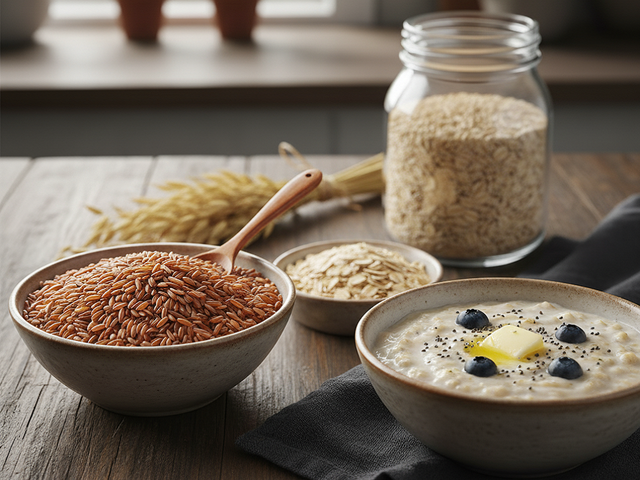
Both brown rice and oats are healthy foods.
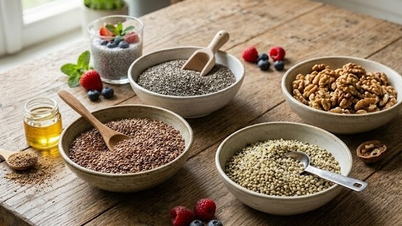
PHOTO: AI
Oats, a whole grain, contain a special type of soluble fiber called beta-glucan. When it enters the intestines, beta-glucan absorbs water, forming a viscous gel that slows down the absorption of fat and cholesterol.
Furthermore, the gel layer retains bile salts, the main component of bile, which the liver synthesizes from cholesterol to digest fats. When bile salts are excreted in the feces, the liver is forced to use additional cholesterol from the blood to create new bile salts, thereby reducing levels of "bad" LDL cholesterol.
A study published in the American Journal of Clinical Nutrition showed that consuming at least 3 grams of beta-glucan daily for several weeks can reduce "bad" LDL cholesterol by an average of 0.25 mmol/L. This amount of beta-glucan is equivalent to about 60-80 grams of oatmeal. The effect is more pronounced in people with high blood lipids or type 2 diabetes.
When it comes to lowering bad cholesterol, oats are one of the most effective whole grains.
Lowering "bad" LDL cholesterol: Oats are more effective than brown rice.
Meanwhile, brown rice contains many beneficial compounds in its bran, such as polyphenols and tocotrienols, a form of vitamin E. These substances can inhibit enzymes involved in cholesterol production in the liver. Additionally, polyphenols in the bran protect blood vessels and reduce the risk of plaque formation.
Many studies show that the bran layer of brown rice contains compounds that may help lower blood cholesterol. However, simply replacing white rice with brown rice in your daily diet often doesn't provide a high enough amount of these bioactive compounds to produce a noticeable cholesterol-lowering effect.
Therefore, brown rice is beneficial for overall health, but if the goal is to reduce "bad" LDL cholesterol, it will be less effective than oatmeal.
A good approach is to combine both oats and brown rice. People can alternate oats for breakfast and brown rice for lunch and dinner to reap the benefits of both grains.
Oatmeal can be eaten 1-2 times a day to reap the benefits of lowering "bad" LDL cholesterol, especially effective when combined with a diet low in unhealthy fats, limiting red meat and fried foods. Meanwhile, although its effect on blood lipids is not as strong as oatmeal, brown rice still helps stabilize blood sugar and weight, and is good for people with metabolic disorders, according to Eating Well .
Source: https://thanhnien.vn/mo-mau-cao-chon-gao-lut-hay-yen-mach-tot-hon-185251113135845698.htm

![[Photo] Solemn bathing ceremony and Buddha procession in Hue](https://vphoto.vietnam.vn/thumb/1200x675/vietnam/resource/IMAGE/2026/05/31/1780228263543_1-jpg.webp)
![[Photo] The General Secretary, President and his wife begin their state visit to the Philippines.](https://vphoto.vietnam.vn/thumb/1200x675/vietnam/resource/IMAGE/2026/05/31/1780230559452_anh-man-hinh-2026-05-31-luc-19-28-11.png)
![[Image] Hanoi Police officially crowned champions of V-League 2025/2026](https://vphoto.vietnam.vn/thumb/1200x675/vietnam/resource/IMAGE/2026/05/31/1780244769054_ndo_br_039d561b692be875b13a-jpg.webp)
![[Photo] Admire the coral "masterpiece" amidst the million-year-old heritage of Dak Lak province.](https://vphoto.vietnam.vn/thumb/1200x675/vietnam/resource/IMAGE/2026/05/31/1780221235105_anh-man-hinh-2026-05-31-luc-16-53-27.png)



















![[Video] Sunset at Lap An Lagoon – Where the sun sets over the fishing nets](https://vphoto.vietnam.vn/thumb/340x192/vietnam/resource/IMAGE/2026/05/31/1780192137701_beach-landscape-sea-water-nature-grass-745871-pxhere-com.jpeg)








































![[Photo] Admire the coral "masterpiece" amidst the million-year-old heritage of Dak Lak province.](https://vphoto.vietnam.vn/thumb/402x226/vietnam/resource/IMAGE/2026/05/31/1780221235105_anh-man-hinh-2026-05-31-luc-16-53-27.png)



































Comment (0)