

With less than two weeks remaining until the June 1st deadline, the U.S. Treasury Department warns that the federal government may run out of money to pay its bills. This could trigger a default, causing chaos in financial markets and a surge in interest rates.
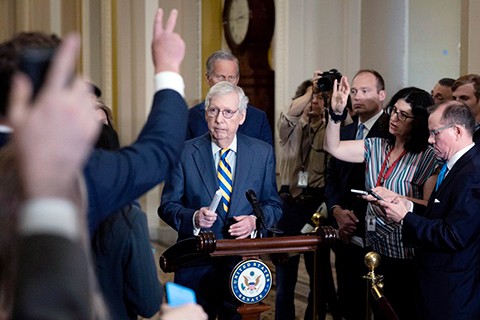
The US is embroiled in a heated debate over the debt ceiling. Photo: AP
Meetings on the US debt ceiling concluded on May 19th. Experts did not continue working on May 20th.
They declared that the meeting had made no progress and did not announce a plan to reconvene. Both Democratic and Republican representatives argued that the other side's proposal was too extreme.
The Republican Party has so far maintained that it will not accept an increase in the government 's borrowing limit without significant spending cuts.
Republicans argue that excessive government spending and Democratic social policies create a "parasite" on federal aid, and this must be addressed.
The conditions for raising the Republican debt ceiling to $31.4 trillion are that certain agencies must cut budget spending by 7% this year and 8% next year, as planned and approved by the House of Representatives last month. These spending restrictions must then increase by 1% each year thereafter.
According to Reuters, a source said the Republican party proposed cutting overall spending but increasing defense spending.
Democrats are proposing to maintain spending levels in subsequent years at this year's level. They argue that the Republican spending cuts would force programs like education and law enforcement to be reduced by at least 22%.
Democrats are proposing to keep non-defense spending at its current level for next year, because adjusting for inflation would result in a reduction in real spending.
According to White House press secretary Karine Jean-Pierre, Democratic leader President Biden and Republican leader House Speaker McCarthy only agreed on one point: that the budget deal had to be agreed upon by representatives from both parties.
Following the May 19 meeting, House Speaker Kevin McCarthy told the media that the White House had taken "no action" regarding the Republicans' demands.
The Republican Party holds a majority of seats in the House of Representatives, and Democrats have narrow control in the Senate, so the parties must reach an agreement.
White House officials said they expected the phone call between Biden and McCarthy to take place after Biden's press conference at the G7 summit in Japan.
During the summit, up until May 20th, President Biden was largely absent from public view. He did not appear to deliver a key statement and left dinner early on May 19th. Instead, he spent his time in his hotel room, where aides in Washington kept him updated on negotiations regarding the debt limit.
National Security Advisor Jake Sullivan acknowledged that world leaders have pressured President Biden over the debt crisis in Washington. However, White House Press Secretary Karine Jean-Pierre said the situation is not yet at a point of panic.
The final agreement, if reached, would require bipartisan support from both Republicans and Democrats to pass Congress. The last time the U.S. nearly defaulted was in 2011. At that time, the Democrats controlled the White House and the Senate, while the Republicans held a majority in the House of Representatives.
The US Congress eventually intervened to prevent a default, but the economy still suffered severe shocks, including its first-ever credit rating downgrade and a massive stock market sell-off.
Compiled by Nguyen Tan
Source link


![[Photo] Close-up of an Australian warship visiting Tien Sa port, Da Nang](https://vphoto.vietnam.vn/thumb/1200x675/vietnam/resource/IMAGE/2026/03/28/1774675489416_tau-5-jpg.)






























































































Comment (0)