


Many banks currently have a very large value of bonds outstanding in the market - Photo: QUANG DINH
Credit growth is projected to accelerate in the second half of this year.
Accelerate borrowing through bonds.
Recently, while the real estate sector has tended to decline in bond issuance value, banks have recorded very good growth in fundraising through this channel.
According to Ms. Le Minh Anh, an analyst at MB Securities' (MBS) research department, from the beginning of the year to mid-June, the banking sector has surpassed real estate to become the industry with the highest issuance value, reaching approximately 54,000 billion VND, a 147% increase compared to the same period last year.
"During the month, there was a complete absence of bond issuances from the real estate sector, while the banking sector accounted for 94% of the total issuance value," an MBS expert commented.
According to Ms. Le Minh Anh, stricter regulations on the ratio of disbursed capital for medium and long-term loans encourage banks to issue more bonds to supplement their long-term capital structure.
Furthermore, in a low-interest rate environment, banks also have an incentive to repurchase and issue bonds with more attractive interest rates. This explains why banks are both the leading issuers of new bonds and the primary repurchasers of previously issued bonds.
Not only in the primary market, but the volume of secondary bank bonds traded through the exchange also surged in May, increasing by more than 80% (compared to the previous month), maintaining its attractive position compared to other sectors.
Many analysts agree that bank bonds will have a busier year than in previous years as credit improves.
Mr. Nguyen Quang Thuan, chairman of Fiingroup, assessed that credit growth in the first five months of this year was very low, at only 3.8% as of June 15th. However, more positive signs of improvement have emerged in the second half of this year.
One of the key indicators is the sharp increase in the value of imported production materials. As exports rebound thanks to the economic recovery in key markets, the capital needs of manufacturing businesses will improve.
To achieve a credit growth of 15-16% for the whole of 2024, banks need capital. However, according to Mr. Thuan, the current capital adequacy ratio of banks is still "thin" for this credit growth target. Therefore, while waiting for an increase in equity capital, issuing bonds (Tier 2 capital) is a more feasible activity for banks.
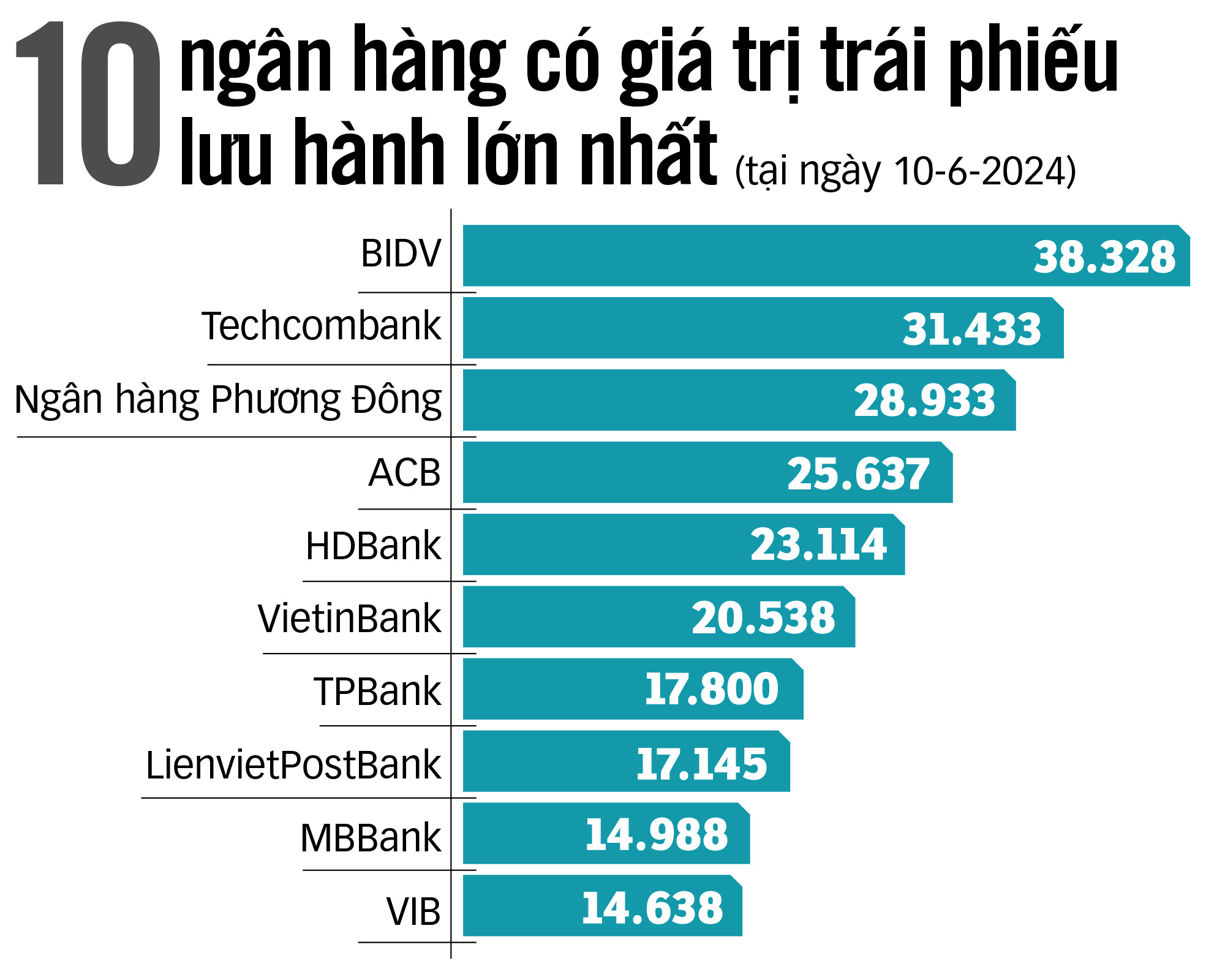
Circulating value: billion VND - Source: Fiinratings - Graphics: N.KH.
The bank needs a huge amount of capital.
Mr. Phan Duy Hung, Director of Analysis at Visrating, also believes that banks will need to increase the issuance of long-term bonds to supplement capital and ensure capital adequacy in order to comply with regulations on operational safety ratios.
The issuance of bonds to support credit growth was further boosted by the slowdown in deposit growth due to declining business conditions during 2021-2022.
According to data from Visrating, banks issued VND 196 trillion in bonds in 2023, significantly higher than the VND 104 trillion issued in 2019. Banks primarily used this capital to support long-term loans, meeting regulatory requirements: keeping the ratio of short-term capital used for medium and long-term loans below 30% and the loan-to-deposit ratio at 85%.
According to Visrating's estimates, the banking sector will issue more than VND 283 trillion in Tier 2 capital bonds over the next three years. Approximately 55% of these new Tier 2 capital bonds will be issued by state-owned banks, as their Tier 2 capital will be significantly reduced.
In short, banks will need to issue new Tier 2 capital bonds to replace the bonds that have been deducted and increase their capital adequacy, provided that Tier 2 capital does not exceed 100% of Tier 1 capital (primarily consisting of charter capital, reserves, and undistributed profits).
Associate Professor Vo Dai Luoc, former director of the Institute of World Economics and Politics , stated that compared to many other sectors, especially real estate, bank bonds are considered relatively safe. Therefore, even though credit institutions issue bonds with relatively long maturities, around 3-5 years, and interest rates of 5-6%, they still attract investors.
The expert believes that issuing long-term bonds in the current low interest rate environment is appropriate for banks. Accordingly, banks can mitigate the risk of increased capital costs as interest rates are trending upwards again.
Regarding the impact on the overall market, the push for bond issuance in the banking sector contributed to the recovery of the bond market after numerous violations that eroded confidence. However, Mr. Luoc believes that the bond market needs better promotion from other sectors, including real estate. If it remains primarily a playing field for banks, the effectiveness of this capital mobilization channel will not be fully realized, failing to create a ripple effect in the economic recovery process.
Furthermore, the expert reminded investors that for bonds issued by any institution, including banks, it is necessary to be fully aware of the risks of potential default and other commitments.
Corporate bonds are volatile due to exchange rates and interest rates.
The Vietnamese corporate bond market is facing significant challenges as the USD/VND exchange rate and savings interest rates have both risen recently.
According to reports, the Vietnamese Dong has depreciated by approximately 5% against the US Dollar since the beginning of the year. At commercial banks, the selling price of the US Dollar has reached 25,473 VND, while on the free market, this figure has exceeded 26,000 VND for the first time, setting a new record.
Simultaneously, savings interest rates have also begun to show signs of rising again. Specifically, the 12-month term interest rate increased from 4.6% at the end of February to 4.8% at the end of June, according to data from Wigroup.
Experts from Fiinratings warn that this trend could increase the risks for corporate bonds with floating interest rates. However, conversely, it could also be an incentive for businesses to increase the issuance of long-term bonds with fixed interest rates.
Source: https://tuoitre.vn/ngan-hang-thanh-trum-phat-hanh-trai-phieu-20240629235048392.htm
![[Image] National Assembly discusses the implementation of the socio-economic development plan.](https://vphoto.vietnam.vn/thumb/1200x675/vietnam/resource/IMAGE/2026/04/20/1776696707422_ndo_br_img-20260420-185419-jpg.webp)


![[Photo] General Secretary and President To Lam meets with National Assembly delegates from ethnic minorities.](https://vphoto.vietnam.vn/thumb/1200x675/vietnam/resource/IMAGE/2026/04/20/1776696701056_a1-bnd-8331-3342-jpg.webp)








































































































Comment (0)