

 |
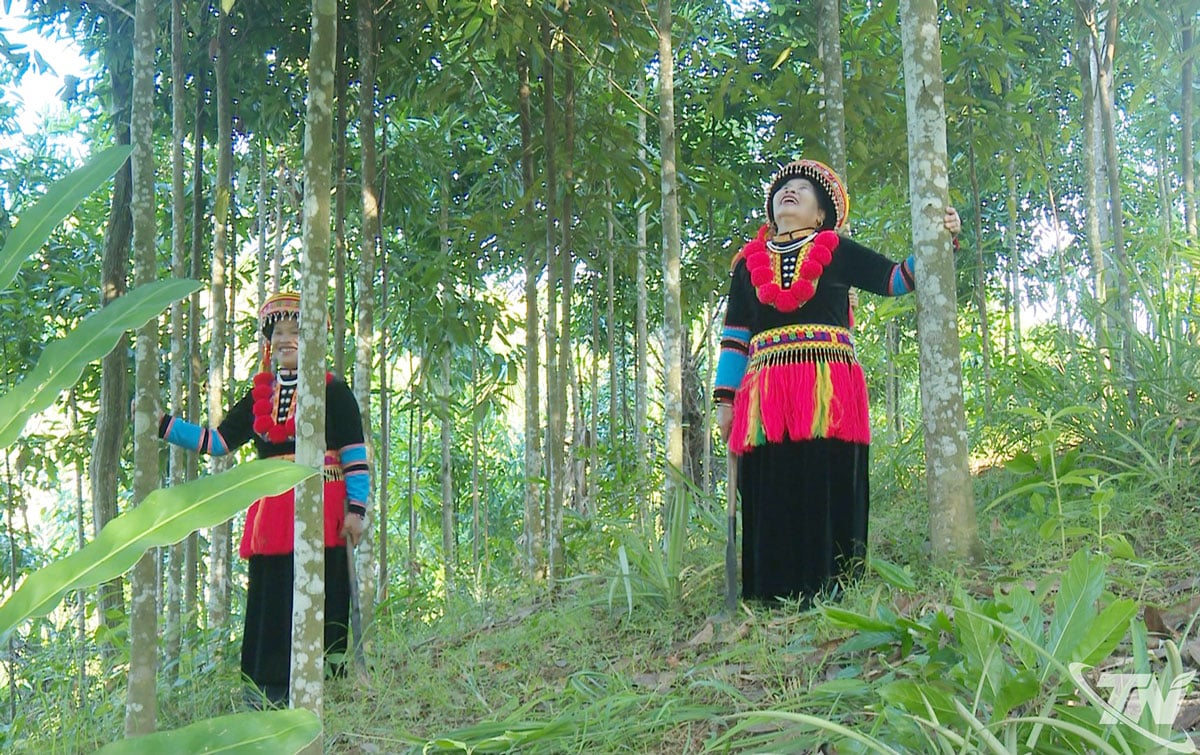
| Residents of Tan Thanh hamlet, Bac Kan ward, inspect the cinnamon hill. |
In 1972, after leaving Khuoi Mang and settling in a new area, the Dao people established Tan Thanh village. Initially, their livelihoods were precarious, and farming relied mainly on short-term crops, so poverty persisted. It wasn't until cinnamon seedlings were brought in from Yen Bai that a new direction for economic development gradually emerged.
Cinnamon trees thrive in the local soil and climate, growing quickly and being resistant to pests and diseases. After 4-5 years, they can be harvested for sale, and after about 10 years, the entire crop yields a significantly higher income compared to native crops. As a result, the people of Tan Thanh village have proactively reforested barren hills and expanded cinnamon cultivation. To date, the entire village has over 300 hectares of cinnamon, making it a key crop and opening up a sustainable path out of poverty for the villagers.
"Thanks to cinnamon trees, the lives of the people here have changed completely. Before, all year round they only knew corn and cassava, sometimes having enough to eat, sometimes not. Now, with each cinnamon harvesting or selling season, people have a regular income, enough to feed their children, send them to school, and build new houses," shared Mr. Phuong Hoang Minh, a resident of Tan Thanh hamlet.
Meanwhile, Mr. Ban Quy Ha, a resident of the area, said: "My family grows more than 2 hectares of cinnamon trees. The trees grow quickly and are not affected by pests or diseases. When the trees are 4 years old, we prune the branches and sell them, providing my family with a regular income to cover our living expenses."
Over the years, the local government has paid special attention to developing the forest economy for the people of Tan Thanh. Through support programs and projects, many training courses on transferring scientific and technical knowledge have been organized, helping people better understand the process of planting, caring for, harvesting, and preserving cinnamon products. As a result, even poor, near-poor, or disadvantaged households have had the opportunity to access seedlings and preferential loans, thereby confidently investing in expanding their forest planting area.
To date, out of 89 households in the village, 100% cultivate cinnamon. The average cinnamon cultivation area per household is 3-4 hectares, with some families owning over 10 hectares – becoming "bright spots" in forest-based economic development.
Not only have many households expanded their cultivated area, but they have also developed scientific farming practices, intercropping short-term crops in the early stages, and then focusing their investment on developing cinnamon trees to yield long-term economic benefits.
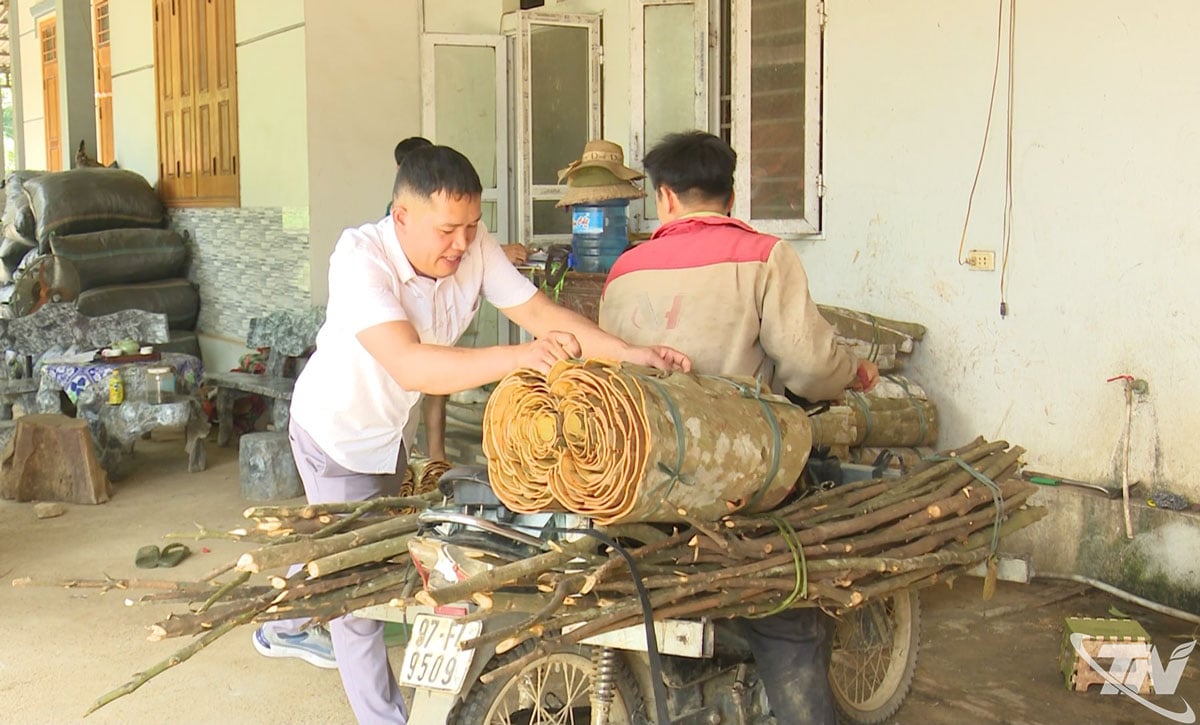 |
| Small traders buy cinnamon from residents of Tan Thanh commune, Bac Kan ward. |
Mr. Trieu Huu Quan's family currently owns over 6 hectares of contiguous forest land. On the gently sloping hills, he dedicates about 4.5 hectares to planting cinnamon, while the remaining 2 hectares of flatter land are planned for planting fruit trees and turmeric. For the newly planted cinnamon trees, which are 1 to 3 years old, Mr. Quan takes advantage of intercropping with short-term crops, both to generate income for the family and to support long-term growth.
In previous years, about 5 hectares of cinnamon trees belonging to his family yielded a harvest. On average, each hectare of cinnamon brought in between 250 and 300 million VND, helping his family to live a more prosperous life than before. "Growing cinnamon is hard work, but it brings clear benefits. Thanks to cinnamon, I can provide for my children's education, renovate my house, and reinvest in the forest," shared Mr. Trieu Huu Quan.
These days, the cinnamon purchasing facility of Mr. Nong Quoc Duong's family is always bustling with people. After harvesting, people cut branches, peel the bark, and transport it back to sell, with the busiest times being late morning and evening. The facility has not only become a familiar sales point for people in the area but also provides stable employment for 8-10 local workers with regular income. Currently, the purchase price is maintained at 18-19 thousand VND/kg of fresh bark and 2 thousand VND/kg of cinnamon branches.
Mr. Nong Quoc Duong said: "Every day, my facility buys an average of 4-5 tons of cinnamon from villagers in the hamlet and surrounding areas. The cinnamon in Tan Thanh is of good quality, with thick bark and high essential oil content, so many traders come to buy it."
Thanks to cinnamon trees, the appearance of Tan Thanh hamlet has changed dramatically. The simple wooden houses of yesteryear have gradually been replaced by spacious brick houses, accounting for nearly 80% of the total households. A more prosperous life has allowed many families not only to acquire modern conveniences but also to purchase cars for transportation and production. In 2024, the average income of the hamlet reached over 53 million VND/person/year, and the number of poor households decreased to only 6.
Source: https://baothainguyen.vn/tin-moi/202509/nguoi-dao-tan-thanh-doi-thaynho-cay-que-a6f626f/
![[Photo] National Assembly Chairman Tran Thanh Man takes the oath of office](https://vphoto.vietnam.vn/thumb/1200x675/vietnam/resource/IMAGE/2026/04/06/1775453300886_ndo_br_1-2229-jpg.webp)



![[Photo] Da Nang: A sea of people respectfully paying homage to the Bodhisattva Avalokiteshvara.](https://vphoto.vietnam.vn/thumb/1200x675/vietnam/resource/IMAGE/2026/04/06/1775454198203_ndo_br_lh24-jpg.webp)












![[Photo] Sidewalks in Vung Tau ward are now more spacious.](https://vphoto.vietnam.vn/thumb/1200x675/vietnam/resource/IMAGE/2026/04/06/1775455388046_5-6796-jpg.webp)























































Comment (0)