

With extremely high pressure, a dark and freezing environment, diving to the deep sea is considered even more difficult than space travel.
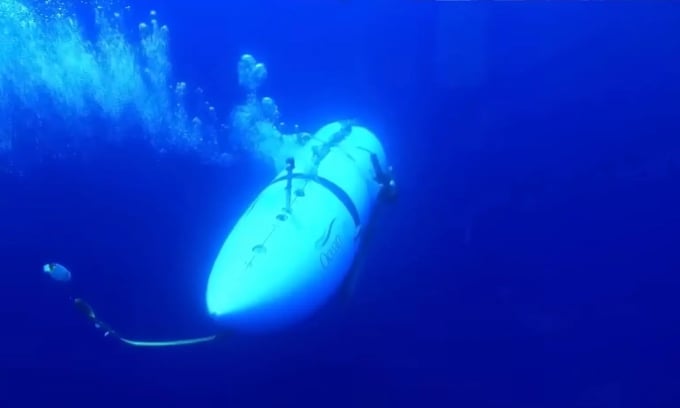
The Titan submersible was featured in a CBS documentary last year. Photo: CBS
Titan, the submersible carrying five people on a tour of the Titanic wreck that lost contact in the Atlantic Ocean on June 18, is part of a growing trend of paid deep-sea exploration , CNN reported on June 21.
Although humans have explored the ocean surface for tens of thousands of years, only about 20% of the seafloor has been mapped, according to 2022 data from the US National Oceanic and Atmospheric Administration (NOAA).
Researchers often say that space travel is easier than diving to the bottom of the ocean. Twelve astronauts spent a total of 300 hours on the moon, but only three have been to the Challenger Deep, the deepest point on Earth’s ocean floor, and explored for about three hours, according to the Woods Hole Oceanographic Institution. “In fact, we have better maps of the moon and Mars than we do of our own planet,” said Dr. Gene Feldman, an oceanographer at NASA.
Human exploration of the deep sea is so limited because diving into the ocean means entering a place of extreme pressure, high risk. The environment is dark, almost invisible, and the temperature is extremely cold.
History of deep ocean exploration
The first submarine was built by Dutch engineer Cornelis Drebbel in 1620, but only went as far as shallow water. Nearly 300 years later, sonar technology began to give scientists a clearer picture of the ocean floor.
A major step forward came in 1960 with the historic dive of the Trieste into the Challenger Deep, about 11,000 meters below the surface of the Pacific Ocean. Since then, only a handful of missions have gone that deep, and they are extremely dangerous, Feldman said.
According to NOAA, for every 10 meters below the ocean surface, the pressure increases by 1 atm. Atm is a unit of pressure, equivalent to 14.7 pounds (6.4 kg) per square inch (6.5 cm²). This means the Challenger Deep dive vessel could withstand pressure equivalent to that of 50 massive Boeing 747 aircraft.
Under this pressure, even the slightest structural flaw could lead to disaster. During a dive aboard the Trieste in 1960, passengers Jacques Piccard and Don Walsh were astonished to see living organisms.
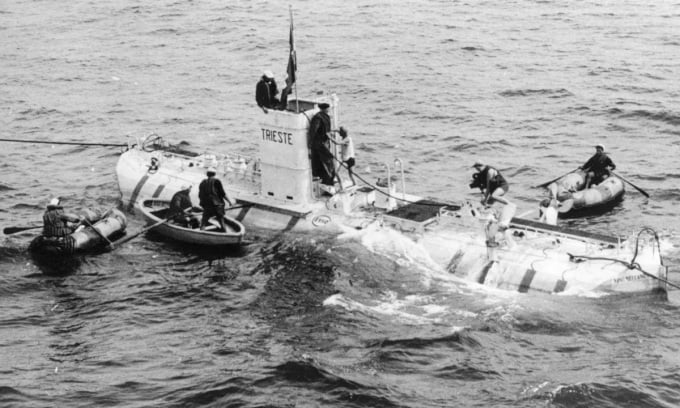
Explorer and physicist Auguste Piccard wearing a life jacket as he emerges from the Trieste after a record-breaking dive to 3,150 metres on October 3, 1953, off the west coast of Italy. Photo: Keystone/Hulton Archive
The major challenge in mapping the ocean floor is...
Humans have only seen a very small fraction of the ocean floor, and even the middle, of the ocean. And only a very small fraction of the ocean floor has been mapped, according to Feldman. A major reason is the cost. Ships equipped with sonar technology can be extremely expensive. Feldman says that fuel alone can cost up to $40,000 per day.
There are still significant gaps in our knowledge of the deep sea. Of the 2.2 million species thought to exist in the Earth's oceans, only 240,000 have been scientifically described, according to the Ocean Census project. However, it's impossible to know for certain how many marine organisms exist, Feldman noted.
Technological advances mean humans don’t need to go directly to the deep sea to explore. Deep-sea robots, high-resolution underwater photography, machine learning, and DNA sequencing in seawater will help speed up the speed and scale of discovering new life forms.
"We have better maps of the surface of the Moon than the seafloor because seawater interferes with radar and other methods used to map the surface on land. However, 150 years of modern oceanography has helped us understand many aspects of the ocean, such as its life, its chemistry and its role in the Earth system," said marine ecologist Alex Rogers, a professor at the University of Oxford in the UK.
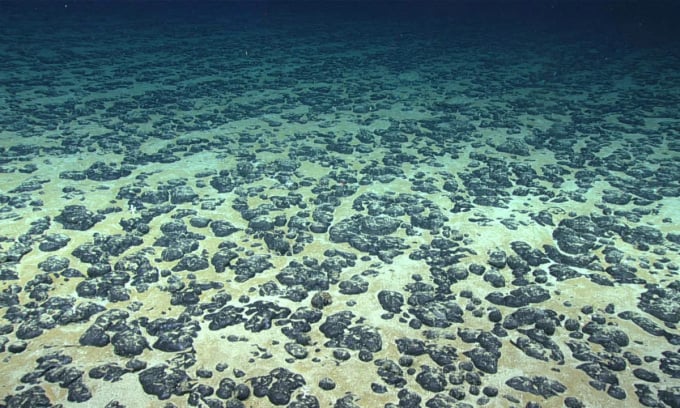
The ocean floor is covered in manganese nodules during an expedition conducted by the U.S. National Oceanic and Atmospheric Administration (NOAA) and its partners in 2019. Photo: NOAA
What do deep-ocean explorations offer?
"Mapping the ocean helps us understand how the shape of the seabed affects ocean currents and where marine life is found. It also helps us understand seismic hazards. It's fundamental science and of immense importance to humanity," Rogers added.
The ocean is rich in compounds, and exploration of the area has led to many biomedical breakthroughs. The first marine-derived drug, Cytarabine, was approved in 1969 for the treatment of leukemia. Experts extracted it from sea sponges. Research on bioactive compounds in cone snail venom led to the development of the powerful painkiller ziconotide.
According to researchers, the ocean and the organisms that live there could provide answers to major medical challenges, such as antibiotic resistance. In addition, studying the ocean could also reveal how life has evolved.
Thu Thao (According to CNN )
Source link

![[Photo] Explore the US Navy's USS Robert Smalls warship](/_next/image?url=https%3A%2F%2Fvphoto.vietnam.vn%2Fthumb%2F1200x675%2Fvietnam%2Fresource%2FIMAGE%2F2025%2F12%2F10%2F1765341533272_11212121-8303-jpg.webp&w=3840&q=75)
![[Photo] The captivating scenery of the fragrant maple forest in Quang Tri](/_next/image?url=https%3A%2F%2Fvphoto.vietnam.vn%2Fthumb%2F1200x675%2Fvietnam%2Fresource%2FIMAGE%2F2025%2F12%2F10%2F1765353233198_lan09046-jpg.webp&w=3840&q=75)



























![[Video] The craft of making Dong Ho folk paintings has been inscribed by UNESCO on the List of Crafts in Need of Urgent Safeguarding.](https://vphoto.vietnam.vn/thumb/402x226/vietnam/resource/IMAGE/2025/12/10/1765350246533_tranh-dong-ho-734-jpg.webp)







































































Comment (0)