

From his roles as a drummer and orchestra conductor to a composer , he has always strived to revive the quintessential values of traditional Vietnamese opera (chèo). In particular, as an orchestra conductor, he has helped bring the melodies of chèo to life with vibrant colors and emotions, preserving the soul of the art form in each performance.
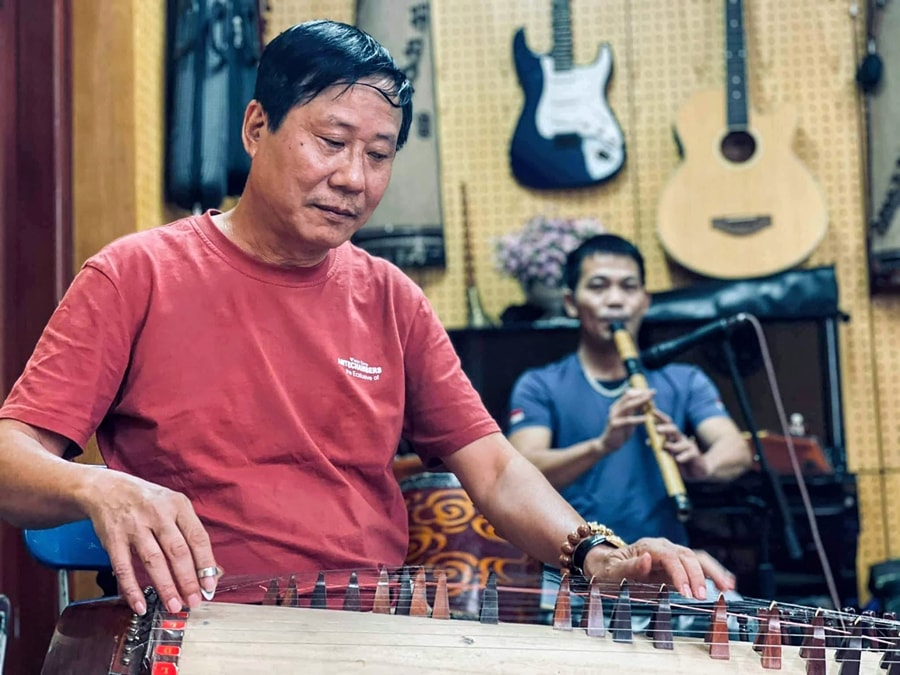
1. Born in Duc Tu commune (Dong Anh district), artist Quang Hiep was fortunate to grow up in a cultural environment steeped in the sounds of drums and traditional Vietnamese opera (cheo). Although his parents were not involved in the arts, he inherited artistic talent from his grandfather, who was once the leader of a famous opera troupe throughout Tu Son prefecture (Dong Anh was formerly Dong Khe district, Tu Son prefecture, Bac Ninh province). From a young age, he was captivated by the simple yet profound melodies of cheo, and his connection with the art of cheo came to him naturally, like breathing. In 1982, he officially joined the Hanoi Cheo Troupe (now the Hanoi Cheo Theatre), starting as a cheo drummer.
Driven by a desire to understand traditional Vietnamese opera (chèo) more comprehensively, he studied music composition and conducting at the Vietnam National School of Theatre and Film (now the Hanoi University of Theatre and Film), gradually becoming an orchestra conductor and then progressing further in the role of composing and arranging music for the stage.
Artist Quang Hiep said that he initially chose to play the drums in Cheo opera because he believed that drums are not just musical instruments, but also a means of storytelling, communicating with the audience, and preserving the spirit of traditional Cheo opera. Even a single incorrect drum beat can disrupt the performance's emotional impact and break the connection between the stage and the audience. To play the drums correctly, the artist must empathize with each role, master the rhythm, and grasp the essence of Cheo opera. Only then can each drum beat truly carry the soul of the performance.
Although his primary focus was studying traditional Vietnamese opera drumming, Quang Hiep had a special love for the zither since childhood. While studying with experienced artisans, he realized that the zither had the ability to convey emotions very powerfully.
“The sound of the zither is gentle and graceful, yet also sharp and captivating. When using the zither in Cheo opera, I always try to maximize the emotional nuances it brings. If the drums in Cheo opera maintain the rhythm and create the foundation for the performance, the zither paints subtle details, enhancing the characters' emotions. If used correctly, the zither can open up a musical space that is both profound and sublime, creating moving moments that linger in the audience's hearts. The zither is not just a supplement, but a crucial element that balances the overall music of the Cheo opera. It can gently provide a backdrop for dance sequences, or resonate powerfully in climactic scenes like a wave carrying the characters' emotions, evoking deep feelings that no other instrument can replace. If the drums in Cheo opera provide a powerful rhythm, then the zither is the softness and lightness, infusing the Cheo opera space with a graceful, gentle yet profound quality,” artist Quang Hiep confided.
2. During the 1980s and 1990s, theatrical arts in general and traditional Vietnamese opera (cheo) in particular faced difficulties, but Meritorious Artist Quang Hiep and his colleagues still traveled to perform, going to rural areas, village squares, schoolyards, etc., to bring folk songs and melodies to the people.
“Once, my colleagues and I performed the play ‘Princess Sita.’ The audience was huge, overflowing onto the stage. The whole troupe performed with great enthusiasm and dedication. But when we got back to our accommodation… there was nothing to eat. No rice, not even fish sauce. My colleagues and I looked at each other and said, ‘It’s tough, but we’ll perform again tomorrow.’ Back then, we performed because we loved our profession. Some troupes traveled for months without pay. Back home, our wives and children lacked rice, but as soon as we heard the sound of the drums, the stringed instruments, and the rhythmic clappers, we were ready to hit the road again. For me, performing cheo (traditional Vietnamese opera) is not just a job, but a passion, a life ideal,” he recounted, his voice softening, but his eyes shining with an undeniable pride.
For artist Quang Hiep, those days of drumming with unwavering faith and conducting the orchestra with passion are not only memories of a difficult time but also a vivid testament to his intense, enduring, and self-sacrificing love for traditional Vietnamese opera (cheo). Overcoming arduous tours, insufficient meals, and meager pay, he remained committed to the stage and the sound of cheo drums, as if it were his breath, his destiny.
Driven by his passion for the craft, he continuously learned and honed his skills to become a versatile artist capable of undertaking many roles in traditional Vietnamese opera (cheo). As playwright Mai Van Lang, Head of the Folk Song and Traditional Music Department at the Voice of Vietnam Radio, affirmed: “It is rare to find a cheo artist like Meritorious Artist Quang Hiep, who, from a drummer, became an orchestra conductor, then a collector, researcher, and disseminator of the essence of classical cheo. He not only possesses a firm grasp of the traditional knowledge but also has the ability to appreciate and spread those values to younger artists and contemporary audiences. He travels extensively to talk about cheo, to introduce the beauty and essence of a national theatrical art form to which he has dedicated his life.”
3. Despite retiring and returning to his hometown after more than 40 years of dedication to the Hanoi Cheo Theatre, artist Quang Hiep still doesn't allow himself to stop. On the contrary, Duc Tu today further fuels his desire to preserve and spread traditional art. “My hometown still cultivates rice, and the villagers are very passionate about Cheo singing. I feel very fortunate to return to the place that nurtured my passion and artistic soul. Now, being able to play drums with the elderly, rehearse plays, guide the children in learning Cheo, and listen to the students humming ancient melodies… for me, that is fulfillment,” he shared.
For over four decades dedicated to traditional Vietnamese opera (chèo), Meritorious Artist Quang Hiep has quietly written an artistic journey filled with passion and devotion. From the rhythmic drumming and the resonant sound of the zither to his role as conductor of the orchestra, the mark of a talented, meticulous, and wholeheartedly devoted artist is evident everywhere. For him, chèo is not just the stage and the singing, but also life and an ideal. And in whatever role he plays – teacher, artist, or torchbearer – Meritorious Artist Quang Hiep continues to diligently preserve each ancient melody as if preserving the very soul of his nation.
Meritorious Artist Quang Hiep (full name Nguyen Quang Hiep) was born in 1961 in Duc Tu commune, Dong Anh district, Hanoi. With over 40 years of dedication to Cheo (traditional Vietnamese opera), he won the Outstanding Musician award at the 2022 National Cheo Theatre Festival with the play "Crying in the Blue Sky" (Hanoi Cheo Theatre) and the Outstanding Musician award at the same festival.
Source: https://hanoimoi.vn/nsut-quang-hiep-miet-mai-giu-hon-dan-toc-703549.html
























































![[Photo gallery] Nhon Trach is ready to transform into a modern and civilized city.](https://vphoto.vietnam.vn/thumb/402x226/vietnam/resource/IMAGE/2026/04/02/1775104005524_hinh_1_20260402085339.jpeg)

![[Photo gallery] Dong Phu aims for modern and sustainable urban development.](https://vphoto.vietnam.vn/thumb/402x226/vietnam/resource/IMAGE/2026/04/02/1775104023925_111_20260402104322.jpeg)









Comment (0)