

The family owns 8 hectares of rice paddies in a low-lying area, producing only two rice crops per year combined with rice farming during the flood season. In previous years, Mr. Truong Cong Dinh, from Hoa An commune, Phung Hiep district ( Hau Giang province), mainly chose to raise whitefish in his rice paddies.
But this year, he invested nearly 100 million VND in dredging irrigation ditches in his fields and buying two types of fish fry, yellow catfish and striped snakehead, to raise.
Mr. Dinh said: "To raise golden catfish in rice fields effectively, first, farmers need to create a ditch about 1 meter wide running along the field, with sufficient depth so that when the water surface gets hot from the sun, the fish can go down there to take shelter. The fish will utilize the readily available food sources in the field such as rice sprouts and insects to grow. After 5 months of raising, the fish reach an average weight of 5-6 fish per kilogram."
The model of raising yellow catfish and striped snakehead fish together in rice fields, linked to product consumption, is a pilot model implemented by the Hau Giang Provincial Agricultural Extension and Services Center in 2023, covering a total area of 15 hectares in Hoa An and Hiep Hung communes.
The total cost of implementing the model was over 661 million VND, of which the budget supported 50% and the people contributed 50%. The stocking density was 1.3 fish/m2.
Of the 5 households participating in the model, 1 household has sold all their fish, and 4 households are gradually harvesting to sell at an average price of 45,000-50,000 VND/kg (depending on the type). The average yield for yellow catfish reached 1,073 kg/ha, and for striped snakehead fish 221 kg/ha. After deducting all investment costs, the farmers achieved a profit of 17.7 million VND/ha.
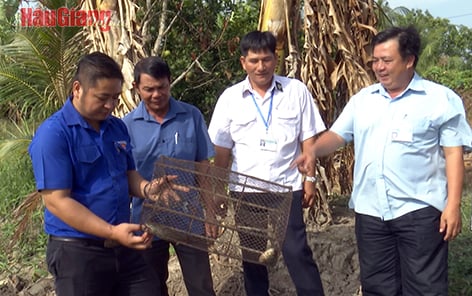
After 5 months of raising golden catfish and striped catfish together in rice fields in Phung Hiep district (Hau Giang province), the golden catfish reached a weight of 5-6 fish per kilogram. Photo: D. KHANH
As one of the four remaining households that haven't finished harvesting their golden catfish and striped snakehead fish, Mr. Nguyen Hoang Hiep, from Hiep Hung commune, proactively pumped water into the irrigation ditches to force the fish back down to the fields for the winter-spring crop. On the banks, he used nets to surround the rice paddies to prevent the fish from getting into the fields, waiting for traders to finalize the price before harvesting.
Mr. Hiep said: "Currently, the fish are ready for sale, but recently there has been competition from farmed fish raised in water during the winter-spring season, causing prices to drop. So, my family has decided to hold onto them, scattering a little feed daily to help them continue growing. We will harvest and sell them when prices stabilize."
According to the Hau Giang Provincial Center for Agricultural Extension and Services, both the yellow catfish and the striped catfish are omnivorous aquatic species, but their hunting habits and processes are completely different.
Yellow catfish, which mainly live at the bottom, utilize food sources such as insects and worms, while striped catfish, which live at the surface, feed on algae and rice seedlings to thrive. Furthermore, the waste products of striped catfish provide a food source for the catfish below. These advantages led the center to choose these two aquatic species for combined development in this model.
Mr. Trieu Quoc Duong, Deputy Head of the Technical Department, Hau Giang Provincial Agricultural Extension and Services Center, said: "Farmers in the province have developed many types of rice paddy fish in recent times, but most of them do not bring high value."
Therefore, over the past period, the center has researched and cultivated several types of fish together. Through this experimental cultivation process, the center's technical staff discovered that raising these two types of fish together yields many benefits. Not to mention, the value of these two aquatic species is currently quite high compared to other fish species.”
Mr. Tran Van Tuan, Head of the Agriculture and Rural Development Department of Phung Hiep District (Hau Giang Province), said: Phung Hiep District is a major rice paddy fish farming area in Hau Giang Province. Every year, farmers here convert about 4,000 hectares of low-yield rice production land to rice paddy fish farming.
Besides economic benefits, rice paddy fish farming also contributes to improving soil fertility and cleaning the fields. The effective combination of yellow catfish and striped snakehead fish in the same farming area will contribute to diversifying the livestock structure and increasing economic efficiency for farming households.
Therefore, the district plans to expand this model to farmers throughout the district in the coming period. By the 2024 flood season, the goal is to expand the area to approximately 30 hectares for the combined farming of these two aquatic species.
According to the Provincial Center for Agricultural Extension and Services, over the past 20 years, it has implemented aquaculture models on 178 hectares, with the participation of 453 households. These models focus on developing aquaculture extension programs for species that are adapted to the local environment and have economic efficiency, specifically: spotted snakehead fish, catfish, and various freshwater fish species.
The center also focuses on developing models for rice paddy fish farming and integrated farming models to utilize water surface areas, contributing to increased income for local people. In addition, it encourages the development of community-based management models for aquaculture production activities, including sustainable aquaculture development; and the development of farming models applying GAP, SQF1000CM standards, etc.
Develop industrial-scale production models and linkage models between groups of households, cooperatives, and aquaculture enterprises with processing enterprises, companies, and corporations both domestically and internationally that have the capacity to consume the products.
The implementation of support models includes: building intensive catfish farming models certified under VietGAP; intensive farming of freshwater eels in tanks using industrial feed; developing lotus cultivation combined with snakehead fish farming in low-lying areas; eel farming in tanks following food safety and hygiene standards, linked to value chain integration; and fish farming in rice paddies... These models have brought practical benefits to the people, helping to increase income per unit area, and are being maintained, developed, and replicated by localities.
Source: https://danviet.vn/nuoi-ca-tre-ghep-ca-sac-ran-chung-mot-ruong-dan-o-mot-xa-cua-hau-giang-bat-ngo-thu-tien-nhieu-hon-20240624132556614.htm


![[Image] Close-up of the newly discovered "sacred road" at My Son Sanctuary](/_next/image?url=https%3A%2F%2Fvphoto.vietnam.vn%2Fthumb%2F1200x675%2Fvietnam%2Fresource%2FIMAGE%2F2025%2F12%2F13%2F1765587881240_ndo_br_ms5-jpg.webp&w=3840&q=75)































































Comment (0)