

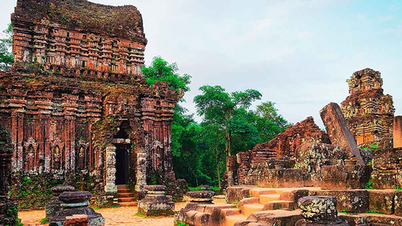
At the conference, former local leaders, researchers, artisans, and conservation collaborators contributed many ideas to preserve and promote the heritage value of Hoi An in the context of changing management and legal models.
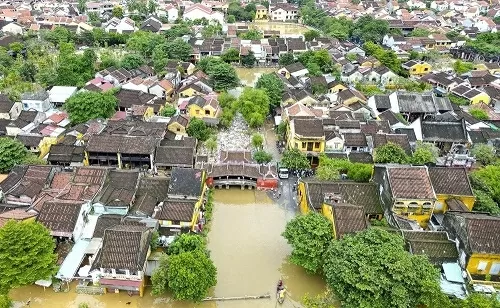 |
| The ancient town of Hoi An and many surrounding historical sites have been severely affected by prolonged flooding. (Source: Culture Newspaper) |
Many delegates argued that greater flexibility is needed in conservation efforts, ranging from managing historical sites and preserving cultural spaces to promoting the value of traditional craft villages.
Some notable proposals include restoring the policy of providing financial support for incense burning at village communal houses; naming a street after Ho Nghinh; renovating the tomb area of Mr. Nguyen Duy Hieu; promoting the "Hoi An - A City of Kind and Compassionate People" project; and finding solutions to preserve Tuong opera (Hat Boi), an art form that is in decline.
From July 1st, when Quang Nam province merged into Da Nang city, the administrative boundaries of Hoi An were reorganized into three wards: Hoi An, Hoi An Dong, and Hoi An Tay, and the island commune of Tan Hiep.
Hoi An ward is the core heritage area, while the remaining wards and communes are home to traditional craft villages, tourism , and accommodation facilities. Currently, this area has 1,439 historical and cultural relics, of which Hoi An ward alone has 1,194; it also possesses 8 national intangible cultural heritage sites, attracting an average of nearly 5 million visitors each year.
According to the Hoi An Center for Conservation of Cultural Heritage, from the beginning of 2025 until now, conservation work has been strongly impacted by three factors: the reorganization of administrative units and changes in management models; adjustments to the scope of heritage protection zones after mergers; and the National Assembly's promulgation of the 2024 Law on Cultural Heritage with many new and more comprehensive regulations.
In addition, extreme weather conditions, including prolonged rainstorms and flooding this year, have significantly impacted the old town and many historical sites in the surrounding areas.
At the conference, the leaders of the Da Nang City People's Committee clearly stated their viewpoint for the coming period: preserving and promoting the value of Hoi An must be based on the principle of not disrupting the overall historical, cultural, and ecological space; maintaining the link between the heritage site and the Cu Lao Cham - Hoi An Biosphere Reserve; and protecting traditional craft villages, relics, the marine and island space, and the river system.
Based on that, the Hoi An Heritage Conservation Center proposes the need to develop a new master plan, consistent with the post-merger management model and the requirements of current laws.
This plan must aim for sustainable conservation, ensuring harmony between heritage and urban-tourism development. At the same time, Hoi An needs to strengthen coordination between the Center for Conservation of World Heritage Sites and the wards and communes; and promote the role of the community – the custodians of the heritage – in monitoring and providing feedback on conservation activities.
The delegates agreed that, in the context of many changes, the preservation of Hoi An cannot rely solely on the management agency but requires the joint efforts of the community, including heritage owners, artisans, researchers, and those passionate about the ancient town. This is a key factor in preserving the authentic beauty of Hoi An – Vietnam's most important living heritage site.
Source: https://baoquocte.vn/phat-huy-gia-tri-di-san-the-gioi-do-thi-co-hoi-an-trong-boi-canh-moi-337261.html
![[Image] Leaked images ahead of the 2025 Community Action Awards gala.](/_next/image?url=https%3A%2F%2Fvphoto.vietnam.vn%2Fthumb%2F1200x675%2Fvietnam%2Fresource%2FIMAGE%2F2025%2F12%2F16%2F1765882828720_ndo_br_thiet-ke-chua-co-ten-45-png.webp&w=3840&q=75)

![[Photo] Prime Minister Pham Minh Chinh receives Lao Minister of Education and Sports Thongsalith Mangnormek](/_next/image?url=https%3A%2F%2Fvphoto.vietnam.vn%2Fthumb%2F1200x675%2Fvietnam%2Fresource%2FIMAGE%2F2025%2F12%2F16%2F1765876834721_dsc-7519-jpg.webp&w=3840&q=75)

![[Live] 2025 Community Action Awards Gala](/_next/image?url=https%3A%2F%2Fvphoto.vietnam.vn%2Fthumb%2F1200x675%2Fvietnam%2Fresource%2FIMAGE%2F2025%2F12%2F16%2F1765899631650_ndo_tr_z7334013144784-9f9fe10a6d63584c85aff40f2957c250-jpg.webp&w=3840&q=75)
![[Photo] Prime Minister Pham Minh Chinh receives the Governor of Tochigi Province (Japan)](/_next/image?url=https%3A%2F%2Fvphoto.vietnam.vn%2Fthumb%2F1200x675%2Fvietnam%2Fresource%2FIMAGE%2F2025%2F12%2F16%2F1765892133176_dsc-8082-6425-jpg.webp&w=3840&q=75)































































Comment (0)