

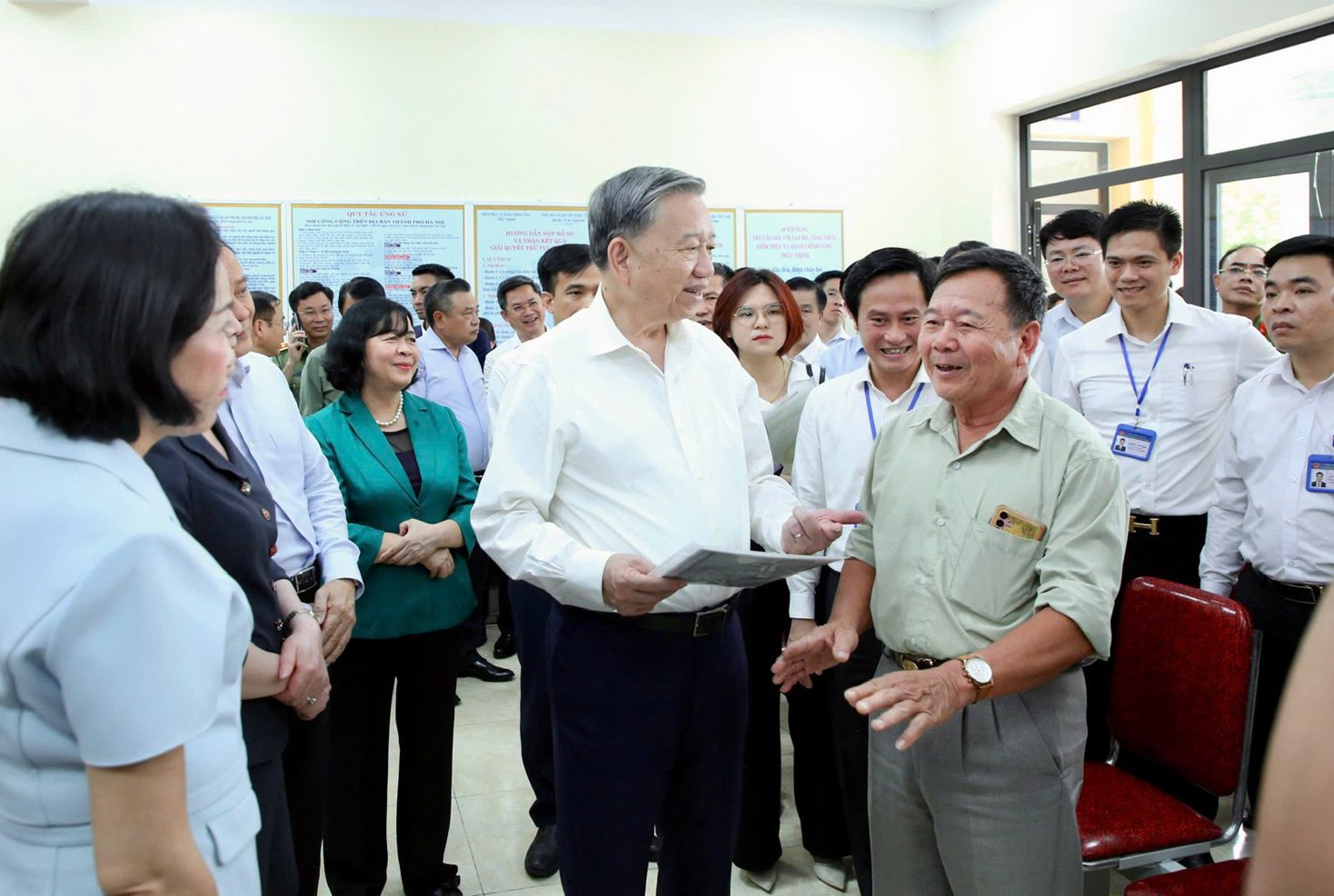
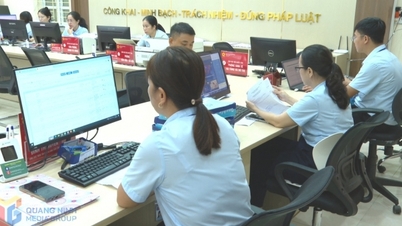
General Secretary To Lam visits people carrying out administrative procedures at the Public Administrative Center of Phuc Thinh commune, Hanoi city. (Source: danviet.vn)
1. Organizing a scientific apparatus contributes to ensuring harmonious development, synchronized operation, and organic cohesion among organizations; thereby contributing to improving the quality, effectiveness, and efficiency of organizations within the political system. Reforming the organizational structure of the political system must be linked to improving the quality of the cadre, meeting the requirements of the new situation. Our Party and President Ho Chi Minh clearly stated: Cadres are the foundation of all work, the decisive factor in the success or failure of the revolution; cadre work is a "very important" issue, "the key of keys." Building a cadre with sufficient qualities and capabilities is an urgent task today to lead the country into a new era, an era of national progress.
Strategic-level officials hold crucial positions, playing a decisive role in resolving strategic issues for the Party, the State, the nation, and the people; they significantly influence all aspects of the Party's personnel work. In the revolution to streamline the organizational structure of the political system, the leadership role of strategic-level officials is even more important.
Under the leadership of the Central Committee, the Politburo, the Secretariat, and directly General Secretary To Lam, the reform process continues to be strong and decisive. One of the focuses of this reform is streamlining the organizational structure. The General Secretary has emphasized: "Absolutely no excuses, substitutions, or laxity in the Party's leadership should occur," implementing revolutionary changes to move towards a political system that is "lean, strong, efficient, effective, and effective." This revolution in streamlining the organizational structure of the political system contributes to enhancing the Party's leadership and governance capacity, the State's management efficiency, the effectiveness of the Vietnam Fatherland Front and other political and social organizations...; minimizing waste and creating a dynamic apparatus that responds quickly to the needs of social development. Streamlining the organizational structure reflects a shift in leadership thinking towards a modern, transparent, and more citizen- and business-friendly governance model. More importantly, reforms help minimize overlapping functions, reduce unnecessary procedures, and focus on key issues. Optimizing the organizational structure will increase the responsiveness of the management system, promote transparency, and effectively combat corruption, negative practices, and waste. Streamlining the organizational structure also facilitates the transfer of resources from less efficient areas to more efficient and necessary sectors, serving the country's development goals. Furthermore, in the context of globalization and increasing competitive pressure, an efficient and effective political system is essential for enhancing national competitiveness.
In accordance with Resolution No. 18-NQ/TW, dated October 25, 2017, of the Central Committee of the Communist Party of Vietnam, the streamlining of the organizational structure has been seriously implemented, achieving important results. In a lecture at the Training Course for Cadres Planning for the 14th Central Committee of the Communist Party of Vietnam (October 31, 2024) at the Ho Chi Minh National Political Academy, General Secretary To Lam pointed out: “Currently, 70% of the budget is used to maintain the administrative apparatus, while the work of arranging and consolidating the state administrative apparatus to be streamlined, effective, and efficient, reducing the number of departments and intermediate levels, is still inadequate. Some parts remain cumbersome, with overlaps between the legislative and executive branches, and have not truly met the requirements for improving the effectiveness and efficiency of management. Some ministries and sectors still shoulder the tasks of localities, leading to the existence of a 'request and grant' mechanism, easily giving rise to negativity and corruption. The work of streamlining personnel linked to job positions, improving the quality and restructuring the contingent of cadres, civil servants, and public employees is still not thorough. This is one of the reasons leading to obstacles to development, increased administrative procedures, and wasted time and effort for businesses.” citizens miss opportunities for national development" (1) .
General Secretary To Lam emphasized: “The new era, the era of the Vietnamese nation's rise, is an era of development, an era of prosperity under the leadership and rule of the Communist Party, successfully building a socialist Vietnam, a prosperous people, a strong nation, a democratic, just, and civilized society, standing shoulder to shoulder with the world's leading powers. All citizens will have a comfortable and happy life, opportunities for development and wealth creation; contributing increasingly to world peace, stability, and development, the happiness of humanity, and global civilization. The goal of this era of rise is a prosperous people, a strong nation, a socialist society, standing shoulder to shoulder with the world's leading powers. The top priority in this new era is to successfully achieve the strategic goals by 2030: Vietnam will become a developing country with modern industry and a high-middle income; by 2045, it will become a developed socialist country with a high income; and strongly rekindle the national spirit.” national spirit, self-reliance, self-confidence, self-strength, national pride, aspiration for national development; closely combining national strength with the strength of the times. The beginning of the new era is the 14th Party Congress, from here, all Vietnamese people, hundreds of millions of people as one, under the leadership of the Party, work together, take full advantage of opportunities and advantages, push back risks and challenges, bring the country to comprehensive, strong development, breakthrough and take off” (2) . The new era of development, the era of the nation's rise, requires the organization of the political system to operate more efficiently, effectively and efficiently. The General Secretary clearly stated: Although the organization of our country's political system has been reformed in some parts, it basically still follows the model designed decades ago, many issues are no longer suitable for the new conditions and are contrary to the law of development; creating a mentality of saying one thing and doing another. More specifically, the organizational structure of the political system in our country is still cumbersome; the functions, tasks, and powers of organizations still overlap, leading to wasted budget resources, inconvenience, unclear responsibilities, or encroachment and "taking over" responsibilities.
Significant changes on a global scale can bring about a noticeable transformation in the quality of operation of the entire political system compared to the current situation. The revolution in streamlining organizational structures aims to maximize the effectiveness and efficiency of agencies and organizations within the political system. When reorganizing the apparatus, it is necessary to properly address the relationships between organizations within the political system, ensuring Party principles and legal compliance. The principle is to ensure the leading and governing role of the Party and the managerial role of the State. Experience in building comprehensive political system models from many countries shows the decisive role of political leaders as well as leading intellectuals. A successful political system model is the product of a combination of determination, vision, progressive thinking, and the wisdom of political leaders and elite intellectuals.
The Resolution of the 7th Central Committee Meeting of the 12th Party Congress "On focusing on building a team of cadres at all levels, especially at the strategic level, with sufficient qualities, capabilities and prestige, commensurate with the tasks" was issued to meet the urgent requirements in the Party's cadre work. The Resolution affirms: "Cadres are the decisive factor in the success or failure of the revolution; cadre work is the 'key' link in the work of building the Party and the political system. Building a team of cadres, especially at the strategic level, is a top priority task, a crucial work of the Party, which must be carried out regularly, cautiously, scientifically, strictly and effectively. Investing in building a team of cadres is an investment in long-term, sustainable development" (3) .
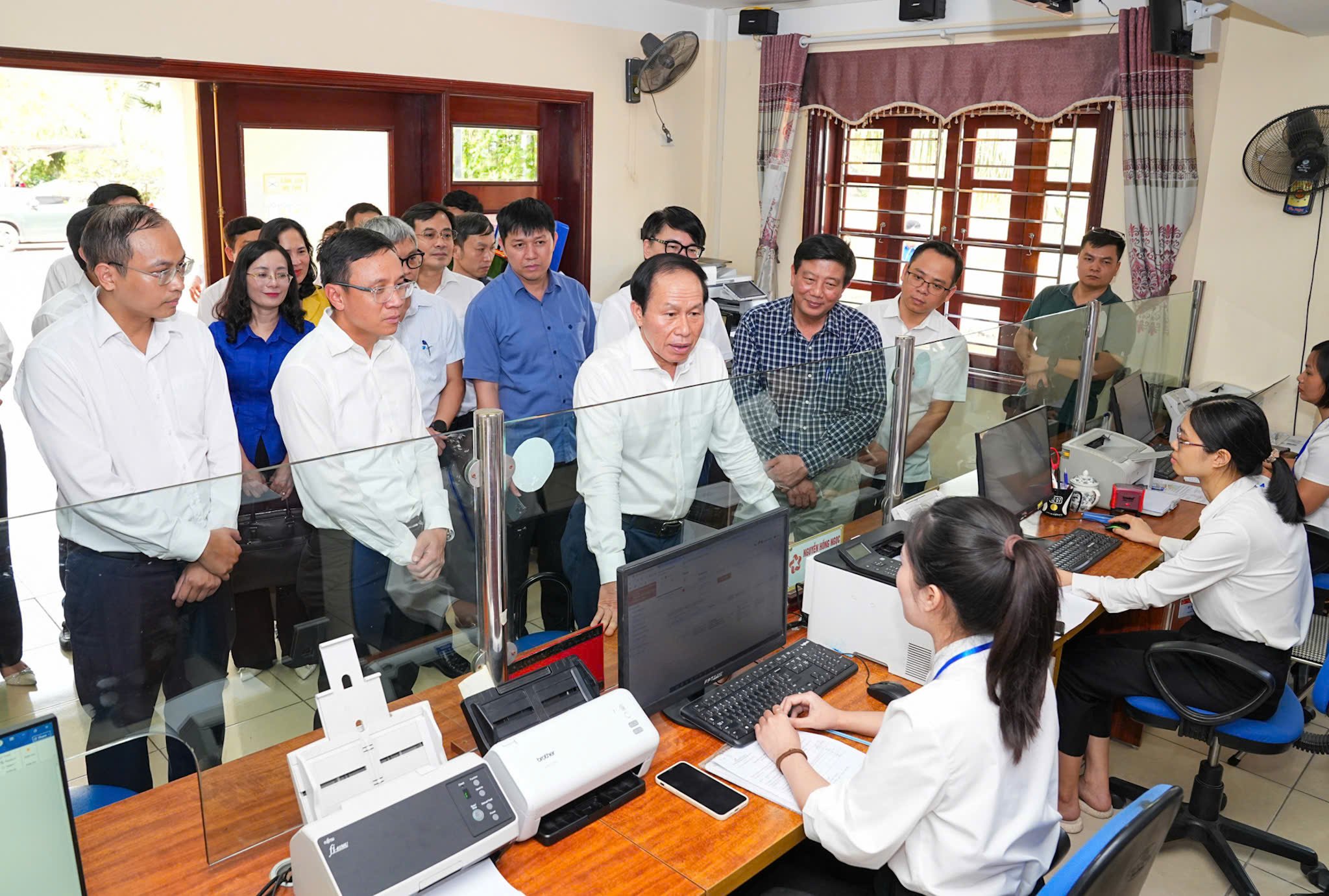
Member of the Central Committee of the Communist Party of Vietnam, Secretary of the Hai Phong City Party Committee Le Tien Chau inspects the operation of the two-tiered local government system in Ai Quoc ward, Hai Phong city. (Source: baohaiphong.vn)
2. Strategic-level personnel play a crucial role in the revolution to streamline organizational structures, aiming for a "lean, efficient, effective, and efficient" organizational structure, specifically:
Firstly, the strategic-level leadership team directly builds, refines, and plays a decisive role in organizing and implementing policies and decisions on streamlining the organizational structure for greater efficiency and effectiveness.
Secondly, in relation to organizations (Party committees, Party organizations; collective leadership of agencies at the central and local levels, the Vietnam Fatherland Front, political and social organizations, specialized agencies, units in the armed forces, enterprise leaders, etc.), strategic-level cadres are leaders of the organization; they make decisions in consolidating and arranging the organizational structure of the political system; they are directly influenced by and strictly comply with the restructuring, consolidation, and improvement of the organization's quality, and at the same time serve as "shining examples" in implementing regulations on streamlining the organizational structure.
Thirdly, strategic-level officials are leaders and managers of cadres and Party members within agencies and units; they are the "bridge" between the Party, the State, the Vietnam Fatherland Front, and political and social organizations with the people; and they directly carry out ideological work and mass mobilization work to contribute to creating consensus and effectively implementing organizational restructuring.
The guiding principle of the Central Committee, the Politburo, the Secretariat, and General Secretary To Lam is to continue focusing on building and streamlining the organizational structure of Party, National Assembly, Government, Vietnam Fatherland Front, and socio-political organizations to ensure effective and efficient operation; streamlining the organizational structure of Party agencies to truly serve as the intellectual core, the "general staff," and the vanguard leading state agencies; cutting unnecessary intermediate layers and reorganizing towards a multi-sectoral and multi-field approach. Promoting decentralization and delegation of power in the direction of "local authorities decide, local authorities act, local authorities are responsible," coupled with strengthening inspection and supervision, clearly defining responsibilities between the central and local levels, between different levels of local government, and between leaders, managers, and civil servants, employees, and workers. Improve the inspection and supervision mechanisms, ensure unity in leadership and management, and promote initiative, creativity, and enhance the self-reliance and self-strength of localities.
To continue effectively implementing the revolution in streamlining organizational structures and building a team of cadres, especially strategic-level cadres, to meet the requirements of the new situation, the following issues need attention:
Firstly, there needs to be a strong reform in the recruitment, appointment, and evaluation of officials, focusing on clarity and substance.
During the recruitment process, it is necessary to organize the competitive examination process effectively. The examination must ensure objectivity and transparency. To attract talented and high-quality personnel, a breakthrough mechanism and new models suitable to the local context and unit's realities are needed. Proactively appoint leading and managerial cadres through competitive examinations as guided by the Central Committee. Focus on and promptly develop and supplement personnel planning to meet the requirements and tasks in the new situation; develop personnel planning based on the principles of "dynamic" and "openness," implementing it from the bottom up; use the planning of Party committee positions as the basis for planning leadership and managerial positions; and use lower-level planning as the basis for higher-level planning. Personnel placement must be based on the functions and tasks of the agency or unit, the requirements of the work, and the capabilities of the cadres. Implementing rotation and reassignment creates opportunities for cadres included in the planning process to gain practical experience, thereby enabling the evaluation, selection, and placement of cadres in a rational and effective manner.
Reforming the evaluation of cadres should be a comprehensive, continuous, multi-dimensional approach, based on criteria, performance-based, through surveys, with publicly available results and comparisons with equivalent positions. Standardizing and digitizing cadre records and profiles will serve as the basis for reforming the process of understanding, evaluating, and assessing personnel, focusing primarily on the qualities, capabilities, reputation, and development prospects of cadres. Regulations regarding political qualities, ethics, lifestyle; intellectual capacity, leadership and management skills, and professional competence need to be specified and quantified. When evaluating cadres, it is necessary to base assessments on achievements, merits, contributions, and seniority of cadres to the organization, the work, and the locality; on health conditions, age, and educational qualifications; and on the comments and assessments of local people, cadres, civil servants, and workers in the workplace regarding the qualities and capabilities of leading and managing cadres. Combining the opinions and assessments of the local people where the official lives with the opinions and assessments of officials, civil servants, and workers where the official works will help the competent Party committees and organizations gain a comprehensive and accurate understanding of the official.
Secondly, we need to build a sufficiently strong and substantive mechanism to encourage and protect officials who "have innovative thinking, dare to think, dare to act, dare to make breakthroughs, and dare to take responsibility for the common good."
Continue to build and improve the system of regulations and rules on scientific personnel work, ensuring consistency and uniformity. Develop and improve the legal system, linked to enhancing the effectiveness and efficiency of law enforcement and improving the quality of all aspects of personnel work. Develop an effective process for protecting personnel, ensuring both the Party's leadership and encouraging cadres and Party members to think boldly, act decisively, and make breakthroughs for the common good. Accordingly, it is necessary to implement lifelong learning, as in the article of General Secretary To Lam: “Only when we promote lifelong learning in a substantive way can we…create a team of courageous cadres who correctly understand objective laws, proactively think and master their thoughts, dare to speak about issues arising from practice, from vibrant life, from the demands of innovation and the legitimate requirements and aspirations of the people; have determination, dare to take responsibility for the results of the work, field, and sector that they are in charge of, dare to admit mistakes, correct errors, and take responsibility before the people and the Party” (4) .
Building mechanisms to encourage and protect cadres must be closely linked to building accountability within Party committees, Party organizations, and their leaders. Creating a healthy work environment, paying attention to the effective implementation of policies, and providing conditions for cadres to confidently strive and improve themselves are crucial. Party committees, Party organizations, and the heads of agencies and units must simplify the process for policy implementation, reduce administrative procedures, and shorten waiting times to create the maximum environment and space for innovation while still ensuring compliance with regulations.
Thirdly, we must resolutely screen and remove from office those who lack the necessary qualities, capabilities, and credibility.
Implement decisively, regularly, comprehensively, and synchronously the work of inspection, supervision, and Party discipline to serve the fulfillment of political tasks and the work of building and rectifying a clean and strong Party. Focus on inspecting and supervising Party organizations, leaders, and key officials in areas prone to violations, where there are many prominent grievances and public concerns; promptly, resolutely, thoroughly, synchronously, and strictly handle violations by Party organizations and Party members. Closely combine proactive prevention with proactive detection and timely and strict handling of acts of corruption, waste, and negativity. Pay attention to supervising the cultivation and training of ethics, lifestyle, and exemplary conduct of leaders, managers, officials, Party members, and civil servants in the political system. Improve mechanisms to promote the role of the people in participating in building a clean and strong Party and political system; Promote the supervisory role of the Vietnam Fatherland Front and political and social organizations, and listen to the opinions of the people to detect, inspect, and supervise effectively. Tighten discipline and order, innovate the working style and methods of Party committees, Party organizations, agencies, units, and localities; strengthen disciplinary education, discipline compliance, and integrity in the performance of public duties. When evaluating, the results of work, the satisfaction and trust of the people must be important criteria for assessing the quality of the organizational structure and the quality of cadres and Party members. Clearly define the declaration and verification of income and assets of leading and managerial cadres at all levels, ensuring transparency and openness. The competent agency responsible for controlling assets and income, in accordance with the regulations of the Party and the laws of the State, must control the assets and income of cadres, civil servants, and public employees, especially those with positions and authority; Appropriate measures should be taken to detect and address the issue promptly.
These contents are expressed in the closing speech of the 12th Central Committee meeting of the 13th term by General Secretary To Lam (5) .
Fourth, focus on training and nurturing personnel planned for the Central Committee, Party committees, and standing committees at all levels; ensuring the selection of Central Committee members, Party committees, and standing committees at all levels, especially leaders, who possess leadership capabilities, sufficient "heart, vision, and intellect," and are talented individuals capable of shouldering the great and glorious revolutionary cause.
Emphasis should be placed on building a rational strategic-level cadre structure, ensuring a continuous and stable transition between generations of cadres. A mechanism should be established to identify and select outstanding and exemplary cadres early and from afar, who have been trained, nurtured, tested in practice, have outstanding achievements, and truly possess promising development prospects, to be included in the strategic-level cadre planning pool. Strict regulations on power control and the prevention and combating of corruption and negative practices in cadre work should be implemented. Strict and consistent enforcement should be carried out in accordance with Party regulations and State laws.
For current and prospective officials, it is essential to seriously implement training and knowledge updating according to the regulations of the Central Committee. Annual plans should be developed for training, professional development, rotation, and secondment of officials. Training and professional development methods should be reformed, linking theory with practice; strengthening surveys of best practices and innovative models in localities and units to learn from experience and apply it to leadership and management practices. Inspection and supervision work should be strengthened, and the evaluation of officials' learning, self-cultivation, and training results should be reformed to be more substantive.
---------------------------
(1) Prof. Dr. To Lam: “Some basic understandings of the new era, the era of national resurgence”, Communist Magazine , No. 1050 (11-2024), p. 7
(2) Prof. Dr. To Lam: “Some basic understandings of the new era, the era of national resurgence”, Communist Magazine , Ibid ., pp. 3-4
(3) Resolutions of the Central Committee of the Party 2016 - 2020 , National Political Publishing House, Hanoi, 2021, pp. 211 - 212
(4) Prof. Dr. To Lam: “Lifelong learning”, Communist Magazine , No. 1058 (3-2025), p. 5
(5) See: Prof. Dr. To Lam: “Maintaining faith, aspirations for development, continuing to innovate, determined to build a peaceful, developed, strong, prosperous and happy Vietnam”, Communist Magazine , No. 1066 (7-2025), pp. 3-8
Source: https://tapchicongsan.org.vn/web/guest/chinh-tri-xay-dung-dang/-/2018/1155902/phat-huy-vai-role-of-the-strategic-commission-team-in-the-revolution-of-organizational-skills-of-the-political-system.aspx
![[Photo] Prime Minister Pham Minh Chinh receives the Governor of Tochigi Province (Japan)](/_next/image?url=https%3A%2F%2Fvphoto.vietnam.vn%2Fthumb%2F1200x675%2Fvietnam%2Fresource%2FIMAGE%2F2025%2F12%2F16%2F1765892133176_dsc-8082-6425-jpg.webp&w=3840&q=75)

![[Live] 2025 Community Action Awards Gala](/_next/image?url=https%3A%2F%2Fvphoto.vietnam.vn%2Fthumb%2F1200x675%2Fvietnam%2Fresource%2FIMAGE%2F2025%2F12%2F16%2F1765899631650_ndo_tr_z7334013144784-9f9fe10a6d63584c85aff40f2957c250-jpg.webp&w=3840&q=75)
![[Image] Leaked images ahead of the 2025 Community Action Awards gala.](/_next/image?url=https%3A%2F%2Fvphoto.vietnam.vn%2Fthumb%2F1200x675%2Fvietnam%2Fresource%2FIMAGE%2F2025%2F12%2F16%2F1765882828720_ndo_br_thiet-ke-chua-co-ten-45-png.webp&w=3840&q=75)
![[Photo] Prime Minister Pham Minh Chinh receives Lao Minister of Education and Sports Thongsalith Mangnormek](/_next/image?url=https%3A%2F%2Fvphoto.vietnam.vn%2Fthumb%2F1200x675%2Fvietnam%2Fresource%2FIMAGE%2F2025%2F12%2F16%2F1765876834721_dsc-7519-jpg.webp&w=3840&q=75)





































![[Photo] Prime Minister Pham Minh Chinh attends the Vietnam Economic Forum 2025](https://vphoto.vietnam.vn/thumb/402x226/vietnam/resource/IMAGE/2025/12/16/1765893035503_ndo_br_dsc-8043-jpg.webp)



















Comment (0)