

Raising the intellectual level of the population creates a foundation for sustainable development.
Following its merger with Kien Giang province, An Giang has a population of over 4.95 million people, of which more than 472,000 are ethnic minorities, accounting for 9.53% of the province's total population. The Khmer people alone make up the majority, with over 399,000 people, living concentrated in border, mountainous, and remote districts and communes. By the end of 2024, the province still had 2,869 poor households belonging to ethnic minorities, with 9 communes and 49 hamlets classified as particularly disadvantaged.
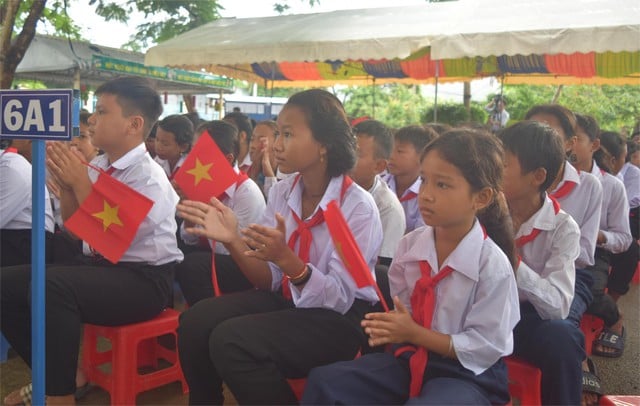
Ethnic minority students in An Giang receive good care and support for their studies.
PHOTO: TRAN NGOC
In this context, the province has continuously strived to improve its school system, from preschool to university, creating conditions for all segments of the population – especially ethnic minorities – to access education equally. The school system in ethnic minority areas has expanded in both scale and quality, gradually meeting the requirements of educational reform in the new era.
The province has implemented a comprehensive set of policies including tuition fee exemptions and reductions; support for learning expenses; investment in upgrading 9 ethnic boarding schools; and the construction of 3 more schools in border areas. As a result, the school attendance rate for ethnic minority students has consistently remained high, exceeding 98%. Notably, the preservation and promotion of ethnic cultural identity through education has received special attention. The province currently has 47 schools teaching the Khmer language and nearly 100 temples offering ethnic language classes during the summer, contributing to the preservation of the traditional languages and scripts of the Khmer and Cham people.
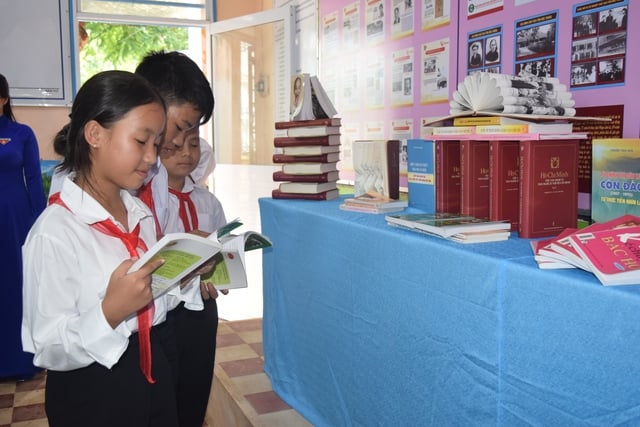
Students at An Tuc Secondary School, An Giang province, read books at school.
PHOTO: TRAN NGOC
Despite the achievements, education in ethnic minority areas of An Giang province still faces many difficulties. In some localities, the infrastructure and teaching equipment are not standardized; the teaching staff does not meet the requirements of innovation; and the situation of teacher shortages and surpluses still occurs in certain areas. In particular, many students in remote and border areas still face difficulties in learning and living conditions, significantly affecting the quality of education.
According to the An Giang Department of Education and Training, the province has achieved universal preschool education for 5-year-old children; level 3 universal primary education; level 2 universal lower secondary education; and level 2 literacy eradication. However, the majority of illiterate people in the area are Khmer and Cham ethnic minorities, belonging to the working-age group, facing economic difficulties, struggling to make a living, and feeling hesitant. Despite this, the need to learn to read, write, and do calculations for convenience in daily life and communication remains very high. Based on this reality, the education sector has identified many effective and appropriate solutions to encourage people to participate in literacy eradication.
Promoting the role of community learning centers
One of the key solutions effectively implemented in An Giang is enhancing the role of community learning centers. Previously, many centers primarily performed administrative tasks, but now they are assigned specific responsibilities, with performance results linked to targets.

Thanks to the focus on education, the intellectual level of ethnic minorities in An Giang province is constantly improving.
PHOTO: TRAN NGOC
Analysis by the education sector revealed that illiteracy is concentrated mainly in the 35-60 age group, mostly among ethnic minority communities. Based on this, the Department of Education and Training proactively developed and implemented literacy eradication plans. Specifically, the Department issued Plan No. 2461/KH-SGDĐT dated June 26, 2023, on implementing literacy eradication for people in ethnic minority areas in 2023; and assigned specific targets to each locality. The close coordination between the Education and Training Department and the Culture and Social Affairs Department after the merger helped to ensure the plans were implemented quickly and synchronously.
During the period 2023-2025, the entire province opened 130 literacy classes, mobilizing 1,890 illiterate people aged 15 to 60 to attend. Of these, 1,134 people studied at level 1, and 756 people studied at level 2; to date, 680 people have been recognized as having completed level 1.
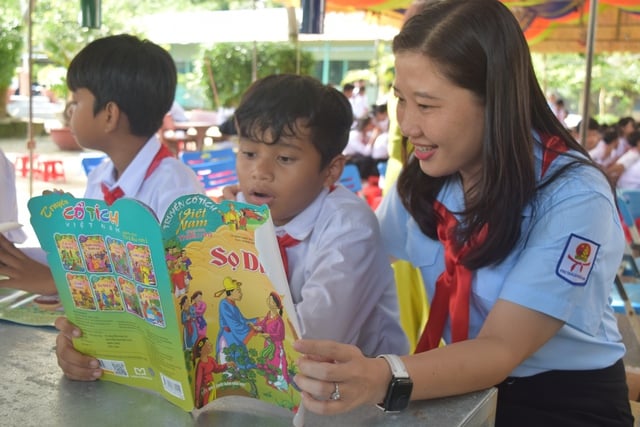
The An Giang Provincial Youth Union always pays attention to and supports students in ethnic minority areas.
PHOTO: TRAN NGOC
To maintain student enrollment and improve learning effectiveness, community learning centers also flexibly utilize Zalo groups to connect center leaders, village committees, and teachers, monitoring attendance at each class. Students receive regular attention and encouragement, making the classroom atmosphere increasingly lively. In addition, social outreach efforts are intensified, with many students receiving gifts on the opening day to encourage their learning spirit.
Strategic orientation for education in ethnic minority areas.
Mr. Tran Quang Bao, Director of the Department of Education and Training of An Giang province, said that the provincial education sector has thoroughly grasped the spirit of Resolution No. 71-NQ/TW of the Politburo, proactively advising the Provincial Party Committee and the Provincial People's Committee to develop an action program with many major goals. These include prioritizing investment in infrastructure, strengthening school buildings, and standardizing teaching equipment, especially for kindergartens, boarding schools, and semi-boarding schools in border areas and areas inhabited by ethnic minorities. The province strives to have 80% of schools meet national standards by 2030.
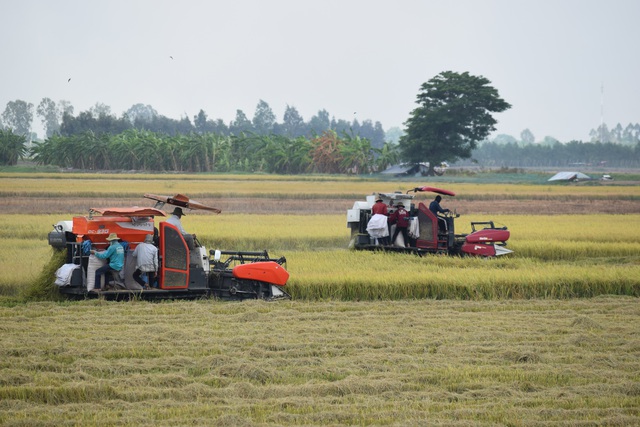
Rice harvesting in the ethnic minority area of Tri Ton commune, An Giang province.
PHOTO: TRAN NGOC
Simultaneously, efforts will be made to improve the quality of the teaching staff, standardize qualifications, cultivate digital skills, enhance experiential learning capabilities, and provide career guidance. The goal is that by 2030, 100% of teachers will meet the standards set by the Education Law, with 30% exceeding those standards.
An Giang is also promoting digital transformation in education, building a digital student record system and a shared learning resource repository, striving to have 100% of schools with high-speed internet and 90% of secondary and high schools with smart classrooms by 2026. In particular, the province focuses on ensuring equity in access to education, expanding the network of community learning centers, building "learning communes" and "learning wards," aiming to become a "learning province" in the Mekong Delta region.
Thanks to concerted, decisive, and long-term efforts, education in ethnic minority areas of An Giang province is gradually improving, contributing to raising the intellectual level of the people, preserving cultural identity, and creating momentum for sustainable development in the new era.
Source: https://thanhnien.vn/phat-trien-giao-duc-dong-bao-dan-toc-o-an-giang-185251215152233617.htm


![[Image] National Assembly discusses the implementation of the socio-economic development plan.](https://vphoto.vietnam.vn/thumb/1200x675/vietnam/resource/IMAGE/2026/04/20/1776696707422_ndo_br_img-20260420-185419-jpg.webp)

![[Photo] General Secretary and President To Lam meets with National Assembly delegates from ethnic minorities.](https://vphoto.vietnam.vn/thumb/1200x675/vietnam/resource/IMAGE/2026/04/20/1776696701056_a1-bnd-8331-3342-jpg.webp)


















































































Comment (0)