

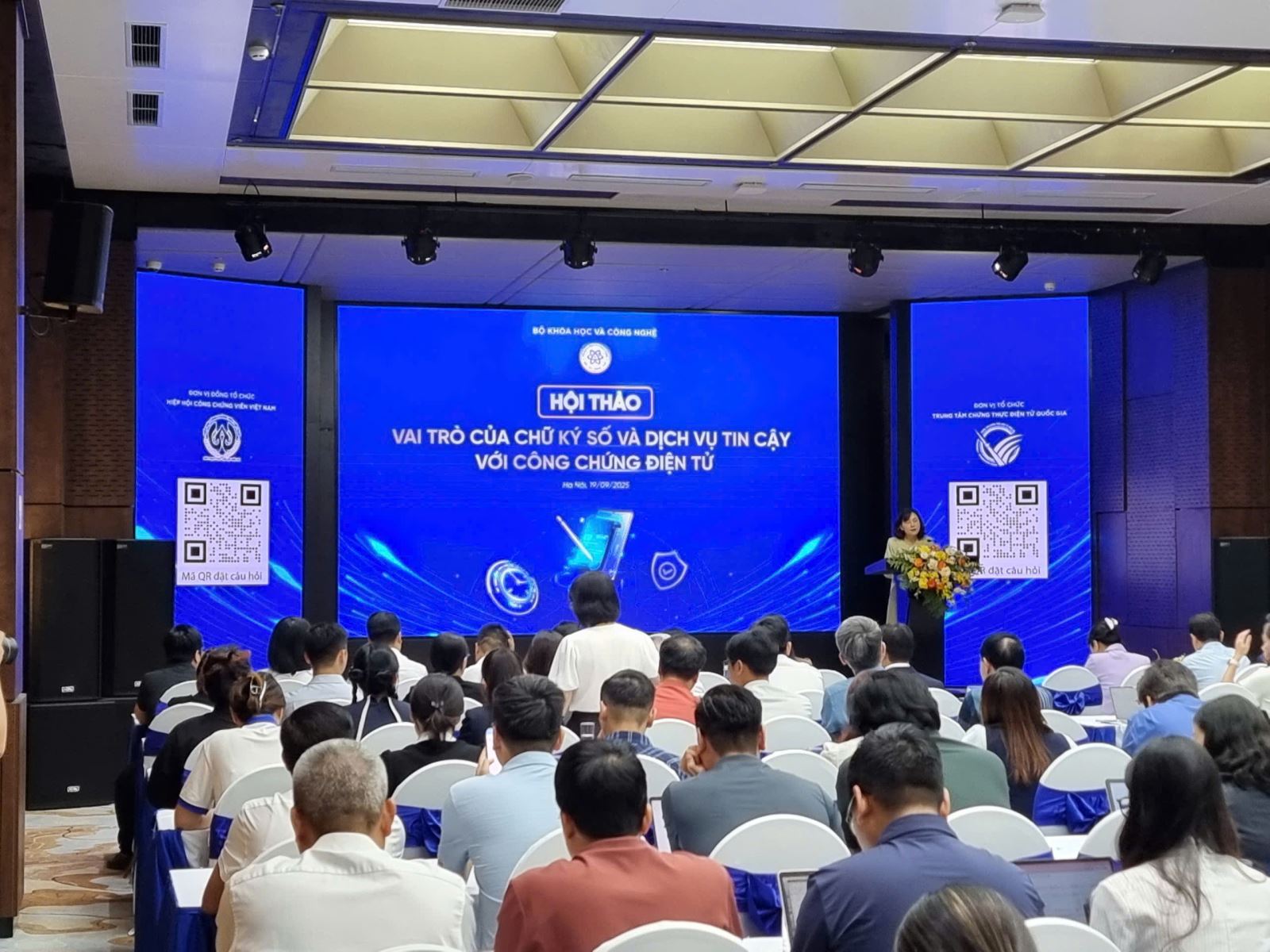
On September 19th, in Hanoi , the National Electronic Authentication Center, in collaboration with the Vietnam Association of Notaries, organized a thematic workshop entitled "The Role of Digital Signatures and Trusted Services in the Field of Electronic Notarization in Vietnam".
The workshop was held in the context of the legal framework for electronic notarization, which has been established by the Law on Notarization and the recently issued Government Decree 23/2025/ND-CP on electronic signatures and trusted services, which has established a complete legal framework for trusted services (digital signatures, data message authentication, timestamping, secure data sending and receiving services, etc.). These new regulations are an important bridge creating a legal foundation for the effective operation of electronic notarization, ensuring that all electronically notarized documents have the same legal value as paper documents.

In her opening remarks at the workshop, Ms. To Thi Thu Huong, Director of the National Electronic Authentication Center (NEAC), stated: “In an era where data has become a new resource and digital transactions are becoming commonplace, ensuring digital trust is a prerequisite.” Vietnam recognizes that digital signatures and trusted services are not just technical tools, but a foundation for ensuring trust in electronic transactions, shaping the digital government, digital economy , and digital society.
According to Ms. Nguyen Thi Tho, Executive Vice President of the Vietnam Notaries Association, the collaboration between NEAC and the Association is a necessary step to ensure the adoption of electronic notarization. The Association will work alongside NEAC in disseminating information, training, and guiding notaries to access new technologies, thereby ensuring the quality of services and the legitimate rights of citizens.
At the workshop, NEAC representatives clarified the legal value and role of digital signature services and trust services in electronic notarization activities, thereby supporting notaries in accessing and applying legal regulations correctly.
Specifically, according to the 2023 Electronic Transactions Law, a digital signature is an electronic signature that uses an asymmetric key algorithm to verify the signatory and confirm their acceptance of the signed content. Digital signatures ensure authenticity, integrity, and non-repudiation; therefore, the Electronic Transactions Law affirms that digital signatures have the same legal value as handwritten signatures in traditional transactions. Furthermore, the 2024 Notarial Law stipulates that electronically notarized documents are effective from the moment they are signed with the digital signature of the notary public and the digital signature of the notarial practice organization.
As electronic transactions become more common, so do related services, one of which is trust services. Decree No. 23/2025/ND-CP has stipulated detailed regulations on trust services, including the conditions that must be met regarding personnel, technology, finance, etc., if a business wants to operate this type of service.
For the field of electronic notarization, reliable service is an effective tool, helping notaries and notarization organizations simplify their operational processes. This gradually transforms traditional notarization transactions from a physical environment to a digital one, enhancing the efficiency of electronic notarization. The workshop also highlighted the benefits that electronic notarization brings to the people and society.
First and foremost, it saves time and costs. People can have certain types of documents notarized online from home, instead of having to travel multiple times to a notary office. Electronic documents are processed quickly, and notarized documents can be issued almost immediately after the notary signs digitally.
It is estimated that, with approximately 8 million notarized documents processed annually, the adoption of electronic notarization could save society hundreds of billions of dong in storage and processing costs.
Secondly, electronic notarization increases security and transparency. Each electronically notarized document includes a digital signature and timestamp, which can be checked online to verify authenticity. Records are stored electronically, avoiding the risk of loss, damage, or forgery.
Thirdly, electronic notarization is integrated with many other public services and electronic transactions. Electronically notarized documents can be used directly in business registration procedures, real estate transactions, banking, etc., without having to submit additional paper copies, reducing duplication and maximizing convenience for citizens.
Source: https://baotintuc.vn/xa-hoi/pho-bien-chu-ky-so-trong-cong-chung-dien-tu-20250919125014253.htm




































































































Comment (0)