

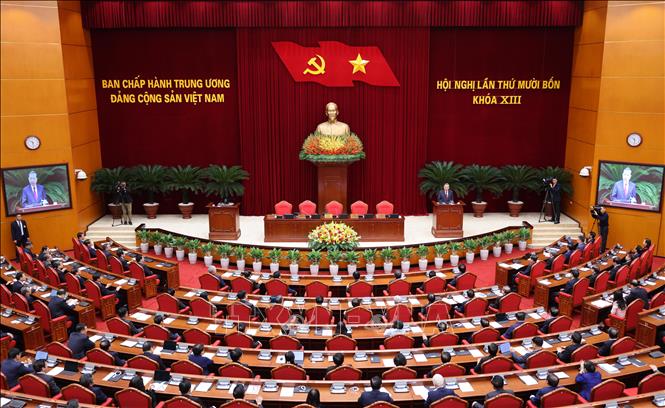
The 14th Conference of the 13th Central Committee of the Communist Party of Vietnam focused on two major groups of issues: issues concerning the work for the 14th Party Congress and issues concerning Party building and the political system. The decisions and assessments at the Conference set specific requirements and important directions for continuing the vigorous reform of the Party's leadership methods in the coming period.
It is very clear that, immediately after the 13th National Congress of the Party, the Central Committee, the Politburo, and the Secretariat promptly led and directed the study, understanding, and implementation of the Congress Resolution with many new, systematic, scientific, and effective approaches; they promptly considered and gave directives to address many difficult, complex, long-standing, and unresolved issues, unlocking resources for national development, especially socio -economic development.
The Central Committee of the Party has led and directed national defense, security, and foreign affairs; the work of building and rectifying the Party and the political system; strictly implemented the Party's principles; and continuously innovated leadership methods and working styles...
Looking back at the 13th National Congress term, our Party has maintained its strategic direction; persistently built and rectified the Party; promoted the improvement of institutions; steadfastly maintained macroeconomic stability; accelerated digital transformation and green transformation; strengthened national defense and security; and expanded foreign relations and deep integration. Many major policies have been institutionalized, many bottlenecks have been removed, and many breakthrough decisions have been implemented.
A key highlight is the innovation in the Party's leadership methods, clearly demonstrated through two major aspects: streamlining the organizational structure and improving the quality and standards of leading cadres.
In particular, the innovation of the Party's leadership methods is concretized through the continued decisive leadership and direction in implementing Resolution No. 18-NQ/TW on "Some issues concerning the continued reform and restructuring of the organizational apparatus of the political system to be streamlined, effective, and efficient." After 8 years of implementing Resolution 18, especially from 2024 to the present, the apparatus throughout the political system, from the central to local levels, has been streamlined, with clearer functions and responsibilities, reduced intermediate levels; personnel reduction coupled with improved quality of cadres, civil servants, and public employees; and the activities of Party and State agencies, the Fatherland Front , and political and social organizations have become increasingly effective and efficient.
The three-tiered government model (central, provincial, and commune/ward) has been in operation for four months, yielding promising initial results, enhancing the effectiveness and efficiency of serving the people and promoting socio-economic development. The public supports and trusts it, and citizens and businesses are beginning to see opportunities, rights, and civic responsibilities becoming more tangible. The two-tiered local government model, with the reorganization of administrative boundaries at the provincial and commune levels, is a bright spot and a breakthrough in the implementation of the Party's Resolution.
The Central Committee of the Party, the Politburo, and the Secretariat have led and directed the vigorous implementation of Central Committee Resolutions, especially Resolution 18 on restructuring and streamlining the organizational apparatus of the political system, completing it five years ahead of schedule. This has created a "boost" and a "turning point" in the implementation of the Party's Resolutions in the new situation; continuing to remove institutional difficulties and obstacles, perfecting policies and legal frameworks, and effectively resolving long-standing difficulties, obstacles, limitations, and weaknesses. Macroeconomic stability has been maintained, inflation has been controlled and kept at a low level; foreign direct investment has increased; the investment and business environment and trade balance have improved; and the growth model has shifted in a positive direction. We continue to effectively implement the three strategic breakthroughs: the people's living standards have improved significantly; Maintaining the independence, sovereignty, and territorial integrity of the Fatherland, as well as national and ethnic interests; creating a peaceful and stable environment for national development; and making positive and responsible contributions to peace, stability, and development in the region and the world. Therefore, the prestige and position of the Party and the country are increasingly enhanced internationally, earning the trust and high regard of cadres, Party members, and the people.
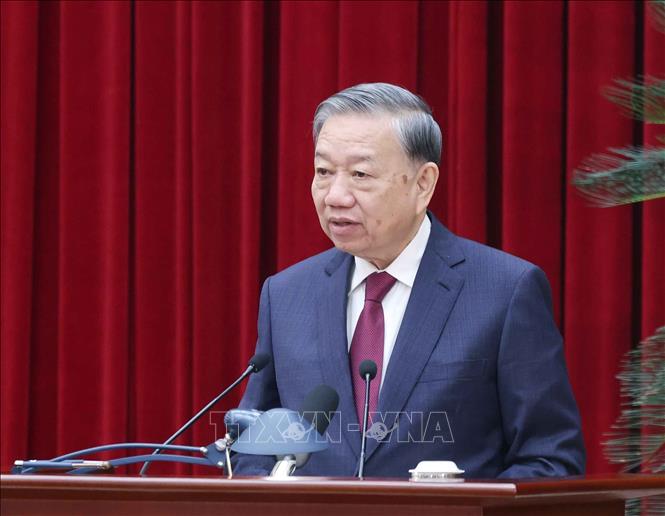
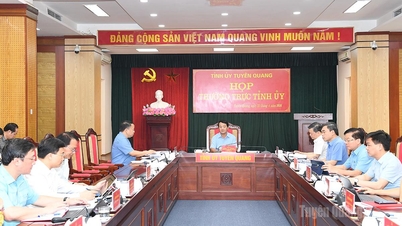
To enhance effectiveness and efficiency, General Secretary To Lam requested a focus on key areas: The entire political system should continue to nurture and build an effective and efficient two-tiered local government model; clearly define the interconnected authority between the three levels for each sector, eliminating overlaps and ensuring no responsibilities are left unmet; decentralization should be accompanied by control, shifting strongly towards post-auditing, and organizing internal audits at the provincial/commune level; public finances should be allocated based on results and the specific characteristics of each locality; promptly identify job positions, implement product-based contracts, and provide mandatory training in professional skills, expertise, and data management; organize a digital one-stop service, eliminate the "request-grant" mechanism, and increase the accountability of leaders; build a shared data system connecting population, land, social security, and businesses, with real-time updates from the grassroots to the central level.
The General Secretary pointed out that the overarching principle is "local authorities decide, local authorities do, local authorities take responsibility" and "clear responsibilities - clear tasks - clear deadlines - clear resources - clear accountability", "the Central Government sets an example, local authorities respond", "serving the people", and "the results and products of the work are the highest measure of the level and quality of cadres".
The Party's comprehensive and synchronized strategic orientations, reflecting innovative thinking, long-term vision, and strong political determination, are further demonstrated by the fact that, from the end of 2024 to the present, the Politburo has issued seven strategic resolutions (Resolutions 57, 59, 66, 68, 70, 71, and 72), which have strategic significance in most key areas of the country and serve as a foundation for the nation to develop into a prosperous and thriving country in the new era. The resolutions consistently emphasize a rapid shift from "issuing policies" to "managing implementation," placing the people and businesses at the center, and using practical effectiveness as a measure. Each agency, organization, and individual is responsible for transforming the content of these resolutions into daily work, into concrete action programs with resources, deadlines, measurable indicators, monitoring, and accountability.
Implementing the seven resolutions requires a high degree of unity in awareness and action throughout the entire political system. From the central level to the grassroots, each Party committee, Party organization, state agency, and mass organization needs to concretize the resolutions into clear programs, projects, and action plans, linking the responsibility of the head of each organization to the results of implementation, ensuring "clear tasks, clear responsibilities, clear progress, and clear effectiveness."
Furthermore, the Party's leadership style is reflected in its personnel work, especially in the selection of high-ranking officials. The 14th Plenum of the 13th Central Committee of the Party held democratic and thorough discussions and reached consensus on the number and personnel nominated to participate in the Politburo and Secretariat of the 14th Party Congress (both re-election and first-time participation), emphasizing high requirements for leadership qualities and capabilities. The responsibility of "choosing the right person for the right job," especially for high-ranking officials and those leading the country, is a prerequisite for translating vision and aspirations into results. The most deserving individuals must be selected and nominated to participate in the Politburo and Secretariat. They must possess strong political acumen, integrity, and exemplary conduct, prioritizing national and people's interests above all else. They must have a sharp strategic vision and organizational capacity to unlock bottlenecks, unleash resources, and mobilize strength.
Leading officials must be the most suitable for the development goals in the new period. Besides general standards, in selecting and nominating personnel to participate in the Politburo and the Secretariat of the 14th Party Congress, special attention is paid to five "plus points," which are: having a national strategic vision and the ability to maintain national autonomy; having leadership and command capabilities on a national scale; having political prestige and integrity at a symbolic level for others to emulate and learn from; having the ability to implement resolutions into measurable results; and having sufficient endurance, both mentally and physically, to withstand the pressure and intensity of work during the 14th term and possibly subsequent terms.
Thus, reforming the Party's leadership methods is not just a theoretical issue, but focuses on practical action through: continuing to streamline the apparatus, decentralizing while maintaining control, digital transformation to eliminate the "request-and-grant" mechanism, and higher standardization of leadership standards, ensuring that the Party's leadership role is exercised scientifically, effectively, and with the highest level of accountability; and simultaneously issuing and implementing resolutions into practice, creating a solid foundation for Vietnam to realize its goal of becoming a strong and prosperous nation.
Source: https://baotintuc.vn/thoi-su/dau-an-doi-moi-phuong-thuc-lanh-dao-cua-dang-20251106162321861.htm
![[Photo] General Secretary and President To Lam meets with National Assembly delegates from ethnic minorities.](https://vphoto.vietnam.vn/thumb/1200x675/vietnam/resource/IMAGE/2026/04/20/1776696701056_a1-bnd-8331-3342-jpg.webp)
![[Image] National Assembly discusses the implementation of the socio-economic development plan.](https://vphoto.vietnam.vn/thumb/1200x675/vietnam/resource/IMAGE/2026/04/20/1776696707422_ndo_br_img-20260420-185419-jpg.webp)



























































Comment (0)