


Dr. Dinh Duc Tien
As Lunar New Year approaches, we start discussing whether we should give gifts or send money via bank transfer to please the recipient. From a cultural perspective, is it better to give gifts or send money via bank transfer?
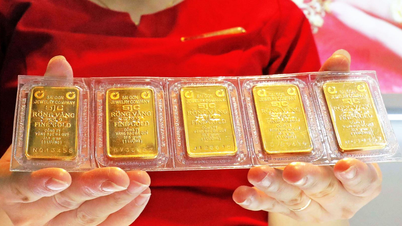
Dr. Dinh Duc Tien: First of all, giving gifts and transferring money are two different things. But sometimes people use the "ting ting" sound to create a relationship disguised as a gift. That is, they are confusing a gift with money. We must separate these two things, otherwise it will become a case of using gifts as a pretext but actually offering bribes, for example.
Gift-giving is related to the specific circumstances of the relationship between the giver and the recipient. It also involves various factors such as motives. When people give gifts of goods or money, those goods or money themselves are not inherently bad; they are neutral. However, their negative impact depends on the individual's intentions and motives; conversely, their positive impact also depends on the individual's intentions and motives. A gift given by a benevolent person to someone in need is clearly a good gift, a positive gesture. But if the gift or money is given with ulterior motives, it becomes a bribe, clearly having a negative connotation.
How did our elders teach us about gift-giving in the old days, sir?
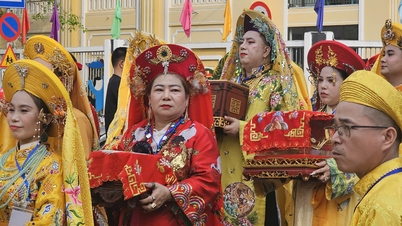
In Vietnamese customs and traditions, there is a recorded custom of gift-giving. This custom of gift-giving is public and clearly regulated. Each village has its own regulations based on its traditions. It is recorded in stone inscriptions and village charters, stating that during Tet (Vietnamese New Year) and other festivals, the village allocates funds to purchase items, and how the offerings to the village's guardian deity are distributed afterwards...
Accordingly, the village elder would receive the first share, according to a clearly defined quota. There was also a rule to share with the elderly upon reaching a certain age. It became a custom to show respect for village elders and to show respect to those of advanced age, such as the elderly, so that they would "share their age" with them... The villagers showed such respect. These are very good and positive actions.
In cultural studies, there is also a theory of gift-giving. This includes gift-giving between those of lower status and those of higher status, and between communities, with weaker communities giving to stronger ones. For example, in the past, many smaller countries paid tribute to China, or Champa to Dai Viet. When receiving such gifts , the larger country received them not only as material goods but also to affirm its position in the eyes of the weaker nation. After the gift-giving, the law of gift-giving also included details about "reciprocity," meaning the stronger community or the larger individual had to give a gift in return. In principle, that gift had to be equivalent to or greater than the gift. When gifts were given to deities, the return was usually in the form of intangible gifts such as peace, blessings for bountiful harvests, or help in overcoming disease.
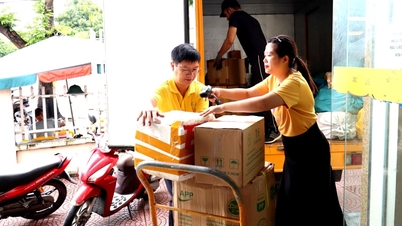
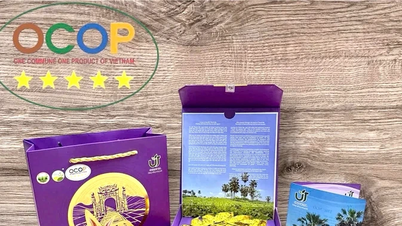
Recently, we've seen more effort and cultural significance in gifts. We now have many gift packages that carry cultural meaning in their design and use. What are your thoughts on this trend?
I think it reflects the awareness and general knowledge of gift-giving. It shows that the gift-giver is more aware that giving gifts is about giving culture, and giving cultural gifts reflects the culture of the giver.
Thank you, sir!
Dr. Nguyen Thi Thu Ha, VICAS National Institute of Culture and Arts:
The advantages of local cultural values
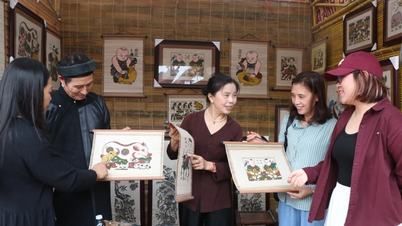
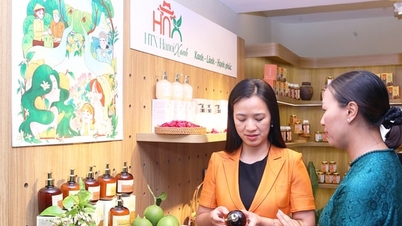
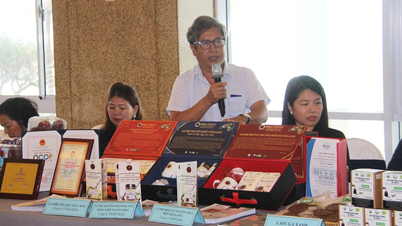
Over the past five years, a clear trend has emerged of increasing cultural content in gift items. This trend shows that businesses are also very sensitive and proactive in integrating cultural elements, especially local culture, to create greater value for their products. This will create competitiveness not only within the province but also nationwide and enable the export of products abroad.

Furthermore, the current high level of gift design capabilities, coupled with keen business acumen, has led to significantly improved industrial packaging designs. Notably, a strong sense of local identity has also emerged in recent years in these designs.
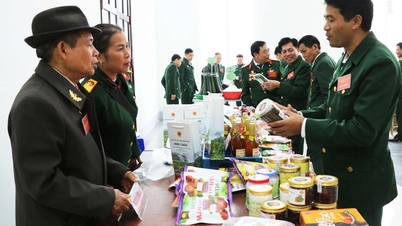
Young people are willing to pay more for gifts that are connected to stories they know, stories of their homeland. At the recent fair organized by Vicas, it was evident that young people were willing to pay higher prices and buy Vietnamese goods instead of foreign ones. This is the advantage of local cultural values, with products that not only have patterns and colors but also stories, allowing prices to be significantly higher, yet still attracting buyers.
Source link


![[Photo] Speaker of the National Assembly meets with the Vietnamese community in Türkiye](https://vphoto.vietnam.vn/thumb/1200x675/vietnam/resource/IMAGE/2026/04/18/1776483346102_1-8136-jpg.webp)
![[Photo] General Secretary and President visit the China-ASEAN AI Application Cooperation Center](https://vphoto.vietnam.vn/thumb/1200x675/vietnam/resource/IMAGE/2026/04/17/1776404277677_vna-potal-tong-bi-thu-chu-tich-nuoc-tham-trung-tam-hop-tac-ung-dung-ai-trung-quoc-asean-8706616-2286-jpg.webp)






































































Comment (0)