

On May 28, US President Joe Biden finalized a budget agreement with House Speaker Kevin McCarthy to suspend the $31.4 trillion debt ceiling until January 1, 2025. According to Biden, the agreement is now ready to be sent to Congress for a vote.
"This is good news for the American people," Biden told reporters at the White House after a phone call with McCarthy to finalize the deal they reached on the evening of May 27 after weeks of tense negotiations.
However, reaching an agreement is one thing, but overcoming political divisions and time-consuming procedural hurdles to pass legislation before June 5th to prevent the US from defaulting is an entirely different challenge.
Strong opposition
The agreement reached on May 27th faced opposition from members of both parties in the House of Representatives, raising doubts about whether it would secure enough votes for Congress to pass and prevent a default before June 5th.
Conservative Republicans said the bill did not create the scale of spending cuts they desired, while progressive Democrats expressed frustration with the expanded demands for food assistance and other concessions from the White House.

When asked whether he had to make too many concessions to gain the approval of Republicans, President Joe Biden simply replied: "No." (Photo: The Guardian)
“This deal is insane. Raising the debt ceiling by $4 trillion with virtually no cuts is not what we agreed on. I will not vote to bankrupt the nation. The American people deserve more,” Congressman Ralph Norman wrote on Twitter.
Representative Ralph Norman, a member of the conservative House Freedom Caucus, said he would not support the bill and hoped Republicans would vote against it. “All that’s needed is to put it back in the negotiating table. Better to have no deal than a bad deal,” Norman said, vehemently opposing the new bill.
The new agreement will raise the debt ceiling until January 1, 2025, limit budget spending for 2024 and 2025, recover unused Covid-19 relief funds, expedite the licensing process for some energy projects, and introduce additional work requirements for food assistance programs for poor Americans.
“This is a terrible policy. I told the President that this is telling the poor and the struggling that we don’t trust them,” said Pramila Jayapal, a Democrat, angrily, referring to the new requirements for recipients of food assistance and other public welfare programs.
The question remains unanswered.
The Republican Party controls the House of Representatives with a 222-213 majority, while the Democratic Party controls the Senate with a 51-49 majority. These figures mean that moderate members of both parties would have to support the bill if it were opposed by hardliners on one or both sides.
"No one gets everything they want, but it's the responsibility of those in charge to avoid the threat of a catastrophic default," Biden said as he urged lawmakers to approve the deal.
When asked whether he had made too many concessions to gain the approval of Republicans, Biden simply replied, "No."
Meanwhile, McCarthy dismissed threats of opposition within his own party, stating that more than 95% of Republicans were “extremely excited” about the deal.
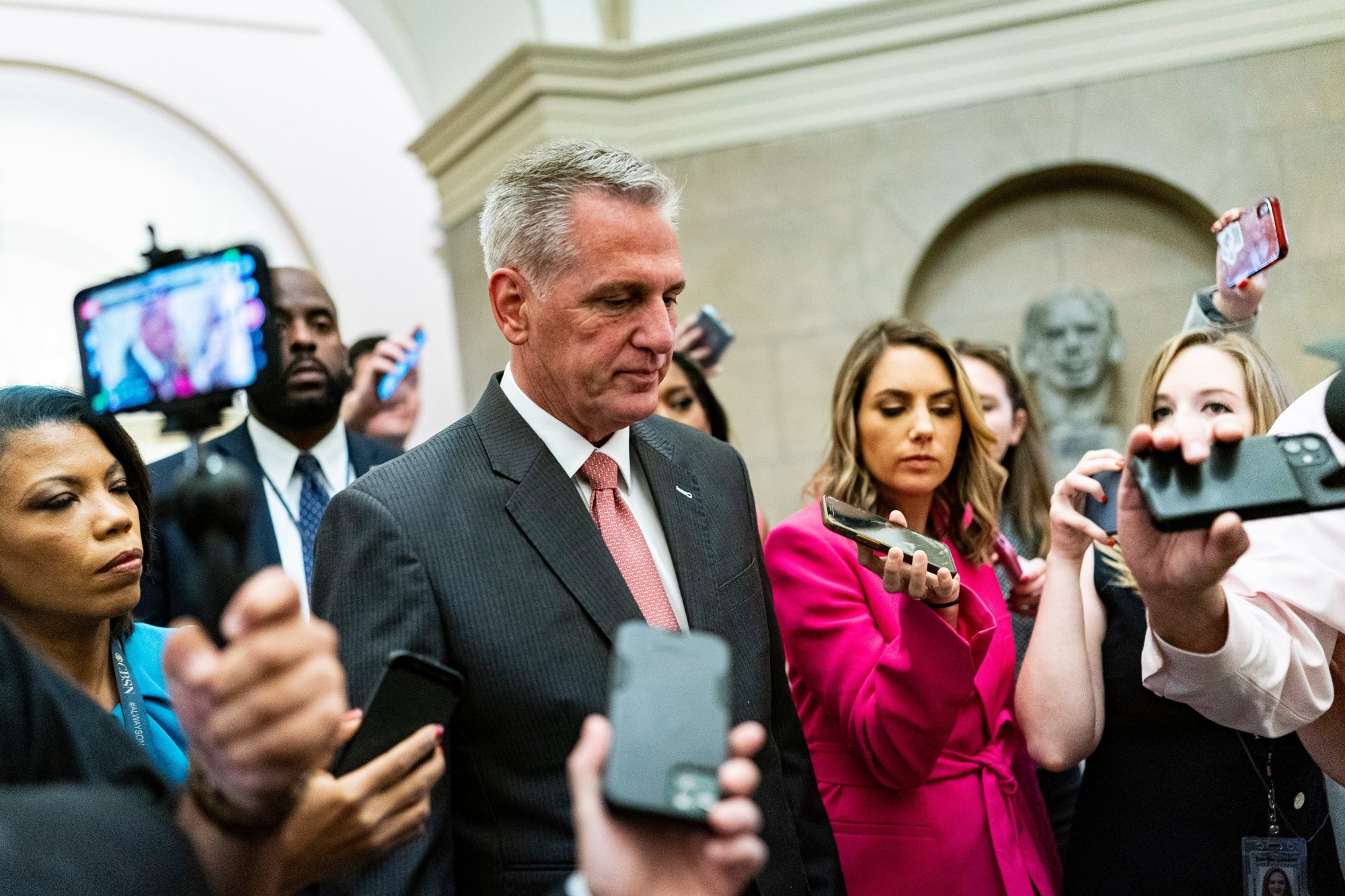
House Speaker Kevin McCarthy said that more than 95% of Republicans were “extremely excited” about the deal he and President Joe Biden reached on the evening of May 27. Photo: Bloomberg
In addition, some members of the Republican party also showed openness to the deal. Representative Dusty Johnson, one of the leading Republican negotiators on the deal, said that only the most conservatives opposed it, and those votes never really mattered.
This agreement needs 218 votes in the 435-member House of Representatives to pass, after which it will be sent to the Senate before reaching Biden's desk.
Opposition from the most conservative members of the House of Representatives was not unexpected. Therefore, the White House believes that as many as 100 Democratic votes in the House may be needed for a debt ceiling agreement to progress.
According to Biden, whether the deal will be passed by Congress remains an open question. “I don’t know if McCarthy will get enough votes. I hope he will,” the President said .
Nguyen Tuyet (Based on USA Today, NY Times, Reuters)
Source


































































![[Video] Sunset at Lap An Lagoon – Where the sun sets over the fishing nets](https://vphoto.vietnam.vn/thumb/1200x675/vietnam/resource/IMAGE/2026/05/31/1780192137701_beach-landscape-sea-water-nature-grass-745871-pxhere-com.jpeg)








































Comment (0)