Butterfly Nebula: Mysterious Beauty of the Universe Captured by Gemini
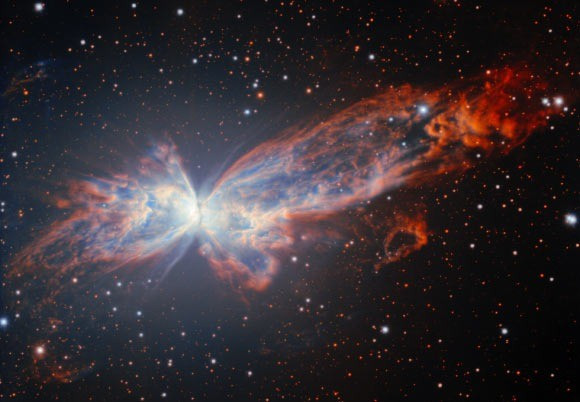
This image of the nebula NGC 6302 shows the magical butterfly shape formed by the white dwarf star and gas and dust glowing brightly in space.
Báo Khoa học và Đời sống•02/12/2025
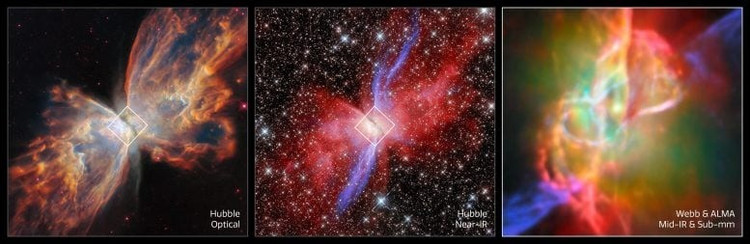
This stunning image of a “cosmic butterfly” was captured by the Gemini South telescope last month. The image shows the butterfly nebula, also known as NGC 6302, the Bug Nebula, or Caldwell 69. Image: International Gemini Observatory / NOIRLab / NSF / AURA / J. Miller & M. Rodriguez, International Gemini Observatory & NSF's NOIRLab / T.A. Rector, University of Alaska Anchorage & NSF's NOIRLab / M. Zamani, NSF's NOIRLab. According to astronomers, the image of the butterfly nebula appears graceful and majestic. NGC 6302 is a nebula located 2,417 light-years from Earth in the constellation Scorpius. Image: ESA/Webb, NASA & CSA, M. Matsuura, J. Kastner, K. Noll, ALMA (ESO/NAOJ/NRAO), N. Hirano, J. Kastner, M. Zamani (ESA/Webb).
At the center of the nebula NGC 6302 is a white dwarf that has long since shed its outer layers of gas. Image: International Gemini Observatory/AURA/M. Paredes. The nebula NGC 6302 has an extremely complex, bipolar morphology, with highly excited, high-molecular-mass gas and crystalline silicate dust. Image: International Gemini Observatory/NOIRLab/NSF/AURA/Kwon O Chul.
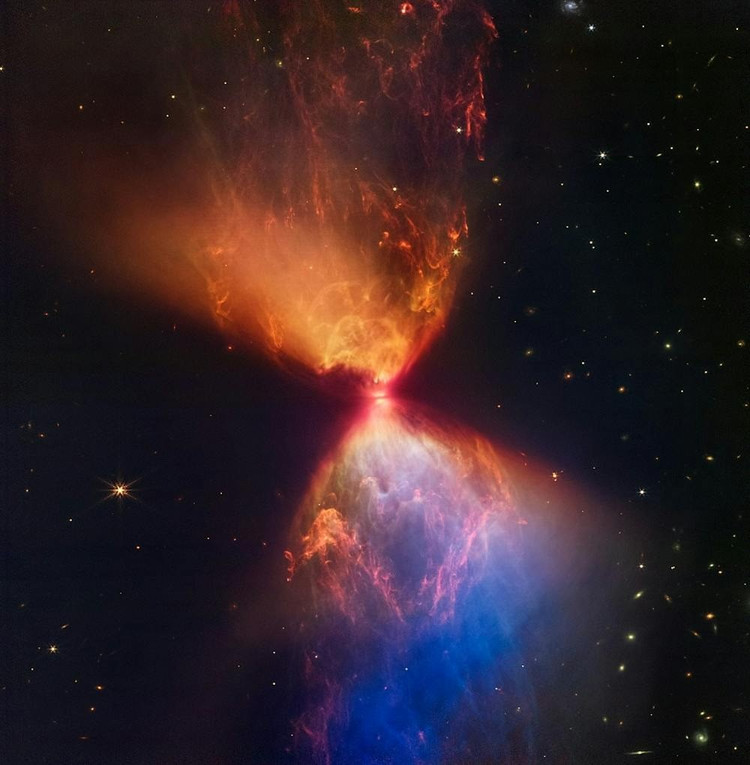
The gas forms “wings” that resemble a butterfly spreading its wings, and its heat causes the gas to glow brightly. Photo: O. Castillo/ESO. Stars are incredibly intense objects, and their births are a source of curiosity. They form from condensations in molecular clouds, where gas and dust collapse and spin under the gravity of the newly born stars. Image: NASA, ESA, CSA, and STScI. This would create a violent “whirlpool” – where surrounding material is sucked into the protostar’s accretion disk, giving the star enough material to grow. Image: NASA, ESA, CSA, and STScI, J. DePasquale (STScI), CC BY-ND.
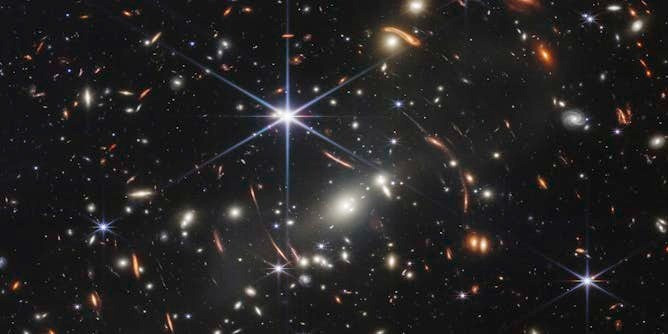
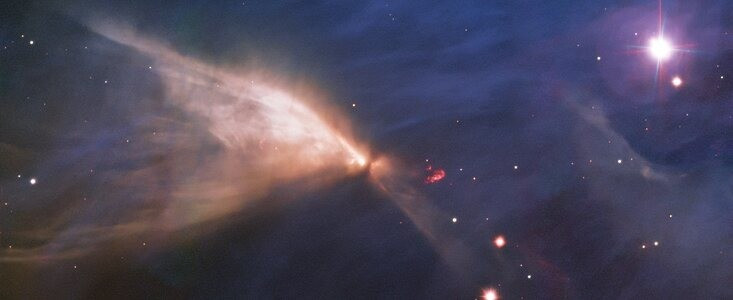
As the protostar grew, it began to generate strong stellar winds. Not only that, but the matter falling into the protostar began to interact with its own magnetic field and blast powerful plasma jets into space. That's how the "butterfly" appeared in the universe. Photo: noirlab.edu. Readers are invited to watch the video : Universe map with more than 900,000 stars, galaxies and black holes. Source: THĐT1.


 Báo Khoa học và Đời sống•02/12/2025









![[Photo] Parade to celebrate the 50th anniversary of Laos' National Day](/_next/image?url=https%3A%2F%2Fvphoto.vietnam.vn%2Fthumb%2F1200x675%2Fvietnam%2Fresource%2FIMAGE%2F2025%2F12%2F02%2F1764691918289_ndo_br_0-jpg.webp&w=3840&q=75)

![[Photo] Worshiping the Tuyet Son statue - a nearly 400-year-old treasure at Keo Pagoda](/_next/image?url=https%3A%2F%2Fvphoto.vietnam.vn%2Fthumb%2F1200x675%2Fvietnam%2Fresource%2FIMAGE%2F2025%2F12%2F02%2F1764679323086_ndo_br_tempimageomw0hi-4884-jpg.webp&w=3840&q=75)















































































Comment (0)