

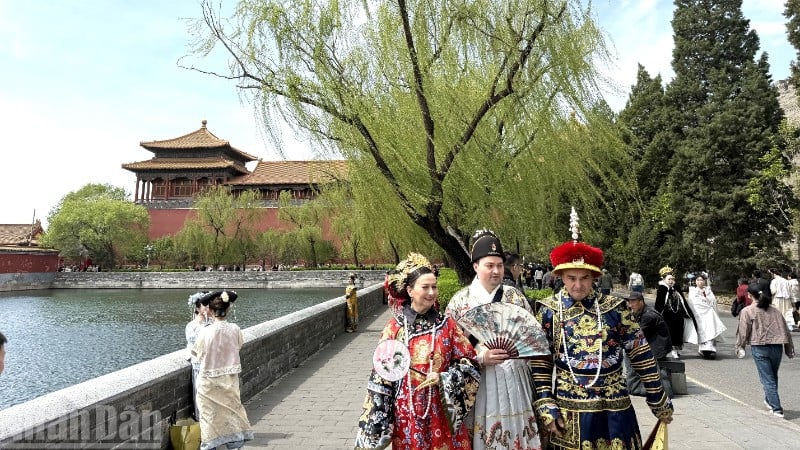
Impressive growth rate
Chinese media, citing data from the online travel platform Ctrip, reported that the number of tourists entering China in 2025 increased by more than 100% compared to the previous year. These tourists not only visited but also increased their spending: American tourists saw a 50% increase in spending year-on-year, while French tourists experienced a strong growth of up to 160%.
Looking at the national level, China's international tourism market is experiencing strong growth. In the first eight months of this year, the total number of international tourists entering the country reached 25.58 million, nearly matching the total for 2024. If this trend continues, the total number of tourists entering the country in 2025 is expected to exceed 35 million, setting a new historical record.
The main driving force behind the boom in China's international tourism market lies in the facilitation of entry and exit procedures. In the first three quarters of 2025, the number of foreigners granted visa-free entry reached 20.89 million, an increase of over 50% compared to the same period last year, accounting for 71.6% of the total number of foreigners visiting China.
Major Chinese cities are also feeling the effects of this shift. For example, Shanghai welcomed a total of 6.326 million incoming tourists, a significant increase compared to the same period in 2024, with a noticeable rise in overnight stays. As of November 25th, the number of passengers entering and exiting Shenzhen Airport exceeded 6 million, an increase of over 23.4%. Of these, nearly 60% were visa-exempt foreigners, a 133.3% increase compared to the same period last year.
In Kunming, the capital of Yunnan province, as of November 19th, the number of foreign passengers entering and exiting through Changshui International Airport exceeded 1 million, a 39.6% increase compared to the same period last year; of which more than 357,000 foreigners were granted visa-free entry, a 54% increase compared to the same period last year.
These positive signals not only boost confidence in the tourism industry but also strongly promote China's economic development. In the first three quarters of this year, Guangdong province's tourism foreign exchange earnings reached 160 billion yuan, while Guangxi and Beijing also saw significant increases. It can be roughly estimated that foreign tourist revenue in China could increase by about 50% this year, reaching approximately $150 billion. Amidst increasing trade barriers and growing export pressure, an industry capable of generating $150 billion in revenue through local restaurants, hotels, and shops is a crucial income pillar for the economy.
The relaxed visa policy, opening its doors to foreign tourists, is believed to be the main reason for the surge in international tourism to China. As of July 30th this year, China has unilateral or reciprocal visa exemption agreements with 75 countries, and the number of countries with visa-free transit has expanded to 55.
Furthermore, the implementation of a series of policies facilitating foreigners, such as exit tax refunds and electronic payments for travel expenses, has led to a sustained increase in demand and interest among foreign tourists in travel, business, sightseeing, and visiting relatives in China. Statistics from the Chinese Ministry of Commerce show that, as of the end of August 2025, there were over 10,000 exit tax refund shops nationwide.

Many solutions to "retain tourists"
Besides visa exemptions and policies that facilitate foreign tourists, several other factors contribute to China's attractiveness to international visitors. These include its long-standing and unique culture with diverse regional elements; its well-developed and convenient infrastructure, such as a nationwide high-speed rail network, clean and beautiful urban environments, and a fully digitized payment system; reasonable costs for hotels, transportation, and food; and guaranteed security and safety, with a very low rate of street crime.
To promote the development of the international tourism market, cultural and tourism agencies and tourism businesses in many localities are continuously innovating tourism products aimed at foreigners, creating more choices for tourists and meeting the diverse and personalized tourism needs of different groups of visitors.
In the ancient town of Zhujiajiao in Shanghai, foreign tourists are fascinated by the old houses, the landscaped gardens reminiscent of Jiangnan, the rowboats, and especially the clear blue canals, which serve as ideal photo spots. In particular, linking destinations to create multi-day regional tours is an innovative approach to promoting the development of high-quality tourism.
In Guangdong Province, foreign tourists can not only visit scenic spots but also experience the vibrant local life, from the rich "breakfast tea" culinary culture to the bustling night streets, feeling the long history of a thousand-year-old "commercial capital" and the modern pace of life in a large bay area with many innovations and creative advancements in science and technology.
The Guangdong Provincial Department of Culture and Tourism has recently published a travel guide for international visitors in four languages, providing information on transportation, destinations, cuisine, maps, and other important notes.
For example, Yunnan province, the tourism capital of southwestern China, is designing family tours themed around "exploring nature and ethnic culture," featuring experiences with local tea and coffee; multi-stop, inter-regional tour routes connecting with major cities like Beijing and Shanghai, creating a distinction between the developed eastern region and the remote border areas, in order to retain foreign tourists.
According to the document proposing the development of a five-year socio-economic development plan, China sets forth requirements to enhance the facilitation and internationalization of outbound tourism, clearly outlining the strategic direction for developing a high-quality outbound tourism market and building a tourism powerhouse.
With significant breakthroughs and progress in facilitating foreign tourists, over the next five years, China aims to further enhance the internationalization of its tourism industry from five perspectives: improving institutions, products, services, human resources, and promoting the image of Chinese tourism to the world.
Source: https://nhandan.vn/trung-quoc-hut-manh-khach-quoc-te-nho-chinh-sach-mien-thi-thuc-post928945.html



















![[Video] National Assembly passes the amended Civil Servant Law with 92.39% of delegates voting in favor](https://vphoto.vietnam.vn/thumb/402x226/vietnam/resource/IMAGE/2025/12/10/1765379039932_1-6690-3945-png.webp)





![[Video] The craft of making Dong Ho folk paintings has been inscribed by UNESCO on the List of Crafts in Need of Urgent Safeguarding.](https://vphoto.vietnam.vn/thumb/402x226/vietnam/resource/IMAGE/2025/12/10/1765350246533_tranh-dong-ho-734-jpg.webp)


























































Comment (0)