

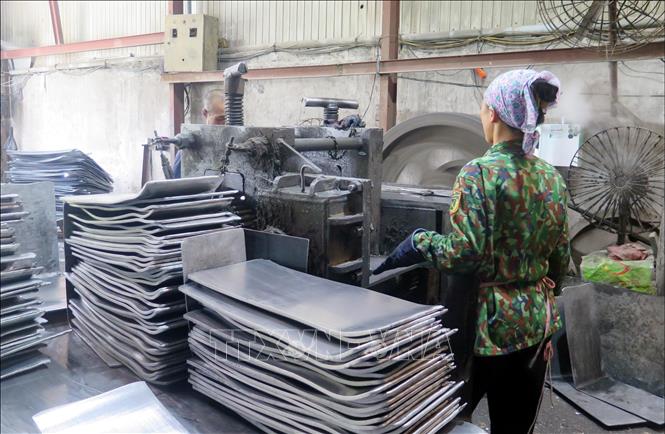
Polluted environment
Visiting Binh Yen village, Nam Ninh commune, Ninh Binh province in the autumn days of September, we witnessed firsthand the village roads and alleys piled high with bags of coal slag and wood scraps... stockpiled for the smelting of scrap aluminum; black wastewater from the chemical washing and polishing of aluminum products flowed sluggishly through drains and ditches, pouring into the canal in front of the village, emitting an unpleasant odor; along with the deafening noise of casting and stamping machines.
Binh Yen village covers more than 72 hectares and has 520 households (including hamlets 1 and 2) with 1,752 inhabitants; approximately 30% of households are involved in aluminum production and recycling, while the remainder are engaged in agriculture , service businesses, civil servants, and workers at production facilities and factories in neighboring localities. The village was recognized as a craft village specializing in aluminum recycling and mechanical production according to Decision No. 1470/QD-UBND dated October 1, 2012, of the People's Committee of Nam Dinh province (formerly). However, by 2025, according to Decision No. 775/QD-UBND dated April 16, 2025, the People's Committee of Nam Dinh province (formerly) removed Binh Yen village from the list of craft villages because its production activities fall under the category of industries not encouraged for development and pose a high risk of environmental pollution.
According to Tran Van Tien, head of Binh Yen 2 hamlet, the entire village of Binh Yen has 170 households involved in production, including 77 households casting scrap aluminum; 27 households processing aluminum products; and 66 households producing, shaping, and washing aluminum. The raw materials for production are approximately 400 tons of scrap aluminum per month, used to create household aluminum products such as pots, pans, and other cookware, and about 360 tons of aluminum ingots per month, employing around 1,000 workers. Due to the spontaneous development of the Binh Yen craft village, outdated technology, and low environmental awareness among producers, environmental pollution caused by aluminum recycling is at an alarming level.
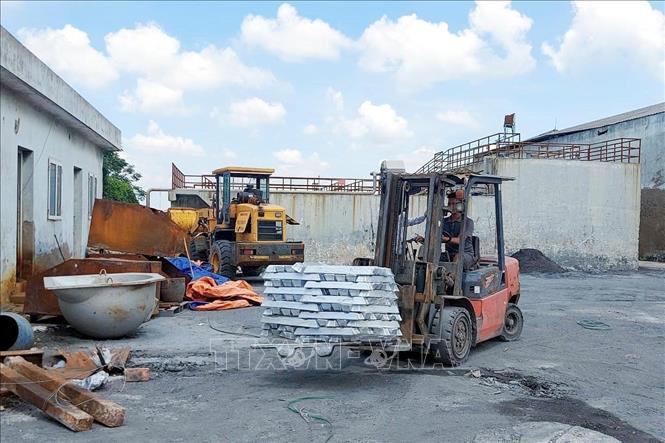
According to a report from the People's Committee of Nam Ninh commune, the village's wastewater consists of both domestic and industrial wastewater, both discharged directly into the environment. The receiving sources for this wastewater are the Truc River in front of the village, approximately 864 meters long, and the river east of the village, approximately 561 meters long. These two rivers are currently heavily polluted due to untreated wastewater from the dipping, cleaning, and washing of aluminum products containing heavy metals such as Ca, Zn, Al, acids, and caustic soda. This has resulted in a thick layer of sludge, ranging from 0.9 to 2 meters deep, on the river surface, containing hazardous waste. An indirect source of wastewater is the Ba Con River to the north of the village, approximately 400 meters long, which receives wastewater after sedimentation in a regulating pond and gradually discharges it into the Hang River to the west of the village.
In addition, while the air quality around the village generally falls within permissible limits, two additional parameters, H2SO4 and HCl, were detected in the samples. These two parameters are generated during the dipping and rinsing process using acid.
The rescue attempt was unsuccessful.
Over the years, various levels and sectors of the former Nam Dinh province have implemented numerous projects worth billions of dong to mitigate environmental pollution in the area, but none have been effective. A prime example is the project "Remediation of pollution and environmental improvement in Binh Yen mechanical craft village, Nam Thanh commune, Nam Truc district, Nam Dinh province," invested by the former Nam Dinh Provincial Department of Natural Resources and Environment with a total investment of approximately 100 billion dong; implemented from 2013 to 2018, with items such as a solid waste storage facility, a wastewater treatment system with a capacity of 500 m3/day, a sand settling tank, and a balancing tank…
In 2020-2021, the village continued to receive investment in the "Construction of environmental treatment facilities for Binh Yen craft village, Nam Thanh commune, Nam Truc district" project, with the People's Committee of Nam Truc district (formerly) as the investor, amounting to nearly 10 billion VND; including items such as a regulating reservoir, construction of a 1,000m long sewer line connecting wastewater from the regulating reservoir to the treatment area… and the "Dredging and treatment of environmental canals in Binh Yen craft village, Nam Thanh commune" project, with the People's Committee of Nam Thanh commune (formerly) as the investor.
However, to date, the wastewater collection and treatment system generated by production activities is not operational. This is because untreated wastewater from production and daily life from households is discharged directly into the Truc River system, causing blockages and preventing it from flowing into the regulating reservoir. The pumping system is also non-functional due to corrosion from caustic soda, leading to direct discharge of production wastewater, causing blockages and flooding in the village's rivers and drainage ditches. Although the exhaust gas treatment system has been tested and treated multiple times by various units, no effective model has yet been found. Untreated exhaust gases continue to pollute the air. Furthermore, the canals surrounding the village, after being dredged, continue to be clogged due to the accumulation of suspended impurities that cannot be drained away.
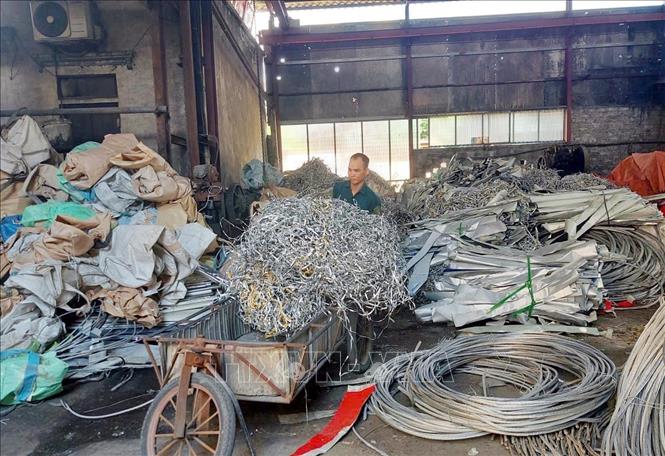
According to the Chairman of the People's Committee of Nam Ninh commune, Luu Van Dung, in order to thoroughly address environmental pollution in Binh Yen village, the commune is considering two fundamental solutions: changing occupations for households and relocating polluting facilities to the Nam Thanh 1 Industrial Cluster (near Binh Yen village, where the investment process is currently underway).
However, both of the above solutions are difficult to implement. Regarding the solution of relocating residents to other occupations, the local authorities currently don't know what suitable occupations to encourage them to switch to; moreover, implementing such a transition requires significant resources to carry out the support policies as stipulated. As for the solution of relocating households currently engaged in production out of residential areas and concentrating them in industrial clusters, the Nam Thanh 1 Industrial Cluster is currently only in the investment process.
When households move into industrial clusters, they must fulfill financial obligations regarding land; according to regulations, the minimum production area in an industrial cluster is 5,000 m2. With current land prices at around 3 million VND/m2, the cost of acquiring land is very high, not to mention the construction of factories and other contributions, therefore relocating production households to industrial clusters is also difficult to implement.
Currently, to minimize environmental pollution, Nam Ninh commune continues to promote and encourage production facilities and households in the craft village to implement environmental protection measures in accordance with the law; to reduce smoke, dust, heat radiation, wastewater, and to treat environmental pollution on-site; to collect, sort, and process solid waste according to regulations; to require households producing metal shapes not to use chemical surface cleaning technology but mainly to use mechanical cleaning methods; and to require households casting to invest in and apply exhaust gas treatment technology that meets permitted standards. At the same time, the commune government is focusing resources on dredging and treating sludge in rivers and canals around and within the village; and maintaining the stable operation of the Binh Yen Village Environmental Cooperative.
Source: https://baotintuc.vn/cong-dong/bat-ono-thon-binh-yen-20250918122004179.htm
![[Photo] General Secretary and President To Lam presides over a meeting with the Central Organizing Committee.](https://vphoto.vietnam.vn/thumb/1200x675/vietnam/resource/IMAGE/2026/06/03/1780482764658_a1-bnd-4741-3342-jpg.webp)
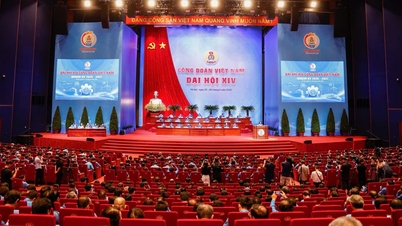
![[Photo] First session of the 14th Congress of the Vietnam Trade Union](https://vphoto.vietnam.vn/thumb/1200x675/vietnam/resource/IMAGE/2026/06/03/1780465947883_ndo_br_img-3852-jpg.webp)
![[Photo] Secretary of the National Assembly Party Committee, Chairman of the National Assembly presides over the meeting of the Standing Committee and Executive Committee of the National Assembly Party Committee.](https://vphoto.vietnam.vn/thumb/1200x675/vietnam/resource/IMAGE/2026/06/03/1780480353201_ndo_br_bnd-2585-jpg.webp)
















































![[Video] Sunset at Lap An Lagoon – Where the sun sets over the fishing nets](https://vphoto.vietnam.vn/thumb/1200x675/vietnam/resource/IMAGE/2026/05/31/1780192137701_beach-landscape-sea-water-nature-grass-745871-pxhere-com.jpeg)


































Comment (0)