

Among the hundreds of artifacts and relics discovered in Binh Thuan from various dynasties in the history of the Champa kingdom, which possess unique cultural, artistic, and sculptural values, the Avalokitesvara Buddha statue discovered in Hoa Thang commune 22 years ago is considered by researchers as a treasure of Champa culture.
From the accidental discovery of ancient statues
In early September 2001, I received a phone call from Border Guard Post 436 informing me that a resident of Hong Chinh village, Hoa Thang commune, Bac Binh district, had discovered a Buddha statue with an unusual shape and handed it over to Border Guard Post 436.
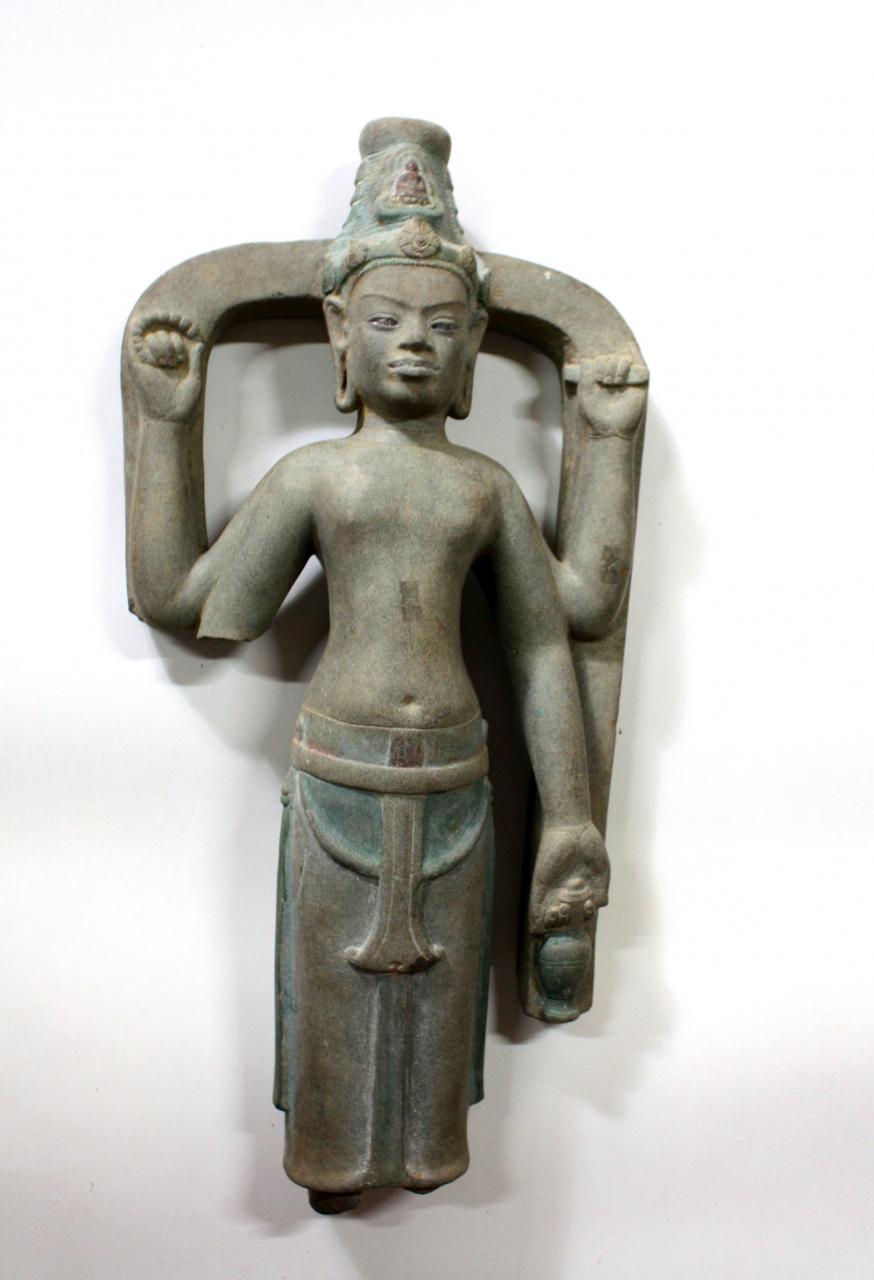
When we arrived at Border Guard Post 436 to receive the stone statue, many local people came along, including Mr. Mai Van Chien, who told us that his father had found this stone statue while working in the fields before the August 1945 Revolution. When they brought it home, everyone was frightened by the statue's shape, face, and the fact that it had four arms.
Due to his knowledge of folk medicine and healing, and because some people advised him to use the statue as a sorcerer to heal and save people, his father died a few years later in an attack by French aircraft. Seeing that the people needed healing, especially the statue when performing rituals, his uncle, Bay Tho, continued to use the statue as a sorcerer. After Bay Tho's death, partly out of fear and partly because no one wanted to continue the sorcery, the family secretly buried the statue deep in the ground.
It seemed as though the statue would rest in peace forever. Unexpectedly, the historic flood of 1996 in Hoa Thang commune, followed by continuous heavy rains, caused the statue to surface. Many people witnessed this and spread rumors and fabricated ghost stories, causing great fear among the villagers. They thought that the heavy stone statue, secretly buried deep, couldn't possibly have surfaced, especially with its head first, its face covered in mud and its eyes filled with resentment. Many believed that the deity wanted to be in a proper temple and couldn't remain buried deep underground forever. People prayed and secretly reburied it.
Several years later, quite by chance, Mr. Ngo Hieu Hoc from Hoa Phu commune bought land and built a house in Hong Chinh village, Hoa Thang commune, the area where the villagers had secretly buried the statue years earlier. Then, also by chance, while digging a hole to build a gate and fence, Mr. Hoc discovered a stone statue at a depth of 40cm. Many people in the village knew about this, and Mr. Hoc himself was knowledgeable about cultural heritage laws. Therefore, Mr. Hoc handed the statue over to the Hoa Thang Commune People's Committee, which then forwarded it to Border Guard Post 436 under the Binh Thuan Provincial Border Guard Command .
The truth about the statue
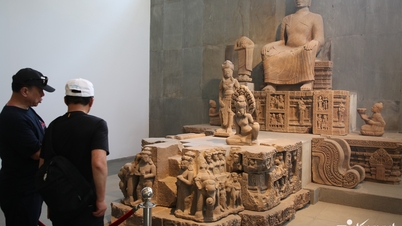
Studies on the religion and beliefs of the Champa kingdom throughout history show that Buddhism was introduced very early, around the first centuries AD, to about the 10th century. Among the most prominent architectural legacies is the Dong Duong Buddhist monastery in Thang Binh district, Quang Nam province, which was the most important Buddhist architectural center of the Champa kingdom and the largest in Southeast Asia in the 9th century.
During this same period, the Panduranga region in the south of the Champa kingdom (present-day Ninh Thuan and Binh Thuan provinces) also followed Buddhism. Many Buddha statues have been found, such as: the "Usnisa" Buddha statue in Phan Thiet dating from the 7th-9th centuries; the floating Buddha statue at Kim Binh Pagoda, Ham Thang commune; and the collection of bronze Buddha statues discovered in Ham Nhon commune in 1973, dating from the 9th-10th centuries.
The statue rediscovered in Hong Chinh village, Hoa Thang commune in 2001 is actually a statue of Avalokitesvara – the Bodhisattva Avalokiteshvara, embodying the compassion of all Buddhas. Avalokiteshvara is one of the most widely revered Bodhisattvas in Mahayana Buddhism during this period. Dating back to the 9th century, this is a unique, original artifact to date.
Upon receiving the statue, we noticed that its body was painted in various shades of blue, white, and light yellow. Upon inquiry, we learned that the original finder had painted it this way for use as a shaman's statue. However, further research revealed that the paint was much older, several centuries old, and similar in color and technique to the statues of kings and Kuts found in Champa temples many centuries ago.
The statue of Avalokitesvara stands on a pedestal with an arched back. From a single slab of sandstone, every line and carving technique reaches the pinnacle of sculptural art, with perfect anatomical symmetry. The head of the statue features a high bun, topped with a multi-tiered pyramidal crown. The front is carved with a clearly visible seated Buddha image – the ancient Amitabha Buddha meditating, as the saying goes: " In the West there is Amitabha Buddha, seated in the jeweled crown of Avalokiteshvara Bodhisattva ." The gentle face perfectly complements the slender, graceful body and bare chest. The statue has four arms: the upper right hand holds a rosary, the upper left hand holds a book. The two lower arms extend forward; the left hand holds a vase of nectar, the left hand is missing (if present, it usually holds a lotus bud). The two ears are large and extend down to the neck. Ancient artisans meticulously carved many detailed decorative elements to depict the miraculous energy of the Buddha.
Compared to other ancient Cham statues from the Binh Dinh, Phu Yen, Khanh Hoa, Ninh Thuan, and even Binh Thuan regions, this statue has a very unique and original appearance. It is known that the Department of Culture, Sports and Tourism is currently collaborating with researchers to build a scientific dossier, as this is a previously unknown masterpiece and a candidate for the upcoming review process for the Government to recognize it as the first national treasure of Binh Thuan.
Source
![[Photo] Capturing the moment the tide recedes at Yen Binh Son rapids - a million-year-old scenic spot in Quang Ngai.](https://vphoto.vietnam.vn/thumb/1200x675/vietnam/resource/IMAGE/2026/05/19/1779175463885_yen9-1199-jpg.webp)
![[Photo] National Assembly Chairman Tran Thanh Man attends the groundbreaking ceremony for the National Highway 1A spatial axis project.](https://vphoto.vietnam.vn/thumb/1200x675/vietnam/resource/IMAGE/2026/05/19/1779161360398_ndo_br_bnd-1412-jpg.webp)








































![[Photo] General Secretary and President To Lam receives Indian Defense Minister Rajnath Singh](https://vphoto.vietnam.vn/thumb/402x226/vietnam/resource/IMAGE/2026/05/19/1779184046302_anh-man-hinh-2026-05-19-luc-16-46-58.png)



















Comment (0)