

According to the report "Industrial Real Estate Focus 2025: A Shift Towards Growth," recently published by Savills Vietnam, in the first 10 months of 2025, foreign direct investment (FDI) in the manufacturing sector was approximately US$18.22 billion; accounting for nearly 60% of total FDI into Vietnam (US$31.52 billion).
Bac Ninh is currently the largest recipient of newly registered FDI in the country for manufacturing, accounting for approximately 13.8% of the total capital. Following closely behind are Hai Phong, Dong Nai, and Hung Yen, with percentages of 10.5%, 9.8%, and 7% respectively.
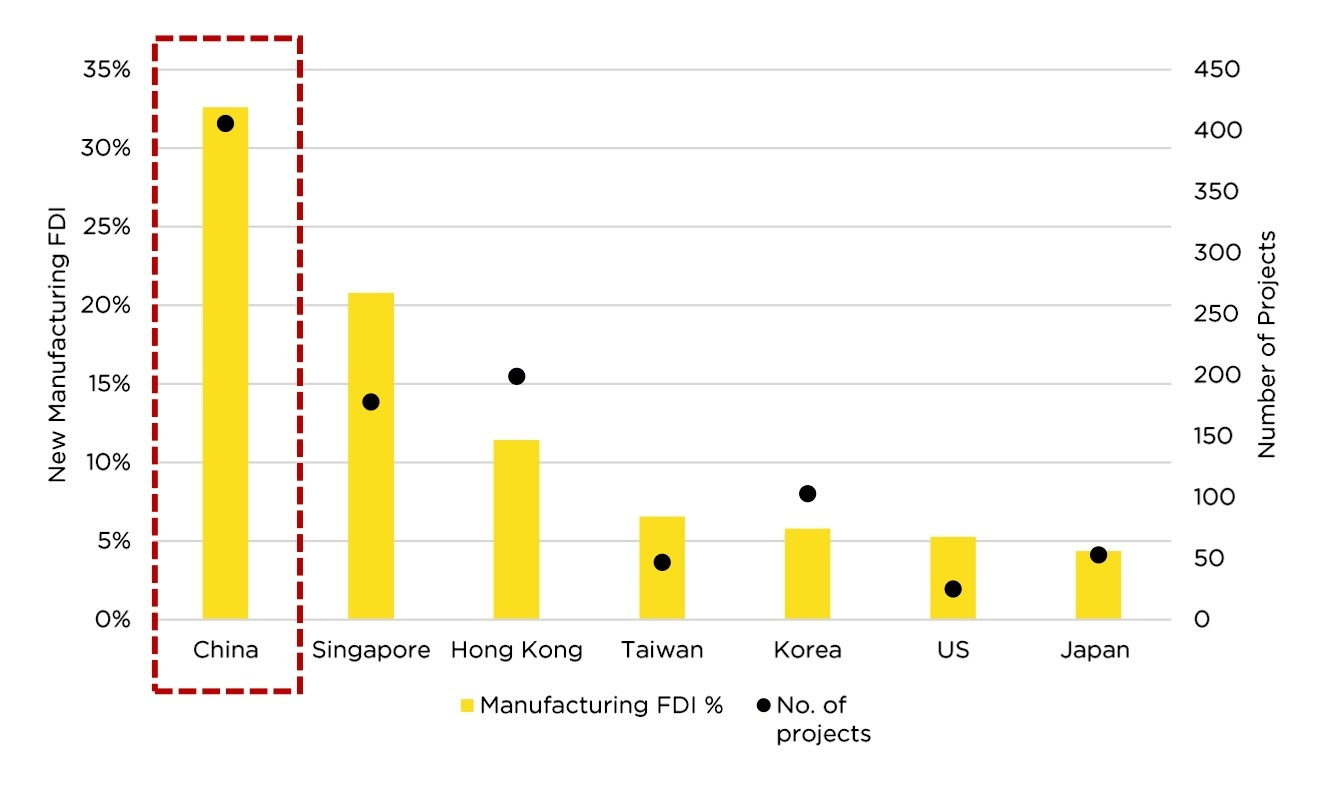
From the investor perspective, in the first 10 months of 2025, China led with investments in 406 new manufacturing projects (accounting for 33% of the total projects), totaling US$2.6 billion. This was followed by Singapore with 178 projects (21%), totaling US$1.7 billion. Hong Kong (China) ranked third with 199 projects, accounting for 19%.
If we categorize FDI capital in manufacturing by sector, the electronics sector is leading with $1.5 billion from 148 projects; metal fabrication follows with $1.2 billion from 181 projects; electrical equipment has $730 million from 87 projects; rubber and plastics has 179 projects with $663 million…
According to John Michael Campbell, Director of Industrial Real Estate Services at Savills Vietnam, the manufacturing and processing sector alone accounts for nearly 60% of total newly registered capital, reflecting a shift towards high-value industries such as electronics, technology equipment, and semiconductors. This is a crucial factor in maintaining Vietnam's attractiveness amidst global uncertainties.
According to the organization's representative, infrastructure continues to be a differentiating factor. The expansion of the Cai Mep - Thi Vai port complex and inter-regional road networks helps shorten transportation times and opens up possibilities for accommodating industries with high logistics requirements.
He assessed that Vietnam is witnessing a shift in several strategic sectors, including intensive electronics manufacturing, industrial equipment, and data centers, towards expanding their scale of operations.
The shift in industries in Vietnam is also more clearly seen through analysis from HSBC.
Accordingly, in 2013, 60% of Vietnam's exports to the US belonged to light manufacturing industries, such as textiles, footwear, and toys. At that time, electronic products accounted for only about 13%.
However, the trend has changed quite rapidly, and electronics exports have recorded exponential growth. The share of electronics, which was only about 1/7 of the light manufacturing group in 2013, has increased to almost the same level by 2024.
Since the beginning of 2025, electronics have surpassed light manufacturing to become the leading export item to the US market.
HSBC experts believe this shift aligns with Vietnam's progress in enhancing its position within the technology value chain. Since escalating US-China trade tensions, Vietnam has strengthened its position in the final assembly of electronics, specializing in complete consumer electronics products.
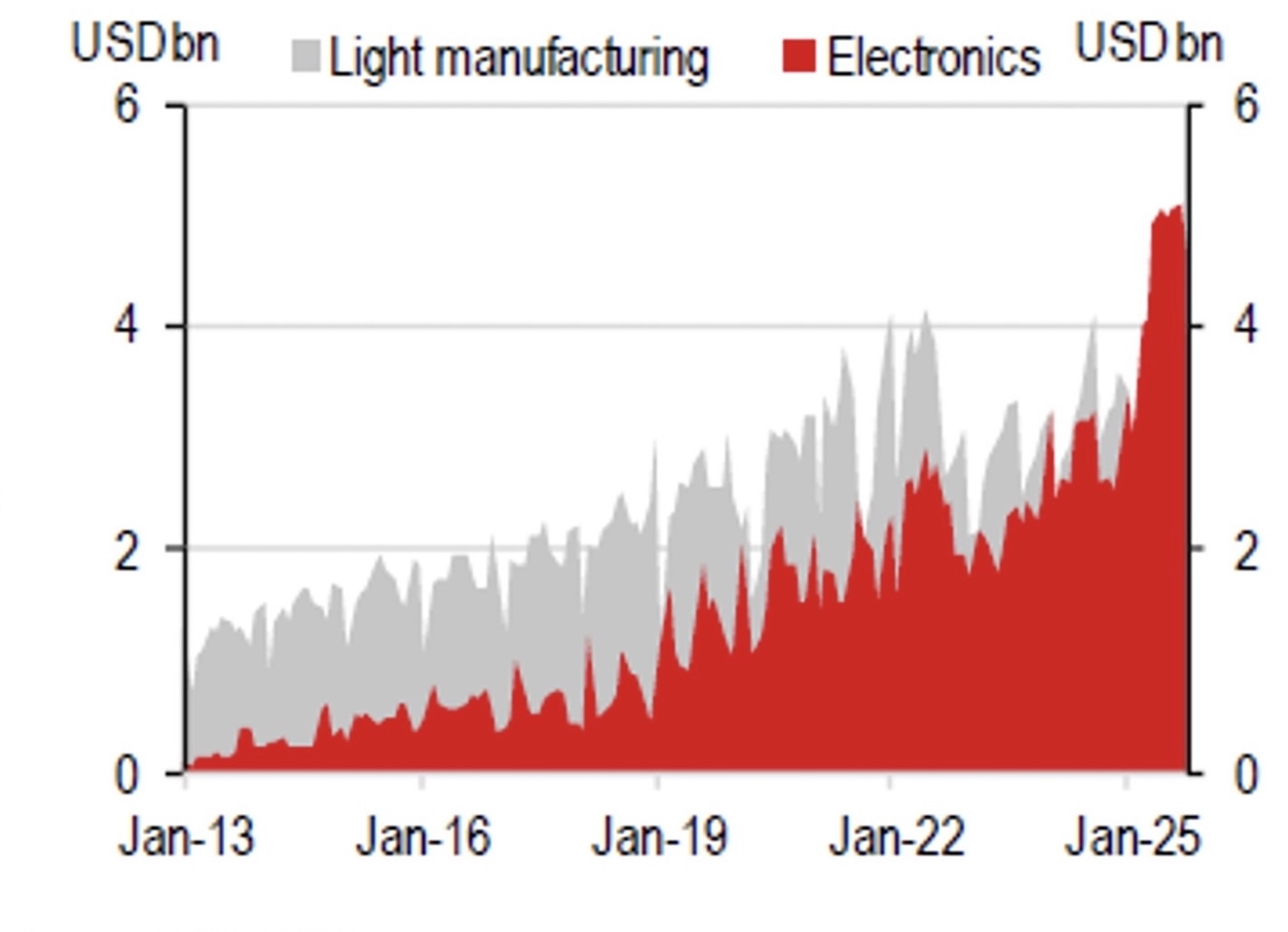
Changes in the structure of exports of electronics and light industrial goods to the US, 2013-2025. Source: CEIC, HSBC
Thanks to Samsung's consistent early investment, since 2007, Vietnam has transformed into a major manufacturing hub, accounting for approximately half of the group's smartphone production.
Although it has not yet surpassed China, Vietnam's export market share in mobile phone-related industries has increased dramatically in less than 15 years, from almost zero.
Besides consumer electronics, Vietnam's role is also becoming increasingly important in the production of integrated circuits (ICs), a segment with higher added value than simply assembling electronics. This is thanks to investment from Intel, one of the world's leading chip manufacturers.
Furthermore, although down from the peak of the same period last year, FDI inflows into the manufacturing sector are currently approximately at pre-Covid-19 average levels. In particular, inflows from mainland China and the US have increased significantly, according to HSBC.
John Michael Campbell believes that 2026 will be a pivotal year for Vietnam's industrial market, with improved manufacturing prospects, a stable investment environment, and a more robust connectivity system, from seaports and energy to digital infrastructure.
According to him, the manufacturing transformation process marks a shift from cost-based growth to system-based growth, in which infrastructure, energy, and operational data will operate synchronously to serve manufacturing industries, reaching increasingly higher standards.
According to Savills Vietnam, over the past four decades, total foreign direct investment in Vietnam has reached more than $526 billion. Following the enactment of the Law on Foreign Investment in Vietnam in December 1987, the economy has strongly attracted FDI inflows. It is estimated that from 1988 to October 2025, total FDI into Vietnam reached over US$526 billion. South Korea is currently the largest investor with a total of 10,329 active projects, totaling US$94 billion in FDI (accounting for 17.8% of total FDI into Vietnam). Following South Korea are investors from Singapore, Japan, and Taiwan (China). |
Source: https://vietnamnet.vn/buoc-dich-chuyen-moi-dien-tu-vuot-det-may-giay-dep-trong-xuat-khau-sang-my-2472102.html
![[Photo] Prime Minister Pham Minh Chinh attends the Conference summarizing and implementing tasks of the judicial sector.](/_next/image?url=https%3A%2F%2Fvphoto.vietnam.vn%2Fthumb%2F1200x675%2Fvietnam%2Fresource%2FIMAGE%2F2025%2F12%2F13%2F1765616082148_dsc-5565-jpg.webp&w=3840&q=75)






















































































Comment (0)