

While changing the water in the eel tanks, Duy confided, "The locals around here affectionately call me 'the eel engineer.' I started my business with shrimp and shrimp-rice farming models. But realizing that these two models weren't as profitable as before, I switched to eel farming, planning to guide others if successful."
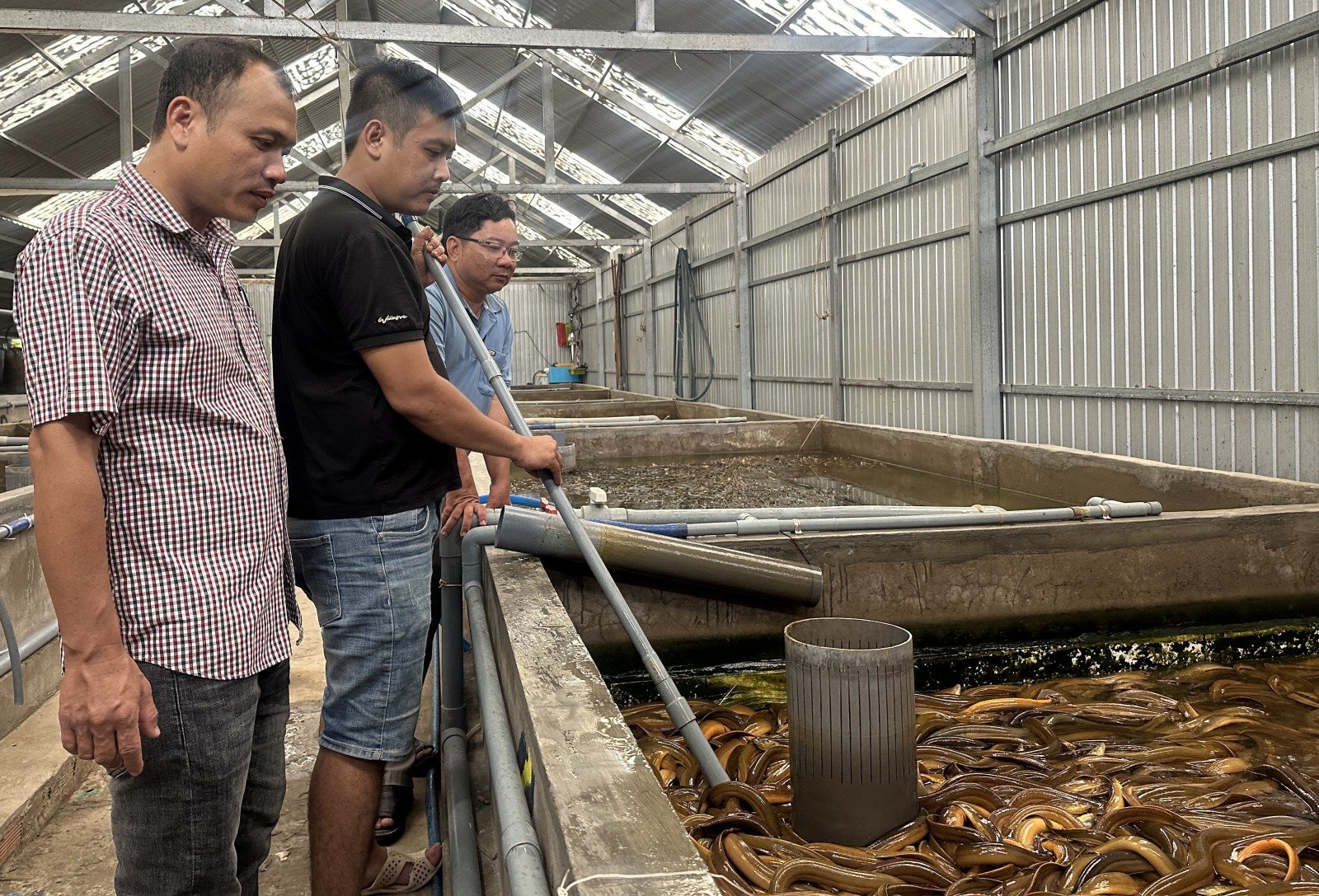
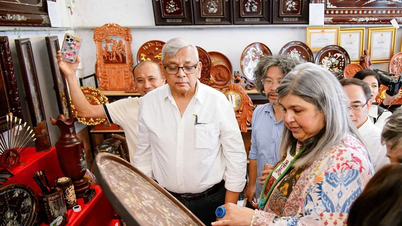
The Board of Directors of Dai Truong Phat Cooperative visited the eel farming facility of Mr. Tran Duc Duy's family. Photo: TUONG VI
In 2019, Mr. Duy had only one eel pond, but now he has nearly 20, demonstrating the economic effectiveness of the model. He has equipped his ponds with many modern, standard-compliant machines. Each pond is about 8m² , with a density of 500-700 eels per pond. However, to achieve this success, Mr. Duy had to overcome many difficulties. In the first batches of eels, the water source was unsuitable; eels live in freshwater, but Vinh Thuan commune has saltwater, so the eels did not develop well, resulting in significant losses and not achieving the desired results. Mr. Duy overcame this by using a drilled well to supply water to the ponds; and he traveled to successful eel farming facilities to learn from their experience. Thanks to their determination and hard work, Duy and his family harvest more than 25 tons of eels per year, with prices ranging from 85,000 to 90,000 VND/kg, earning a profit of 300 to 400 million VND.
On the other hand, finding eel fry is quite difficult, so Duy researched and bred eel larvae (newly hatched eels) to increase his income. After successfully breeding them, he can both sell the larvae and raise them into commercial eels. The process of breeding eel larvae has many stages, taking 30-40 days. When the number reaches 1,000 eels per kilogram, they can be released into ponds for rearing or sold as larvae. Duy said: “To effectively breed eel larvae, it is necessary to prepare a substrate for the eels to hide in. I usually use rope or a fine mesh net because it is breathable. When the eels are young, the food must be carefully selected, mainly tubifex worms or eel meal because they have a high nutritional content and are easy to find.”

Mr. Duy takes care of and monitors the growth of the eel fry. Photo: TUONG VI
Currently, Duy is the only person in Ranh Hat hamlet breeding eel fry. His eel farm has also become a supplier of eel fry to local people.
Recognizing the increasing number of households raising eels, although the scale and fragmentation of their operations remained significant, in April 2025, the Ranh Hat hamlet leadership established the Dai Truong Phat Cooperative to unite and support these households. Mr. Duy is one of the key members of the cooperative. Mr. Le Trung Kien, Head of Ranh Hat hamlet and Director of the Dai Truong Phat Cooperative, stated: “Duc Duy is a core member of the cooperative. He has the most experience in commercial eel farming and is responsible for supplying fingerlings, guiding the construction of breeding ponds, and providing eel farming techniques to the members. He is very diligent and hardworking. Whenever an eel farmer faces difficulties, he will go to their location to provide free support. Each harvest yields an average of over 30,000 eels per member, and after deducting expenses and losses, the income is approximately 20 million VND. The success of Duy's commercial eel farming model has created a new direction for local economic development, alongside the strengths of shrimp and rice farming.”
TUONG VI
Source: https://baoangiang.com.vn/chuyen-ve-ky-su-luon--a461602.html

![[Photo] General Secretary and President To Lam presides over a meeting on preparations for the review of one year of operation of the three-tiered government system.](https://vphoto.vietnam.vn/thumb/1200x675/vietnam/resource/IMAGE/2026/06/02/1780391821195_a1-bnd-4595-9717-jpg.webp)

























































Comment (0)