

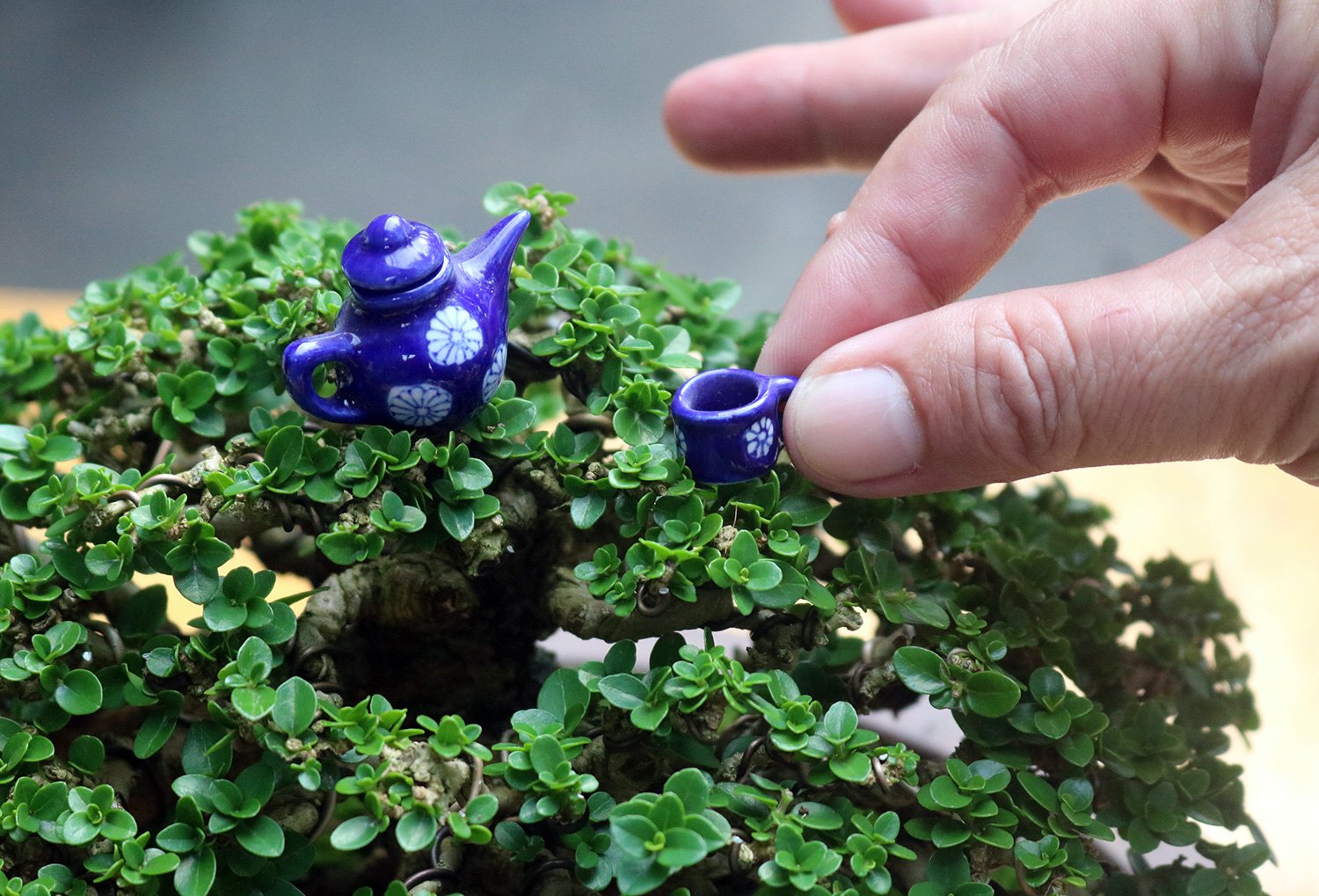
The art of "arranging" miniature items. Photo: GIA KHÁNH
Anyone familiar with the art of bonsai will understand that "the hobby requires a lot of effort." Not satisfied with that, artisans like to "increase the difficulty" by reducing the size of the tree. Thus, mini and super-mini bonsai were born. "Normal or large bonsai trees have the advantage of being easy to care for and shape, but are difficult to transport. Conversely, mini trees are very easy to transport, but extremely difficult to care for. Imagine them as bonsai trees in the shape of ancient trees, but as fragile as newborn babies. Just one day without care and they will wither," Mr. Nguyen Dang (49 years old), residing in Long Xuyen ward, began his story.
Miniature bonsai trees are skillfully propagated by cuttings from regular bonsai. But strangely, when planted in tiny pots, the trees also shrink, with minuscule leaves, yet still maintain perfect proportions: large roots, mature grain, and abundant moss growth… Mr. Dang explains that the trees never grow larger because they are nurtured in miniature pots, where the nutrients "control" their growth. In return, while a large tree takes 8-10 years to reach its full form, a miniature tree only needs 2-3 years. Trees measuring 10-30cm are classified as miniature. Those smaller than this are considered super-miniature.
Experienced growers believe that achieving a 30-50% survival rate for miniature bonsai trees is already a success. There's no single answer or formula; each grower needs to carefully study the characteristics of their plant and find ways to maintain the highest possible humidity. Only after successfully growing and nurturing them do they think about showing them off at professional gatherings and engaging in exchanges. Mr. Dang shared: "Mainly, we meet to satisfy our passion and socialize; the economic aspect is secondary. At these offline events, everyone brings out their VIP, high-quality bonsai trees. If something catches their eye, they negotiate a price, sometimes just enough for coffee. But there are also trees that change hands for millions or tens of millions of dong."
Among those who cultivate ornamental plants, Mr. Nguyen Cong Tram (53 years old), residing in Binh Duc ward, is a veteran, having been involved with his garden for over a decade. His profession of growing and selling ornamental plants helps him maintain his passion for caring for and shaping plants in general, and bonsai in particular. Last year, he saw a large-leaved, long-branched dwarf flowering tree, over 10 years old. What prompted him to buy the tiny bonsai pot for 2 million VND was the tree's unusual mutation. “We evaluate trees based on the criteria of ‘ancient, unique, and beautiful.’ ‘Ancient’ refers to the age of the tree, ‘unique’ refers to its unusual and distinctive features, such as the gnarled parts of this apricot tree. The base and each branch are gnarled and bumpy, giving it a very unusual appearance; only one in a thousand trees is like this. ‘Beautiful’ refers to the overall shape of the tree, which is visually appealing and captivating. In my opinion, the tree is not yet perfect; it needs another three years of care, at which point it could fetch at least 20 million dong,” Mr. Tram explained.
It's impossible to simply cultivate miniature bonsai trees because they need pots. The value of a tree increases significantly when planted in a beautiful pot. Therefore, most bonsai enthusiasts are knowledgeable about and interested in collecting pots, especially ceramic ones. As Mr. Dang says, they pursue the art of "positioning and arranging." Whether a tree has soul or not, and how poetic the resulting masterpiece is, largely depends on how each person arranges and positions it. A solitary bonsai tree has its own unique beauty, but if photographed with a small, charming teacup, it creates a different, harmonious beauty. In this way, bonsai enthusiasts are always creative, feeling that the flow of art never ends.
That's also why Mr. Dang has dozens of miniature ceramic collections. Every time he goes somewhere, or attends a hobby group meetup, he always "looks around," searching for items that fit in the palm of his hand. After decades of collecting, he has amassed ceramic tea sets from Vietnam, Thailand, Japan, England, and more. They are only the size of a fingertip, but extremely exquisite, sharp, and distinctly representative of each country. Of course, their prices are anything but "mini," amounting to millions of Vietnamese dong. Even with money, you might not be able to buy them because they are no longer mass-produced, becoming unique, one-of-a-kind pieces.
In the noisy atmosphere of the weekend café, I feared that the tiny art pieces would be overshadowed. But no, they remained proudly present, admired from every angle. Everyone passing by the offline area stopped to chat, ask questions, and take photos. For Mr. Dang, Mr. Tram, and the other participants in this hobby, that alone was enough to make them happy. Art was breathed into a miniature world , then spread into the wider world, adding a touch of poetry to life.
Source: https://baoangiang.com.vn/dam-me-trong-long-ban-tay-a461750.html
![[Photo] General Secretary and President To Lam presides over a meeting with the Central Organizing Committee.](https://vphoto.vietnam.vn/thumb/1200x675/vietnam/resource/IMAGE/2026/06/03/1780482764658_a1-bnd-4741-3342-jpg.webp)
![[Photo] Secretary of the National Assembly Party Committee, Chairman of the National Assembly presides over the meeting of the Standing Committee and Executive Committee of the National Assembly Party Committee.](https://vphoto.vietnam.vn/thumb/1200x675/vietnam/resource/IMAGE/2026/06/03/1780480353201_ndo_br_bnd-2585-jpg.webp)
![[Photo] First session of the 14th Congress of the Vietnam Trade Union](https://vphoto.vietnam.vn/thumb/1200x675/vietnam/resource/IMAGE/2026/06/03/1780465947883_ndo_br_img-3852-jpg.webp)









![[Infographic] Over 1.2 million candidates registered for the 2026 High School Graduation Exam](https://vphoto.vietnam.vn/thumb/402x226/vietnam/resource/IMAGE/2026/06/03/1780496872518_w_20260603205412.jpeg)











































![[Video] Sunset at Lap An Lagoon – Where the sun sets over the fishing nets](https://vphoto.vietnam.vn/thumb/1200x675/vietnam/resource/IMAGE/2026/05/31/1780192137701_beach-landscape-sea-water-nature-grass-745871-pxhere-com.jpeg)






























Comment (0)