

Formed by the merger of the former Lang Thíp and Lâm Giang communes, the current Lâm Giang commune (Lao Cai province) boasts a vast natural area of over 178 km2. Identifying forest-based economy as its main focus, Lâm Giang has been orienting its sustainable forest-based economic development, not only helping people escape poverty but also opening up opportunities for them to become wealthy right in their homeland.
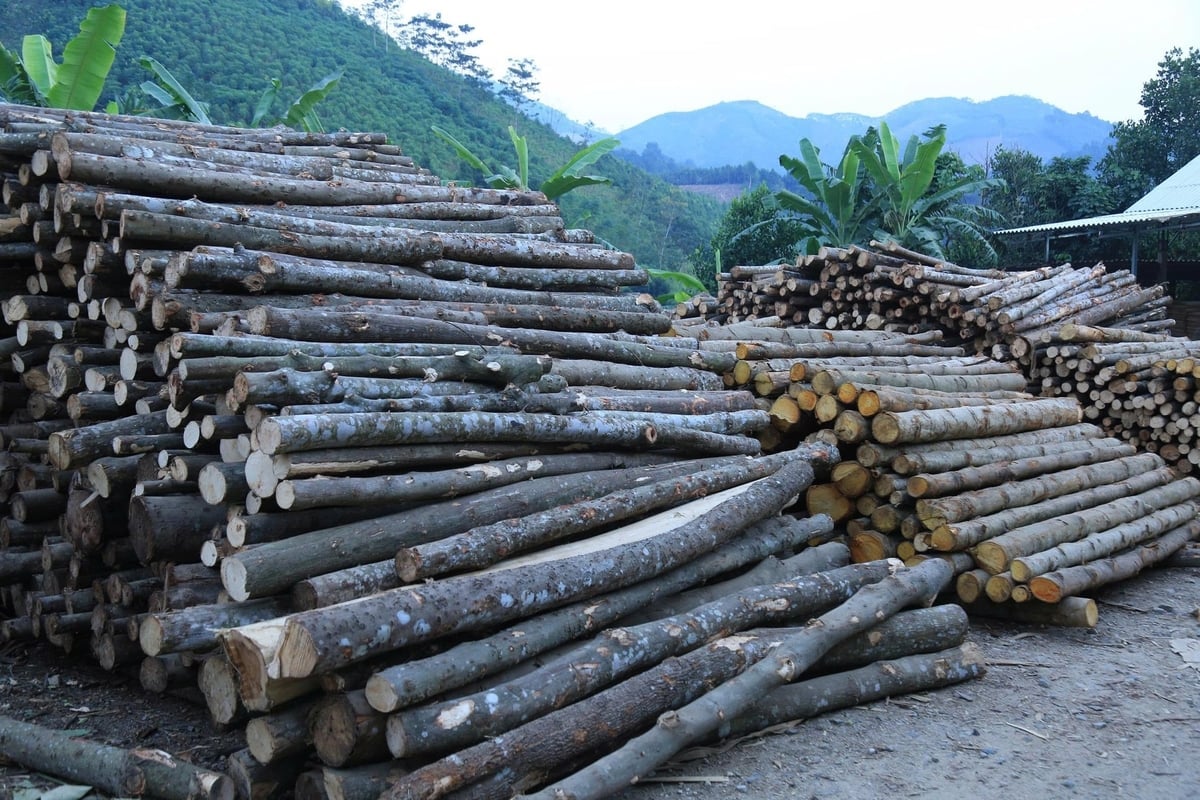
Lam Giang commune is leveraging its strengths in hill and forest-based economy to increase income for its residents. Photo: Thanh Tien.
Billionaire Under the Forest
In Hop Lam village, Lam Giang commune, everyone knows about Ms. Do Thi Hien, a billionaire who rose to prominence from the forest economy. Meeting Ms. Hien, a resident who has been connected to this land for over 20 years, we truly appreciated the miraculous changes that the forest has brought.
Ms. Hien currently owns about 10 hectares of forest. Previously, her family planted bodhi trees, but realizing that cinnamon trees yielded higher economic value, she boldly converted the entire area.
According to Ms. Hien's calculations, one hectare of cinnamon trees, planted for about 10-15 years, can yield 500-700 million VND if sold whole. This doesn't include the income from annual thinning. Last season, her family earned over 200 million VND from peeling the cinnamon bark alone, and they expect this figure to reach 300 million VND next season. From a struggling household, thanks to their commitment to the forest, Ms. Hien's family now has a comfortable home and has become a role model for successful economic development in the village.
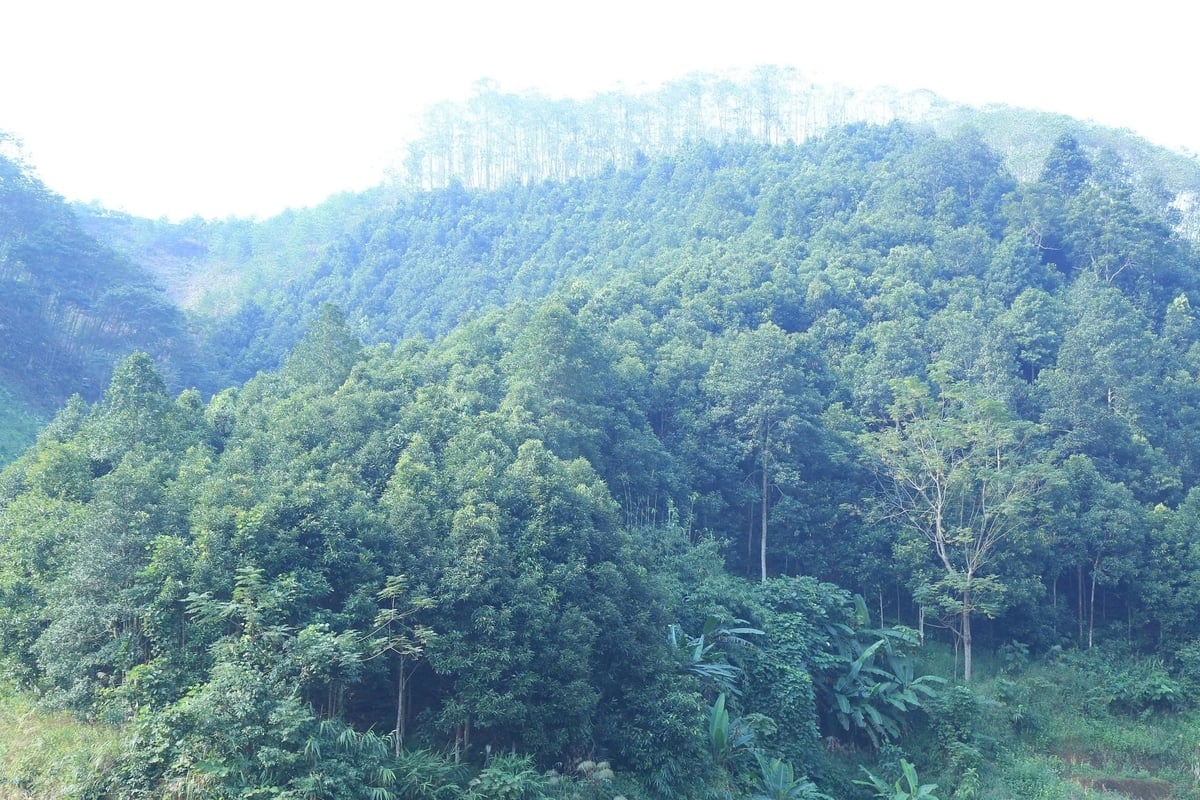
With assets including dozens of hectares of cinnamon trees, Ms. Hien's family is known by the villagers as the "forest billionaires." Photo: Thanh Tien.
Unlike Ms. Hien, who owns a large plot of land, Ms. Thieu Thi Thuy's family in Nghia Giang village has nearly 2 hectares of hilly forest land.
Ms. Thuy said that for Bodhi trees or other types of timber, the harvesting cycle is 5-7 years. Each hectare, when sold as timber, brings in an income of 70-100 million VND.
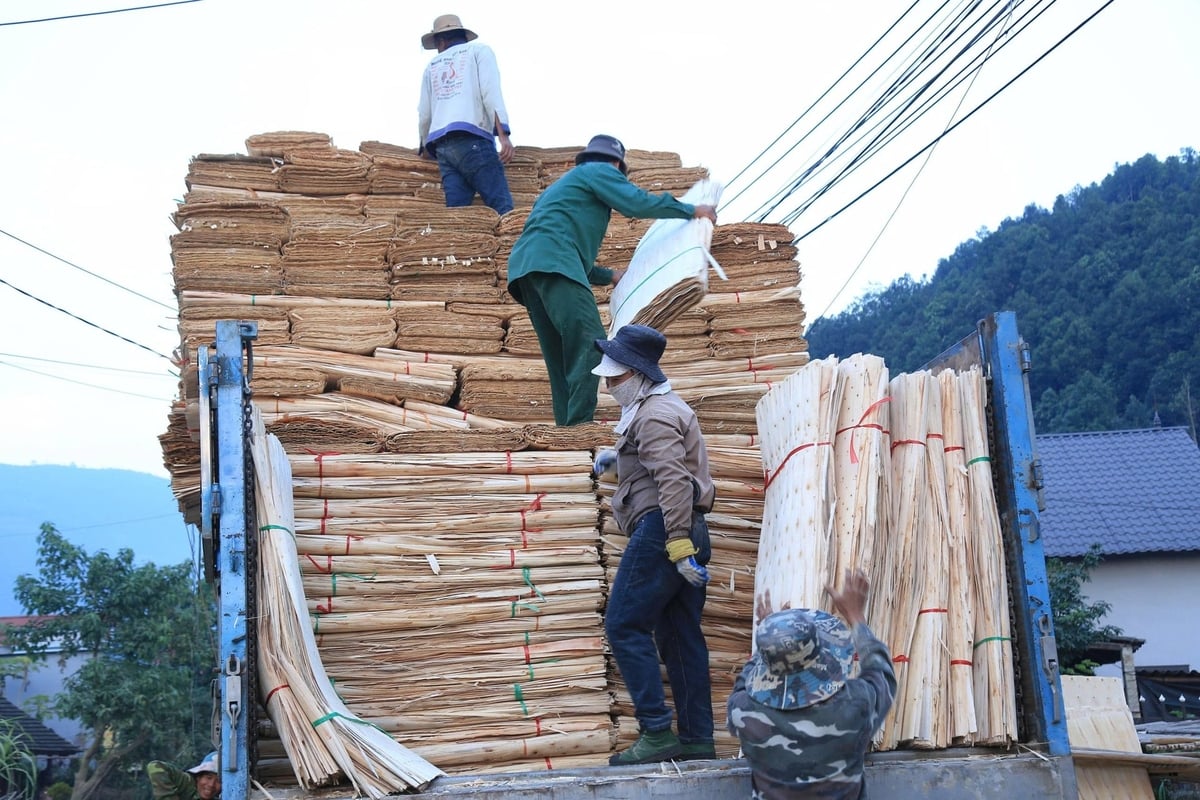
Besides tending to their family's forest land, Thuy and her husband also work drying timber for local factories. This job helps them earn an extra 13-15 million VND per month. Combined with income from logging, their family life is very stable, and they no longer worry about poverty.
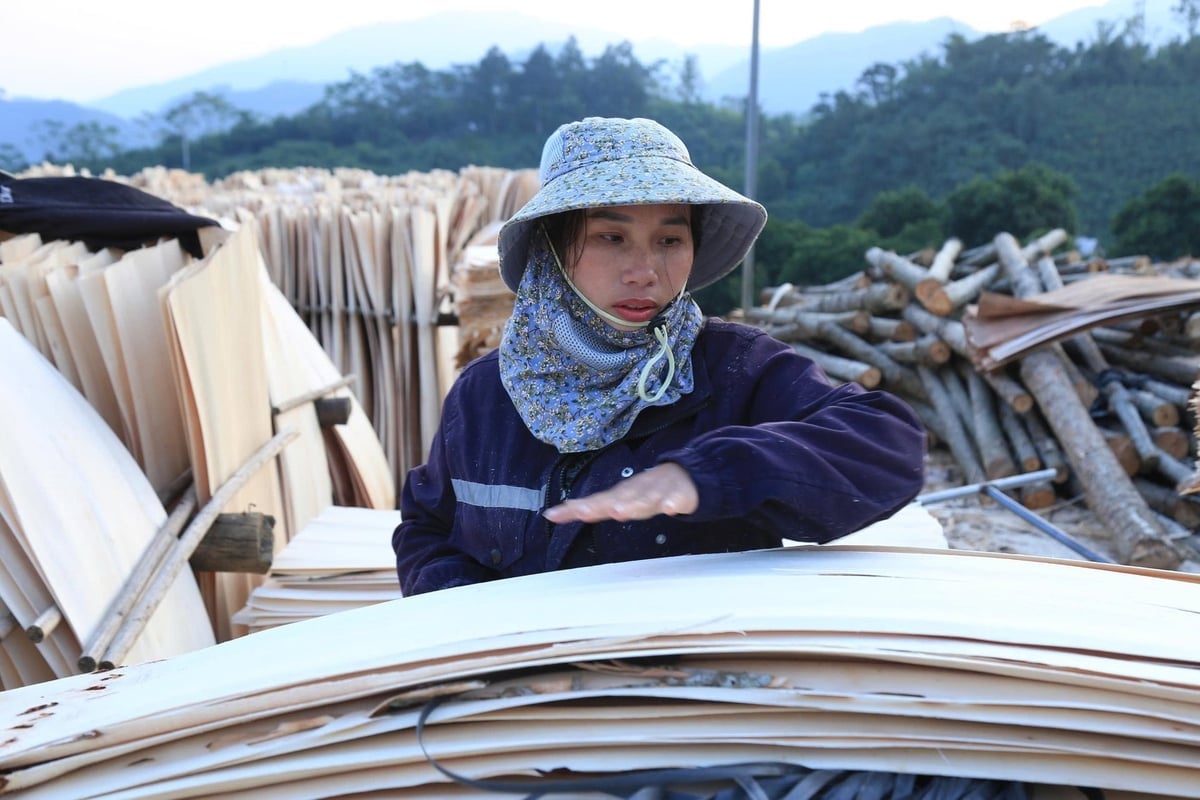
Besides cultivating planted forests, Thuy and her husband also work daily drying veneer boards for veneer factories. Photo: Thanh Tien.
According to Ms. Thuy, most people here are involved in forestry. Some households have several tens of hectares, while others have at least a few hectares. The people's economy mainly depends on the forest. The synergy between forestry and jobs related to timber processing has helped hundreds of households in Lam Giang achieve double income, ensuring sustainable livelihoods.
Forest planting goes hand in hand with processing.
The development of timber resources in Lam Giang has led to the establishment of numerous processing facilities, creating a closed economic cycle within the locality. Besides selling timber, the people also have additional work during their leisure time between farming seasons.
Ms. Nguyen Thi Thanh, Director of Huyen Thanh Cooperative, a unit specializing in purchasing and processing veneer, said that she decided to open the factory three years ago because she realized that the local raw materials were abundant. Instead of letting people sell round timber far away at low prices, the cooperative buys timber from planted forests from the people, organizes veneer peeling and pressing right at the factory.
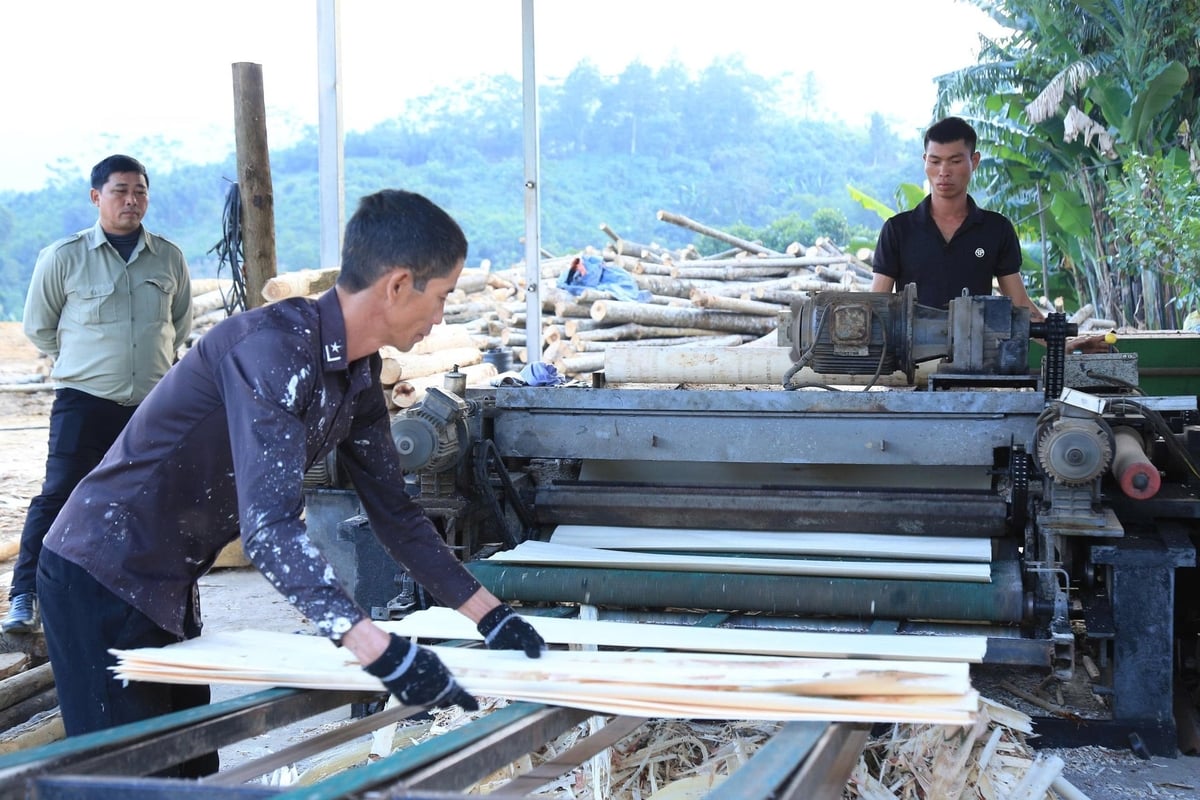
In Lam Giang commune, there are dozens of wood processing facilities. Photo: Thanh Tien.
Although not yet very large in scale, Ms. Thanh's workshop operates continuously, supplying more than 300 cubic meters of plywood to the market each month. More importantly, it has created regular employment for 15-17 local workers.
"Workers are paid by piecework, with an average income of 8-9 million VND per month. Those who are diligent and highly skilled can earn even more. This income helps them stabilize their lives without having to leave their hometowns to work far away," Ms. Thanh added.
The forest sustains people, and people get rich from the forest.
Speaking with reporters, Mr. Nguyen Anh Tien, Secretary of the Party Committee of Lam Giang commune, affirmed that the forest economy is currently the greatest strength and the backbone of the local economy. The entire commune currently has over 2,100 hectares of planted forest, with the percentage of households owning forest land accounting for about 65%. Key tree species such as cinnamon, bodhi, and oil palm cover most villages.
The value of industrial production from timber from planted forests in the commune reaches approximately 450 billion VND per year. Photo: Thanh Tien.
In particular, the industrial production value from timber from planted forests in the commune reaches approximately 450 billion VND/year. Currently, there are 8 enterprises and 21 wood processing facilities in the commune, providing regular employment for more than 500 workers with incomes ranging from 7-12 million VND/month.
Mr. Tien stated that, in order to develop a sustainable forest economy, Lam Giang commune is pursuing a policy of gradually reducing the area planted with cassava (a crop that depletes soil fertility and has low economic efficiency) and switching to planting large, long-term timber trees.
"We are stepping up our efforts to educate the public on adopting biotechnological methods, absolutely prohibiting the use of banned herbicides or toxic chemicals, especially on cinnamon and bodhi trees. The goal is to create a clean and sustainable raw material area," the Party Secretary of the commune emphasized.
In addition, the locality is also rolling out the red carpet to attract large enterprises to invest in building large-capacity, deep-processing factories to enhance the value of plantation timber products, instead of just exporting raw or simply processed products as is currently the case.
From barren, deforested land, Lam Giang today has donned a new, lush and fertile green coat. With the right direction of "using the forest to nourish people, and people to get rich from the forest," Lam Giang commune is steadily progressing on the path of sustainable development, so that each forest becomes a valuable green treasure that helps increase the income of the people.
Source: https://nongnghiepmoitruong.vn/danh-thuc-vung-dat-kho-nho-mui-nhon-kinh-te-rung-d788910.html
![[Image] Leaked images ahead of the 2025 Community Action Awards gala.](/_next/image?url=https%3A%2F%2Fvphoto.vietnam.vn%2Fthumb%2F1200x675%2Fvietnam%2Fresource%2FIMAGE%2F2025%2F12%2F16%2F1765882828720_ndo_br_thiet-ke-chua-co-ten-45-png.webp&w=3840&q=75)

![[Photo] Prime Minister Pham Minh Chinh receives the Governor of Tochigi Province (Japan)](/_next/image?url=https%3A%2F%2Fvphoto.vietnam.vn%2Fthumb%2F1200x675%2Fvietnam%2Fresource%2FIMAGE%2F2025%2F12%2F16%2F1765892133176_dsc-8082-6425-jpg.webp&w=3840&q=75)
![[Photo] Prime Minister Pham Minh Chinh receives Lao Minister of Education and Sports Thongsalith Mangnormek](/_next/image?url=https%3A%2F%2Fvphoto.vietnam.vn%2Fthumb%2F1200x675%2Fvietnam%2Fresource%2FIMAGE%2F2025%2F12%2F16%2F1765876834721_dsc-7519-jpg.webp&w=3840&q=75)
![[Live] 2025 Community Action Awards Gala](/_next/image?url=https%3A%2F%2Fvphoto.vietnam.vn%2Fthumb%2F1200x675%2Fvietnam%2Fresource%2FIMAGE%2F2025%2F12%2F16%2F1765899631650_ndo_tr_z7334013144784-9f9fe10a6d63584c85aff40f2957c250-jpg.webp&w=3840&q=75)





































![[Photo] Prime Minister Pham Minh Chinh attends the Vietnam Economic Forum 2025](https://vphoto.vietnam.vn/thumb/402x226/vietnam/resource/IMAGE/2025/12/16/1765893035503_ndo_br_dsc-8043-jpg.webp)





















Comment (0)