

The elderly couple lay embracing each other on the bed, silently watching the icy seawater fill the cabin, slowly rising around them. He squeezed his wife's hand and gently kissed her cheek. They waited for fate to strike.
That's the image of the elderly couple in director James Cameron's famous film Titanic. However, that's just an artistic depiction in the movie. In reality, Isidor Straus, 67, and his wife, Ida Straus, 63, passed away together in a different way.
They refused to board the lifeboat, giving their place to women and children. Then, he embraced her on the side of the boat and was swept into the deep sea by the waves. As director Cameron described, they died in love just as they had lived with it.
The following story is what actually happened on that fateful night - April 14, 1912.
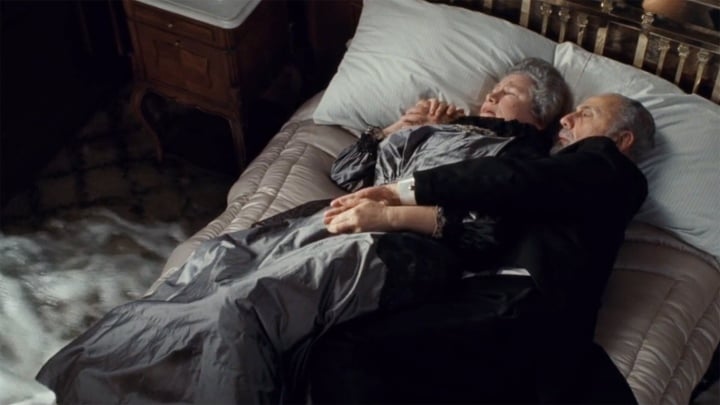
The elderly couple in the film were inspired by the real-life Mr. and Mrs. Strauss.
The truth about the fateful midnight train journey.
Just before midnight on April 14, 1912, the "unsinkable" Titanic struck an iceberg. Seawater began to pour in through holes in the hull. As the ship was about to sink, Isidor and Ida followed instructions – putting on life vests and running to the deck where officers were lowering lifeboats. Women, children, and first-class passengers were given priority boarding. And of course, the elderly couple – among the wealthiest passengers on the ship – were also given priority.
According to the accounts of two witnesses who were alive at the time, Ida, wearing a long mink coat to protect herself from the freezing temperatures, stepped into the lifeboat. But when the officer signaled for Isidor to get in, he shook his head.
"Mr. Isidor said, 'No, I won't get on a lifeboat until I see that every woman and child has a chance to escape' " - the couple's great-grandson, Professor and family historian Paul Kurzman of the Strauss family, told CountryLiving.
"The officer said, 'Mr. Straus, we know who you are, so of course you'll have a place on the lifeboat.'"
But Isidor chose to remain on the ship's deck.
Immediately, Ida climbed out of the lifeboat and turned to her beloved husband, saying, "We've lived a wonderful life together for 40 years and have six beautiful children. If you don't get on the boat, I'll stay with you."
She carefully removed her mink coat and handed it to her maid, Ellen Bird. "I don't need it anymore," she said. "Take this with you when you get on the lifeboat to keep warm until you're rescued."
Then, Mr. Isidor put his arms around her. "A huge wave swept over the port side of the ship and carried both of them into the sea. That was the last time anyone saw them alive," Mr. Kurzman recounted.
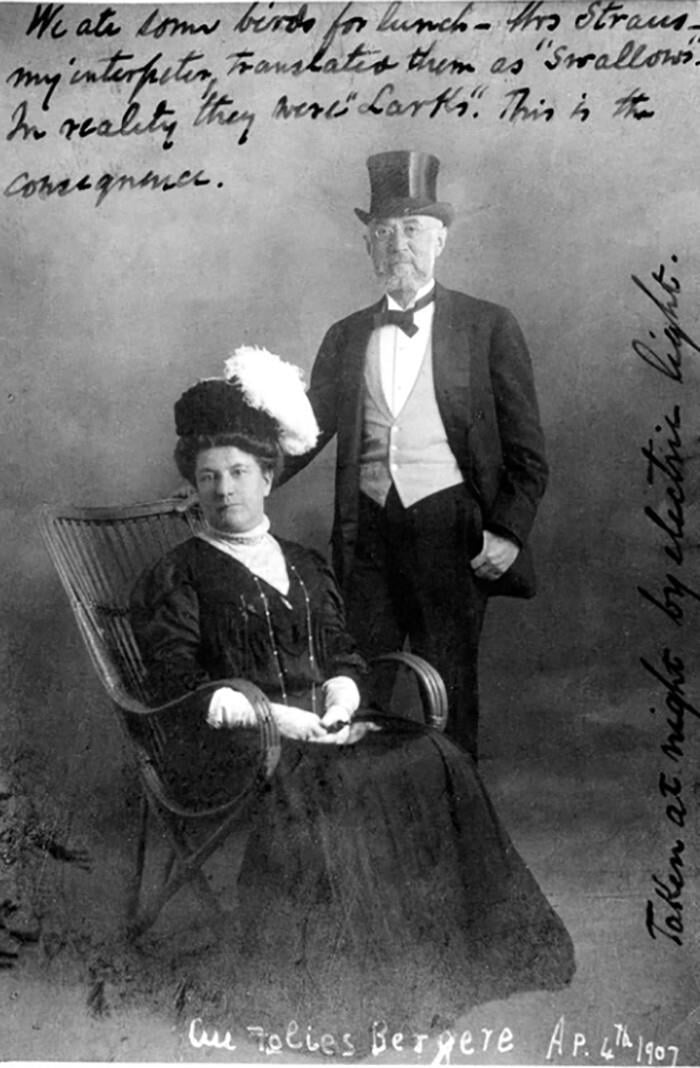
Mr. and Mrs. Strauss in Paris in 1907.
That sweet moment was just one of many bittersweet stories that ultimately recounted the Titanic, but unlike others, it received extensive media coverage at the time. The noble love and sacrifice of the Straus couple were immortalized by director Cameron in the film Titanic.
In a deleted scene, Isidor is seen trying to persuade Ida to board a lifeboat without him. Ida replies, "Wherever you go, I will go. Don't argue with me, Isidor. You know that's not a good idea."
Later, director Cameron staged a scene of the elderly couple lying in bed, hugging and holding hands. Kurzman said that this second scene was included in the film, although neither scene was entirely accurate.
“James told me he knew it wasn’t accurate, but he was the director. I told him, ‘As long as you know it’s not accurate.’ The truth is they died while standing and embracing on the ship’s deck.”
In an interview with USA Today, director Cameron shared: "I'm a screenwriter. I didn't think about becoming a historian."
The immortal love of Isidor and Ida Strauss
Isidor was born in Otterberg, Rhenish Bavaria, Germany in 1845. He emigrated to Georgia, USA with his family in the mid-1850s and eventually settled in New York City, where he was introduced to Ida.
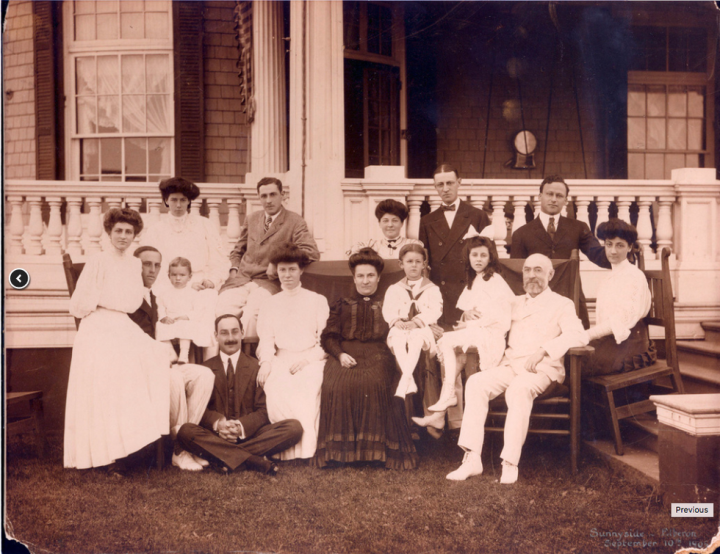
Mr. and Mrs. Strauss and their children and grandchildren in 1905.
In 1871, at the age of 26, Isidor proposed to Ida, 22. According to Kurzman's account, they "loved each other" and were very open about their relationship.
“They were often seen holding hands, kissing, and hugging, actions never publicly displayed among people of status and wealth at that time . They were even once caught cuddling. And that behavior continued into their later years. They had something truly special, and it’s something that our generation cherishes deeply.”
Mr. Isidor was the owner of the Macy's retail chain and was elected to the House of Representatives in 1894. According to Mr. Kurzman, his great-grandfather was a close friend of several presidents, and even a close friend of President Grover Cleveland.
In 1912, after participating in some social activities in Europe, they booked tickets home on the RMS Olympic, but the trip was delayed. They decided to board the Titanic instead.
The couple were assigned to a "fully furnished apartment on deck C, comprising cabins 55 and 57," author June Hall McCash wrote in her book, *The Titanic Love Story: Ida and Isidor Straus*. Their maid, Ellen Bird, was in a smaller cabin across the hallway.
Reports indicate that on April 14th, Isidor and Ida enjoyed a ten-course meal in the first-class dining room before strolling hand-in-hand on the ship's deck. Afterwards, they returned to their cabin.
Just before midnight, the Titanic struck a deadly iceberg, causing the ship to sink. Of the 2,224 passengers and crew on board, more than 1,500 perished – including Ida and Isidor.

A statue of Ida in Strauss Park, near 106th Street (New York, USA).
Ida's body was never found, but Isidor's body was recovered from the sea and brought back to New York for a memorial service. Among his belongings were a piece of jewelry engraved with the initials IS (an acronym for Ida and Isidor), and a photograph of Jesse and Sara, their first two children.
On May 12th, more than 6,000 people attended a memorial service for Ida and Isidor at Carnegie Hall. New York City Mayor William Jay Gaynor delivered a eulogy alongside billionaire Andrew Carnegie.
A memorial park named after Straus was built for the couple near their home on 106th Street. The memorial plaque reads: "Water cannot extinguish love. Floods cannot drown it."
"This is a love story," said Kurzman, the couple's great-grandson. "And I hope that at a time when the world needs a little more love, a little more inspiration, the enduring story of Ida and Isidor Straus will offer people hope."
(Source: Vietnamnet)
Beneficial
Emotion
Creative
Unique
Source

![[Photo] Two flights successfully landed and took off at Long Thanh Airport.](/_next/image?url=https%3A%2F%2Fvphoto.vietnam.vn%2Fthumb%2F1200x675%2Fvietnam%2Fresource%2FIMAGE%2F2025%2F12%2F15%2F1765808718882_ndo_br_img-8897-resize-5807-jpg.webp&w=3840&q=75)

































































































Comment (0)