

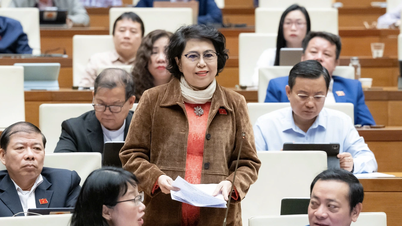
Recently, at the National Assembly session on October 4th, delegate Nguyen Thi Yen ( Ba Ria - Vung Tau ) raised the issue that doctors and nurses are the silent soldiers on the front lines of public health care. However, the allowances for night shifts and surgeries have not been changed for over 10 years.
Therefore, delegates suggested paying attention to adjusting and increasing allowances to motivate and support the morale of the medical staff.
In addition, the female delegate pointed out that it is difficult to get into medical school, the study period is long, and tuition fees are higher than other fields of study. Therefore, the delegate suggested that the Government consider applying a tuition fee support policy for medical students similar to the current policy for the education sector.

Members of Parliament have proposed considering waiving tuition fees for medical students, similar to pedagogical students. (Illustrative image, source: KT)
Regarding tuition fees for medical school, Nguyen Hai Yen, a fourth-year medical student at Hanoi Medical University, said that her cohort was fortunate to still be subject to the old tuition fee of 28 million VND per year, with only a 10% increase each year. However, tuition fees have increased for subsequent cohorts, with the highest rate currently reaching 55 million VND per year.
Hai Yen argues that, with rising tuition fees, a long study period (at least 6 years of university), and the need for further specialization or residency after graduation, an average medical student will need about 10 years of study before practicing. Therefore, many students who lack sufficient financial resources will find it difficult to pursue a medical career.
“Medical students have very packed schedules: clinical classes at the hospital in the morning, theoretical classes at school in the afternoon, and night shifts. Most of us students don't have enough time or energy to work part-time. Only a very small number of exceptionally bright students can arrange to tutor to earn extra income; most of the rest rely on family support for tuition and living expenses. The amount of money required to start working is considerable, much higher than in other fields of study,” Yen shared.

Nguyen Hai Yen believes that if there were policies to support tuition fees, similar to those for education students, it would alleviate the financial burden on medical students. (Photo: Provided by the interviewee)
The female student stated that while Hanoi Medical University offers scholarships annually, the eligibility requirements are not easy, and tuition fee waivers are only available to a small number of students from families with preferential policies. Therefore, if there were a tuition fee support policy similar to that for education students, it would alleviate the financial burden on medical students, allowing them to focus on their studies and dedicate themselves to the profession.
Meanwhile, Hoang Anh Tu, a third-year medical student, said: "I understand that the increase in tuition fees for medical programs at universities is inevitable, as the learning process requires a lot of modern equipment and tools, resulting in high costs. However, not all students have the financial means, so besides the pressure of studying because of the heavy workload, there is also significant financial pressure."
Dr. Hoang Van Tam, a lecturer at Hanoi Medical University, believes that, in principle, this is a good thing, helping to reduce pressure on students and attract talent to the medical field. “From a student's perspective, I fully support this proposal; however, looking at it from a broader perspective, it is impractical and very difficult to implement. Waiving tuition fees for medical students would put enormous pressure on the budget, because training a doctor is incredibly expensive.”
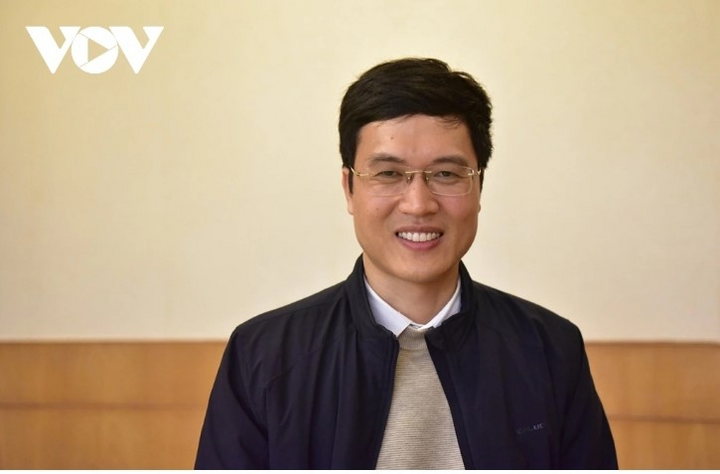
Dr. Hoang Van Tam, lecturer at Hanoi Medical University.
According to Dr. Hoang Van Tam, during their six years of university, students not only study theory but also need a lot of practical training, which requires significant training costs. It is very difficult for medical schools to reduce tuition fees. At Hanoi Medical University, the highest tuition fee for the medical program is over 50 million VND per year; however, compared to other countries, this is still quite low.
This lecturer argues that it is difficult to compare the cost of teacher training with medical training, because the cost of training a doctor is much greater than the cost of training a teacher.
Dr. Hoang Van Tam, MD, PhD, frankly stated that current tuition fees are a major obstacle for many students wanting to pursue a career in medicine. Not only are undergraduate costs high, but postgraduate training is also very expensive. However, upon graduation, the salaries young doctors and medical staff receive are not commensurate with their income. For example, resident doctors are only paid based on a coefficient of 2.67, while medical graduates receive a coefficient of 2.34. Even with additional allowances, their income remains low, especially for doctors and medical staff at lower-level healthcare facilities.
According to the Law on Medical Examination and Treatment of 2023, which officially came into effect on January 1, 2024, the State only provides financial support for students studying psychiatry, pathology, forensic medicine, forensic psychiatry, infectious diseases, and emergency resuscitation. Specifically, students will receive full tuition support and living expense support for the entire course if studying at a state-run health sector training institution; and tuition and living expense support for the entire course corresponding to the prescribed level if studying at a private health sector training institution.
Source: https://vtcnews.vn/de-xuat-mien-hoc-phi-nganh-y-hay-nhung-khong-thuc-te-ar906215.html


![[Image] Vietnam's colorful journey of innovation](/_next/image?url=https%3A%2F%2Fvphoto.vietnam.vn%2Fthumb%2F1200x675%2Fvietnam%2Fresource%2FIMAGE%2F2025%2F12%2F14%2F1765703036409_image-1.jpeg&w=3840&q=75)






























































![[Image] Vietnam's colorful journey of innovation](https://vphoto.vietnam.vn/thumb/402x226/vietnam/resource/IMAGE/2025/12/14/1765703036409_image-1.jpeg)

































Comment (0)