

The Vietnamese stock market experienced a rather volatile trading week, interrupting a four-week winning streak after retesting its previous peak in March (the 1,280-1,295 point range).
The market fell by more than 19 points at the end of the week, as interbank interest rates surged and exceeded 5%, reflecting a lack of liquidity in the system compared to previous periods. In addition, the higher-than-expected US PMI index also raised investor concerns about the possibility of the Fed cutting interest rates this year, causing the US dollar index (DXY) to rise, putting pressure on the VND exchange rate.
At the end of the week, the VN-Index fell 11.18 points, or 0.9%, to 1,261.9 points. The HNX remained almost unchanged at 241.7 points, and UPCoM rose 1.4% to 94.4 points.
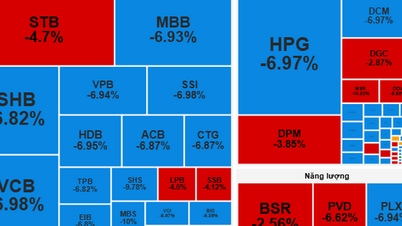
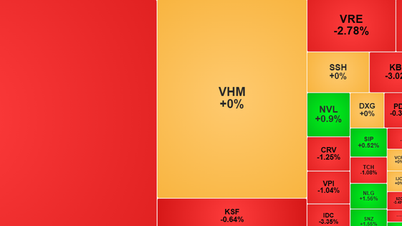
Last week, GAS rose 4.4%, HVN rose 12.6%, and PLX rose 8%, which were the main factors supporting the market. Conversely, VCB fell 1.7%, VIC fell 4.1%, and TCB fell 3.8%, putting pressure on the overall index.
Liquidity continued its upward trend, with trading value across the three exchanges reaching VND 27,670 billion per session, a 37.6% increase compared to the previous week.
Foreign investors sold a net 5,352 billion VND across all three exchanges, including a net 3,871 billion VND on HoSE, a net 33 billion VND on HNX, and a net 1,448 billion VND on UPCoM.
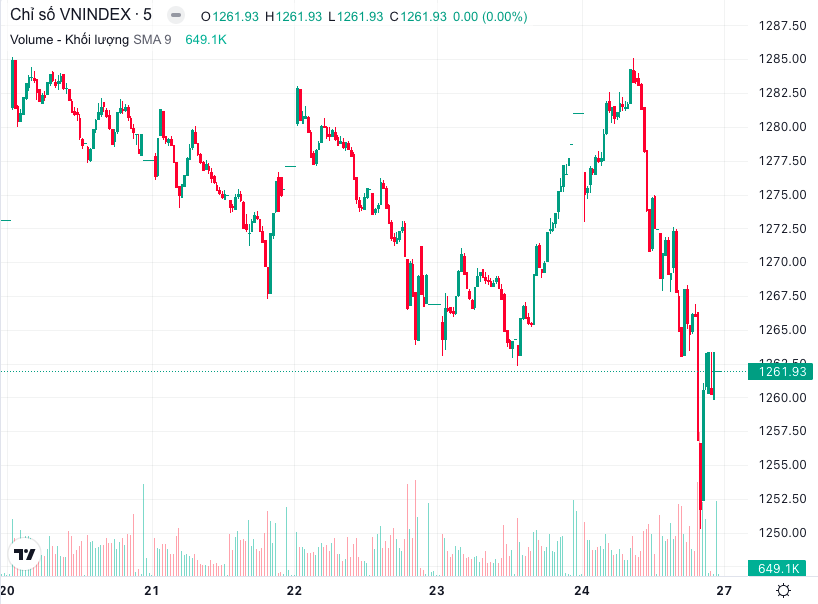
VN-Index performance last week (Source: TradingView).
According to Mr. Bui Van Huy, Director of DSC Securities' Ho Chi Minh City branch, the market has risen by more than 100 points from its bottom, and a 3-5% correction is normal. The actions of domestic investors are now more important.
The nearest support level for the VN-Index is around 1,250 points. The underlying scenario is that the market will consolidate in the 1,250-1,290 point range, stabilizing before gaining further upward momentum. Stronger support in a worst-case scenario is around 1,220 points.
According to this expert, the current market is quite vibrant and money is flowing in well. The money flow can spread to different stock groups, as long as investors correctly predict industry trends to seek profits.
Therefore, Mr. Huy suggested that investors should "put their money into" stocks that maintain revenue and profit growth rates or have recovered from their bottoming-out business performance.
First, there are the "strong" stocks such as technology, retail, tourism and entertainment, telecommunications, and chemicals. Investors can continue to hold these stocks; if buying new ones, they should pay attention to the accumulation zone and whether there is still significant room for growth.
Next, the group of stocks likely to strengthen includes oil and gas, securities, steel, and fertilizers. Money then may shift to the third tier, comprising real estate, construction, and materials. Bank stocks could pull the index up in the final phase. Penny stocks could surge and become the fifth tier of shifting stocks.
"Each cycle from the beginning to the end of the wave can last from a few weeks to a few months until the wave ends. Investors can be flexible to take advantage of opportunities," Mr. Bui Van Huy advised.
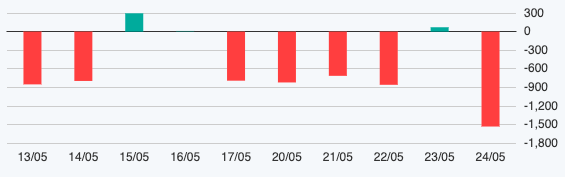
Foreign investor trading activity.
Meanwhile, Mr. Dinh Quang Hinh - Head of Macroeconomics and Market Strategy Department at VNDIRECT Securities, observes that short-term risks are increasing as the market receives unexpected information both domestically and internationally.
Specifically, the US macroeconomic data released last week, such as the services PMI, manufacturing PMI, and higher-than-expected jobless claims, suggest that the outlook for US economic growth remains strong. This raises concerns that the Fed will continue to delay cutting interest rates.
Domestically, despite intervention efforts by the State Bank of Vietnam, exchange rate pressure has not eased. Coupled with the auction of gold bars, this has absorbed a significant amount of liquidity from the market. This has resulted in less liquidity in the system than before, and the interbank overnight interest rate has exceeded 5%. Along with this, the State Bank of Vietnam also increased the OMO interest rate to 4.5% per annum, a 25 basis point increase compared to before.
This information had an immediate impact on the stock market, as it is a sector sensitive to interest rates.
Given the emerging signs of risk, it is essential for investors to reassess the current state of their portfolios, prioritizing risk management above all else.
Therefore, traders who are using leverage (margin) or holding a high proportion of stocks should take advantage of technical rebounds to reduce their positions and lower their stock holdings to a safe level to manage portfolio risk.
For long-term investors, it is advisable to continue holding stocks that have not yet reached their target price. However, it is not recommended to rush into buying and instead patiently observe supply and demand, market developments in the coming sessions, and wait for more attractive buying opportunities to invest. The nearest support level for the VN-Index is around 1,250 points, and a further support level is around 1,220 points .
Source: https://www.nguoiduatin.vn/lang-kinh-chung-khoan-27-5-diem-ten-nhung-co-phieu-khoe-a665429.html







































































































Comment (0)