

To avoid missing opportunities for development and to usher the country into a new era, an era of national progress for Vietnam, closely following the profound directives of the General Secretary and other Party and State leaders in recent times, it is clear that the time is ripe to promote fundamental reforms in the work of lawmaking and enforcement. This is the assessment in the article "Strongly reforming the work of lawmaking and enforcement to ensure the country's steady progress into a new era" by Dr. Nguyen Hai Ninh - Member of the Central Committee of the Party, Secretary of the Party Committee, Minister of Justice . Vietnam Law Newspaper respectfully presents the Minister's article.
1. Throughout thousands of years of nation-building and defense, our ancestors painstakingly constructed a legal system with its own unique character, a source of pride with the famous legal codes of the Ly, Tran, Le, and Nguyen dynasties. Along with "easing the burden on the people," "respecting the law," "respecting discipline and order," and "respecting talented people," these have become enduring strategies for governing the nation.
2. On his journey to find a way to save the country and its people, Nguyen Ai Quoc - Ho Chi Minh - the brilliant leader of our Party and nation, was acutely aware of the importance of the Constitution, laws, and the "divine rule of law" in "preserving the territory" and "building the nation." Immediately after gaining independence, under the extremely precarious conditions of the revolution, President Ho Chi Minh still prioritized holding general elections so that the people could enjoy freedom and democracy, establish a people's government, and promulgate a democratic and progressive Constitution on November 9, 1946, which was later chosen as "Law Day of the Socialist Republic of Vietnam."
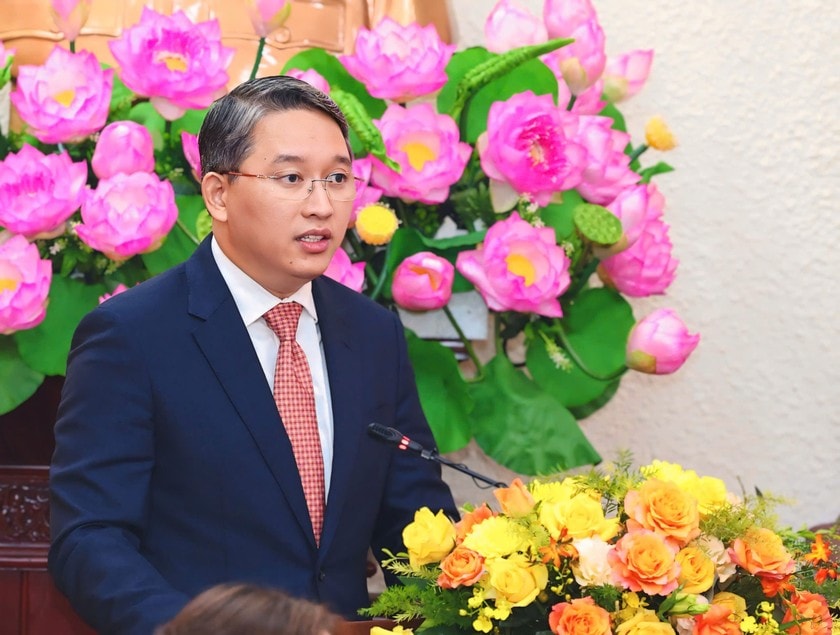 |
| Dr. Nguyen Hai Ninh - Member of the Central Committee of the Communist Party of Vietnam, Secretary of the Party Committee, Minister of Justice. |
3. After enduring a long and arduous struggle, the country was unified in 1975, and in 1986, the Party launched the great reform process, gradually perfecting a development model more suitable to the country's realities. The need to build a comprehensive legal system and shift the management and administration method from primarily based on administrative orders and bureaucracy to based on laws and adherence to market principles has become increasingly urgent. Since then, the Party has had many important policies and guidelines on building and perfecting the socialist rule of law in Vietnam in general, and building and perfecting the legal system in particular, and improving the effectiveness of law enforcement, which are concentrated in: the Resolution of the Mid-term National Congress of Delegates in 1994; the Platform for Building the Country during the Transition Period to Socialism in 1991 (supplemented and developed in 2011); Resolution No. 48-NQ/TW dated May 24, 2005, of the Politburo on the Strategy for Building and Perfecting the Vietnamese Legal System until 2010, with orientation to 2020; Resolution No. 49/NQ-TW dated June 2, 2005, of the Politburo on the Strategy for Judicial Reform until 2020, and especially Resolution No. 27-NQ/TW dated November 9, 2022, of the Sixth Plenum of the Central Committee of the 13th Party Congress on continuing to build and perfect the socialist rule of law state of Vietnam in the new period. Based on that foundation, with the efforts of the entire political system, we have built a legal system that regulates almost all areas of social life, ensuring human rights and civil rights, creating a legal basis for socio-economic development, ensuring security and national defense, guaranteeing the leadership role of the Party and the management role of the State, and promoting the people's right to self-governance. The work of building and implementing laws has made a significant contribution to the overall achievements of the Doi Moi (Renovation) process.
4. Nevertheless, the socio-economic development practices in our country over the past period have revealed limitations, shortcomings, and institutional "bottlenecks," as General Secretary To Lam pointed out. For example: The quality of lawmaking and improvement has not met the needs of reality; some newly enacted laws have had to be amended; many regulations still cause difficulties and hinder implementation; a truly favorable environment has not been created to attract resources from domestic and foreign investors and unlock resources from the people; administrative procedures are still cumbersome; and the organization of law and policy implementation remains a weak point…
5. In order not to miss opportunities for development, to usher the country into a new era, an era of national progress for Vietnam, and to strive to successfully achieve the goals of the 100th anniversary of the Party's leadership and the 100th anniversary of the nation's founding, and to transform Vietnam into a developed, high-income country oriented towards socialism, based on the Party's guiding directions in Resolution No. 27-NQ/TW dated November 9, 2022, of the Sixth Plenum of the 13th Central Committee of the Party, and closely following the profound directives of the General Secretary and other Party and State leaders in recent times, it is evident that the time is ripe to promote fundamental reforms in the work of lawmaking and enforcement. In particular, the following key solutions should be prioritized:
Firstly, a fundamental reform of the thinking behind lawmaking is necessary, considering this a "breakthrough of breakthroughs" in perfecting the development institution. In the new era, law must truly be the foundation of development, serving and promoting development; "putting the people and businesses at the center and as the subjects." Lawmaking must adopt a practical and realistic approach; ensuring it is consistent with the country's actual conditions, addressing the difficulties of life, and finding a path to development from practical experience. At the same time, selectively absorbing international experience in lawmaking and implementation, keeping pace with the trends of the times. To meet this requirement, the law must: (i) remove legal "bottlenecks," urgently bringing stagnant social resources back into operation; (ii) both ensure the requirements of state management and encourage innovation, unleashing the full productive force and mobilizing all resources for national development; (iii) to create a legal basis for the formation of new growth drivers, new production relations and productive forces, new service sectors, and new industries.
Transforming the mindset in lawmaking must begin with resolutely changing perceptions, breaking down all barriers, vested interests, and localized interests of sectors, localities, organizations, and individuals in lawmaking. Focus on reducing and simplifying administrative procedures, cutting compliance costs, and eliminating the "request-and-grant" mechanism; creating a healthy and favorable investment and business environment. Resolutely abandon the "if we can't manage it, we'll ban it" mentality, and effectively implement the principle that "citizens are allowed to do everything that the law does not prohibit." State agencies, officials, and public employees must fulfill their responsibilities according to the regulations of the Party and the laws of the State; strictly implement the requirements of the 2013 Constitution: "Human rights and citizens' rights can only be restricted by law in necessary cases for reasons of national defense, national security, social order and safety, social morality, and public health."
Secondly, we must vigorously innovate the law-making process, focusing on improving the quality of legal documents. The law-making process must be professional, scientific, timely, feasible, and effective, with clear assignment of responsibilities to each entity at every stage. The policy-making process should be more clearly defined, linking it to the responsibilities of the lead agency in policy planning, especially its head. Policies must be specific and clear, avoiding vagueness and confusion between state policies and Party guidelines. Activities such as summarizing, surveying practical experiences, studying foreign best practices, gathering information, assessing policy impacts, and selecting policies should be carried out thoroughly and seriously. A clear distinction should be made between policy development and policy codification; research should be conducted on organizing a centralized agency for drafting legal documents, ensuring professionalism, scientific rigor, and the consistency and uniformity of the legal system. Clearly define the legislative process and the process for drafting subordinate legislation. Focus on substantive policy impact assessment; build effective mechanisms to receive and address feedback from affected parties, especially citizens and businesses; avoid creating difficulties for citizens and businesses in policy design and legal regulations. The authority of law-making entities must be based on the functions and tasks stipulated in the Constitution and laws on organizational structure; consider the Government and the Prime Minister issuing legal documents on specific mechanisms and pilot programs to thoroughly and promptly resolve difficulties, obstacles, and new issues arising in practice.
Thirdly, focus on perfecting the legal system in conjunction with restructuring the political system, ensuring it is "lean, efficient, effective, and effective," promoting decentralization and delegation of power with the motto "local authorities decide, local authorities act, local authorities are responsible." The Central Government, the National Assembly, and the Government will strengthen institutional reform, maintain their role in creating and enhancing inspection and supervision. The legal system will be perfected to ensure the best possible functioning of the relationship between "Party leadership, State management, and people's ownership." The role and effectiveness of law will be enhanced to contribute to social management, maintain political stability, develop the economy, integrate internationally, and ensure human rights and civil rights. A legal framework for new issues and trends, especially those related to artificial intelligence, digital transformation, and green transformation, will be urgently developed. Breakthrough mechanisms will be established to attract talent from both within and outside the country. Promote research and selectively refer to international experience in lawmaking based on the Party's guiding principles, serving the purpose of deep international integration. Focus on controlling power, tightening discipline, and resolutely combating corruption and vested interests in lawmaking. Laws must fully, correctly, and promptly institutionalize the Party's policies and guidelines, serving as a bridge to bring the Party's resolutions into life. Consider the leadership in concretizing the Party's policies and guidelines into law as a central and ongoing task in reforming the Party's leadership methods.
Fourth, build a strict and consistent mechanism for the implementation of laws, ensuring the supremacy of the Constitution and the law. Improve the effectiveness of legal dissemination and education; build a culture of law compliance, making law compliance a norm of social conduct. Regularly monitor, review, and evaluate the effectiveness of laws after their promulgation, apply technology in receiving, responding to, and processing feedback and suggestions from citizens and businesses related to law implementation, and identify errors in legal documents to promptly improve them. Promptly finalize the law on the organization of law enforcement; improve regulations and mechanisms for guiding, interpreting, and applying laws by establishing principles, criteria, and bases for interpreting and applying laws, to ensure the vitality of legal regulations instead of constantly changing them. Promote the application of digital technology and ensure financial resources for the dissemination, popularization, and enforcement of laws.
Fifth, focus on developing human resources for legal work, commensurate with its nature as one of the three strategic breakthroughs. Pay attention to training, nurturing, and developing human resources for legal drafting with strong political convictions, good moral character, professional expertise, and practical experience. A portion of these personnel should be prepared to participate in multilateral institutions and international organizations to protect the national interests of the Vietnamese people and businesses. Research and promulgate specific financial mechanisms for legal drafting work, and specific policies for officials and civil servants working in legal drafting and legal affairs. Focus on investing resources in a strong digital transformation, applying digital platforms and artificial intelligence in legal drafting and enforcement, and building specialized databases to connect, integrate, and enrich the national population database.
6. Adhering closely to the Party's guidelines and strictly implementing the directives of the General Secretary and other Party and State leaders with urgency, determination, great effort, and extraordinary endeavors, the work of drafting and enforcing laws will and must be strongly reformed to contribute to the development of the country in the new era, the era of the Vietnamese nation's rise.
Dr. Nguyen Hai Ninh
(Member of the Central Committee of the Communist Party, Secretary of the Party Committee, Minister of Justice)
Source: https://daidoanket.vn/doi-moi-manh-me-cong-tac-xay-dung-va-thi-hanh-phap-luat-de-dat-nuoc-vung-buoc-tien-vao-ky-nguyen-moi-10294098.html

![[Photo] Two flights successfully landed and took off at Long Thanh Airport.](/_next/image?url=https%3A%2F%2Fvphoto.vietnam.vn%2Fthumb%2F1200x675%2Fvietnam%2Fresource%2FIMAGE%2F2025%2F12%2F15%2F1765808718882_ndo_br_img-8897-resize-5807-jpg.webp&w=3840&q=75)



























































































Comment (0)