

Located on the northern bank of the Ma River, nestled against Truong Sinh Mountain and facing a vast rice field, Luong Ngoc village (Ngoc village) in Cam Luong commune (Cam Thuy district) is as beautiful as a landscape painting. It also boasts the Cam Luong scenic area with its complex of fish streams, caves, temples, and traditional cultural spaces... all contributing to the unique charm of this ancient Muong land.
 Tourists enjoy visiting and exploring Ngoc Stream with its famous "sacred fish".
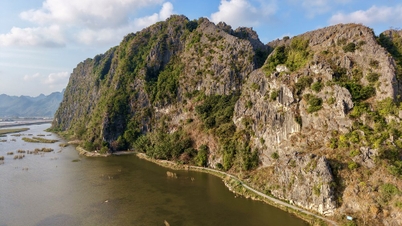
Located about 80km from the center of Thanh Hoa City, Luong Ngoc village lies in a vast valley. The Truong Sinh mountain range, stretching through Ngoc village, has created a system of pristine caves and a peaceful, beautiful natural landscape.
In particular, from within the Trường Sinh rocky mountains flows a cool, refreshing stream that never seems to dry up. Locals often call it Ngọc Stream (Ngọc Stream) - home to the famous "sacred fish". Beneath the cool, clear water that remains blue all year round, the fish frolic and swim playfully, much to the delight of visitors.
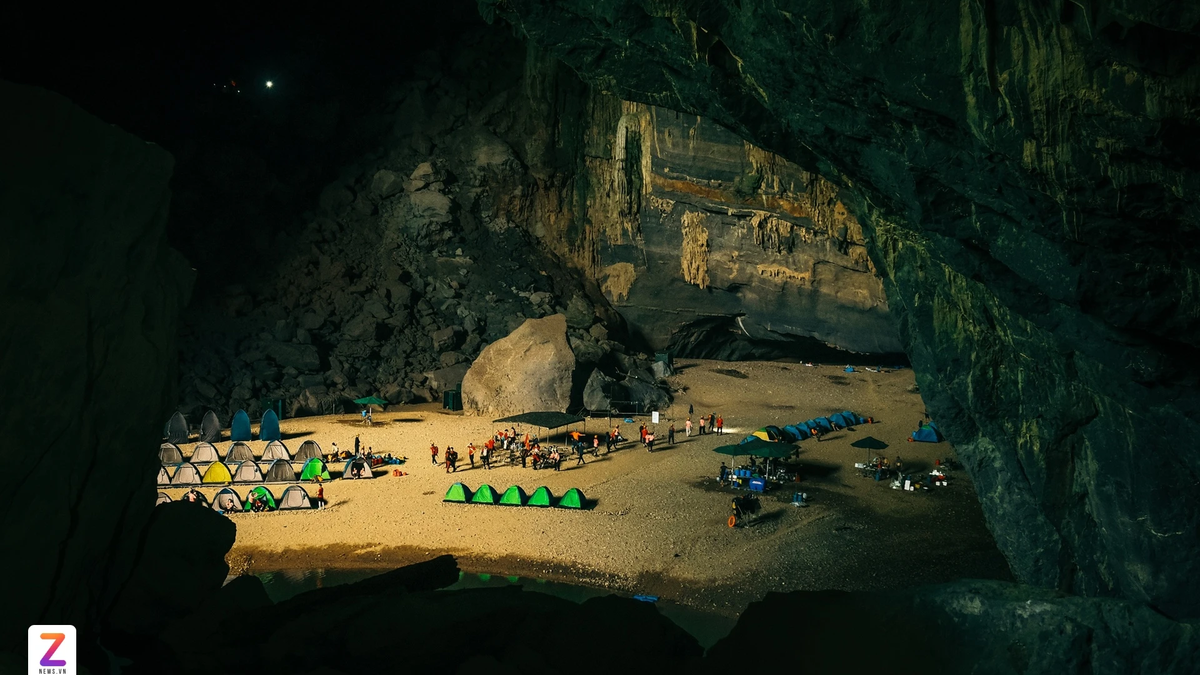
Following the cool stream, guided by the locals, we visited the sacred temple dedicated to the Water Dragon King (the Snake God) on the banks of the Ngoc stream to offer incense. From there, continuing to the source of the stream, we encountered the Truong Sinh mountain range. Climbing the stone steps into the mountains led to a system of pristine caves (Cay Dang Cave) with many strangely shaped stalactites and stalagmites, sparkling beautifully. Inside the cave, visitors feel as if they have wandered into a fairyland, captivated by its beauty. Cay Dang Cave is open at both ends; the villagers of Ngoc often say, "Enter through the father's gate, exit through the mother's gate."
When the journey of exploring the village, the Ngoc stream, and Truong Sinh mountain seems tiring, visitors can sit by the stream and savor some bamboo-cooked sticky rice made by the local Muong people. The sticky rice, cooked in bamboo tubes, is fragrant and chewy without being mushy, and dipping it in sesame salt is quite delightful. According to the villagers of Ngoc, bamboo-cooked sticky rice was previously mainly made and consumed during village festivals and holidays. Since the Cam Luong scenic area became an attractive tourist destination, bamboo-cooked sticky rice has also become a popular gift for visitors to the ancient Muong people. Made from rice harvested from the village fields, packed into small bamboo tubes, and roasted over a fire in the traditional way, bamboo-cooked sticky rice has become a rustic gift – a culinary attraction that draws visitors to Ngoc village.
During our exploration of Ngoc village, we had the opportunity to chat with Mr. Bui Hung Manh, a respected figure in the Muong community of Ngoc village. From this conversation, we learned many interesting things about the ancient Muong land of Luong Ngoc.
According to Mr. Bui Hung Manh, for the Muong people in Luong Ngoc, Ngoc stream is a sacred stream, closely associated with the formation of the Muong village there. From ancient times, generations of Muong people have recounted the legend: Long ago, when the mountains and forests were still wild and uninhabited, a young Muong man from Hoa Binh went hunting. A deer was struck by his arrow but did not die; it used its strength to escape across the mountains and through the forest. The hunter did not give up, determined to follow the deer's blood trail day and night. Until one day, the little deer "led" the hunter to a cool, refreshing stream. Believing this to be a good place to settle, the hunter hurried back to his homeland, bringing his wife and relatives to the cool stream at the foot of Truong Sinh mountain to establish a village and build a life. Ngoc village has existed since then.
The life of the Muong couple by Ngoc Stream flowed peacefully. One day, while at the stream bank, the husband found a small egg. He couldn't bring himself to eat it, so he gave it to a hen to incubate. One day, the egg hatched into a small snake with a red crest on its head. Intrigued, the husband decided to release the snake back into Ngoc Stream. But when he returned home, the snake was there again. Seeing this, the couple decided to raise the snake. Years passed, and the small snake grew into a giant, beloved by the people of the Muong village.
One day, the giant snake suddenly disappeared. During those days, the sky was turbulent, with terrible thunderstorms and lightning. Loud rumbling sounds emanated from Truong Sinh Mountain, and in the distance, the Ma River rose continuously, causing landslides and floods... When the sky cleared, the villagers were surprised to find the giant snake's carcass by Ngoc Stream, alongside the carcass of a water monster. After burying the snake's body by Ngoc Stream, that night the villagers dreamt that the spirits had "revealed" them: The Snake Man had been sent by the gods to protect the villagers. In the past few days, the Snake Man had fought the water monster to bring back peace.
Out of grief and gratitude for the Snake God, the people of Ngoc village erected a temple to the deity (the Snake Temple, also known as Ngoc Temple) right by the stream, where they worship him year-round. The custom of worshipping the Snake God has become a long-standing cultural belief of the Muong people in Luong Ngoc. Over time, various feudal dynasties have bestowed titles upon the deity such as "Supreme Venerable Deity" and "Water Dragon King".
“From the Ngọc stream, thousands of fish with reddish-purple tails and fins swim in schools, bowing towards the majestic Ngọc Temple, their reflections shimmering on the clear blue water. As night falls, the fish from the Ngọc spring retreat into the Trường Sinh mountain, leaving only the petrified turtles and dragons prostrating themselves before the sacred temple… These strange fish with red tails and fins, and eyes like glittering golden rings… are friendly and close to the lives of the people of Ngọc village. They never catch or eat them… Locals say that the fish are the soldiers of the Serpent, transformed into divine fish to daily bow before the Ngọc Temple – dedicated to the Serpent God” (according to Hoàng Minh Tường, author of the book "Returning to the Tourist Region of Thanh Hoa").
“Ngoc Stream is a sacred stream, closely linked to the material and spiritual life, and cultural beliefs of the people of Ngoc village. It is cherished by the villagers as a treasure bestowed by heaven. No one is allowed to harm the sacred stream and the deities; that is truly a taboo,” Mr. Bui Hung Manh affirmed.
Every year, from the 7th to the 9th of January, local people flock back to Ngoc Stream to hold the Khai Ha festival – praying for water, favorable weather, and a bountiful harvest. During the festival, the villagers carry the palanquin of the Snake God from Ngoc Temple to the large stilt house (the village's stilt house) for the ceremony. On the day of the festival, from the banks of Ngoc Stream, the village elders strike the gongs, their voices echoing throughout the Muong village, paying homage to the gods, awakening all creatures, and summoning the villagers to join in the festivities. In this sacred space, the villagers believe that the Snake God – the "patron" of Ngoc Village – will understand their wishes and bless them with a more prosperous life. Following the solemn ceremony is a lively festival with unique folk games and performances of the Muong people...
In the vibrant days of spring, returning to Luong Ngoc, to the beautiful village nestled at the foot of Truong Sinh mountain, with its glimpses of stilt houses, strolling along the cool Ngoc stream, and watching the "sacred fish" swimming playfully, one suddenly realizes how peaceful and beautiful life is.
Text and photos: Khánh Lộc
Source
![[Photo] General Secretary and President To Lam presides over a working session with the Central Policy and Strategy Committee on the development of the materials industry.](https://vphoto.vietnam.vn/thumb/1200x675/vietnam/resource/IMAGE/2026/05/21/1779359935432_a3-bnd-3129-1412-jpg.webp)
![[Photo] National Assembly Chairman Tran Thanh Man working with the Standing Committee of the Law and Justice Committee](https://vphoto.vietnam.vn/thumb/1200x675/vietnam/resource/IMAGE/2026/05/21/1779378929214_ndo_br_1-4610-jpg.webp)




































































Comment (0)