

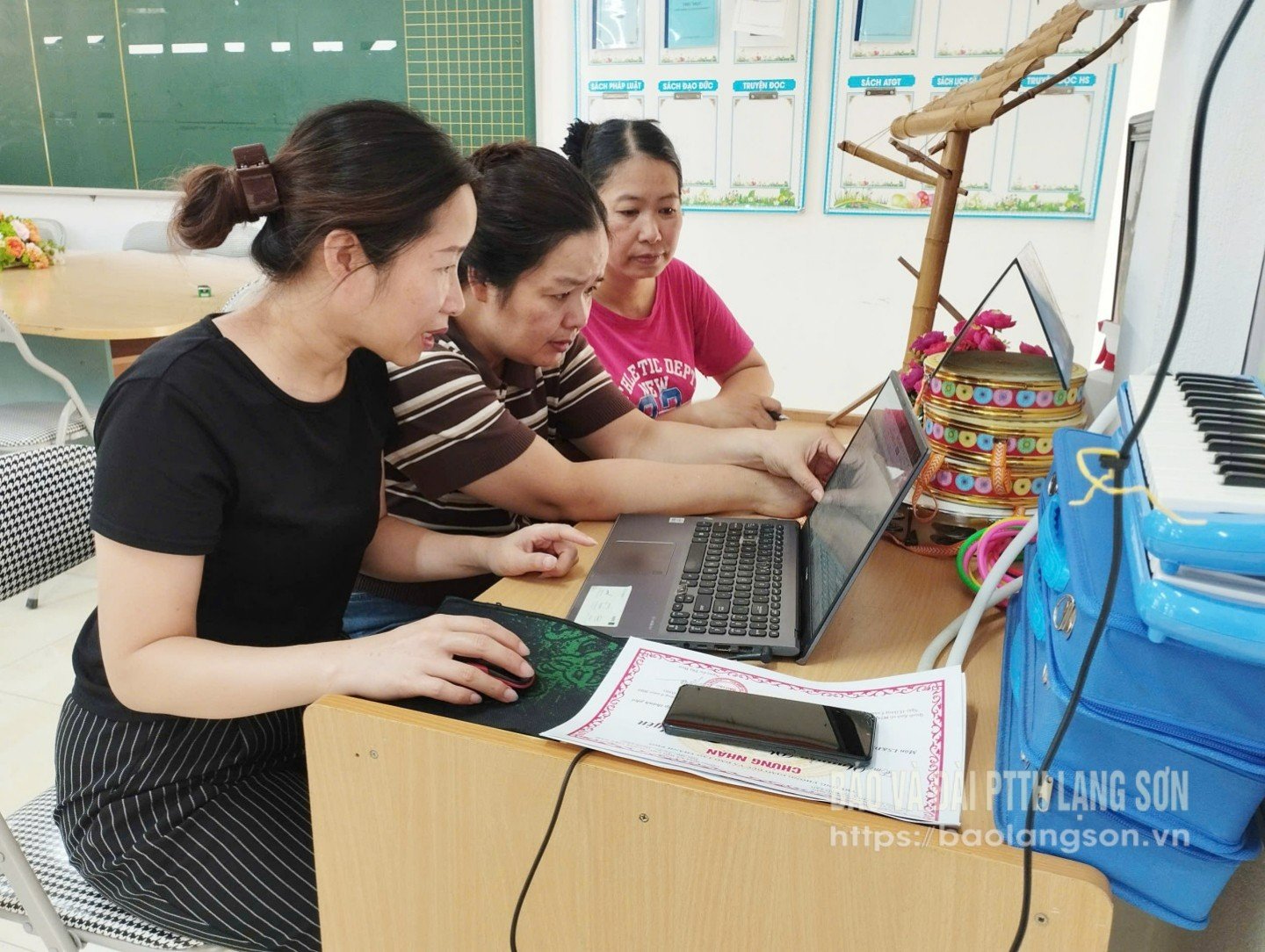
Distinguished teacher Dang Tuan Cuong, the school's principal, said: From the 2024-2025 school year, the school will develop a plan for innovation in four main directions: applying artificial intelligence (AI) in the design and organization of teaching and learning; developing the school robot movement; strengthening technology training for teachers and students; and integrating technology into core subjects.
During the school year, the school implemented several software programs such as Vitanbrain, Wordwall, Mozaik Education, and Kahoot to design visually engaging and interactive lessons. Some teachers used AI to suggest teaching methods suitable for different student groups, and to support the development of question banks and teaching scenarios. AI virtual assistants were deployed in review sessions, answering student questions and helping students develop questioning, critical thinking, and self-learning skills.
Simultaneously, the school established a robotics team, comprised of students who love technology and are passionate about engineering. They guided the students in learning basic programming, assembling models, and controlling robots for practical exercises. This activity was not limited to the team but extended to experiential sessions for students throughout the school, including demonstrations of products designed by the students themselves.
Nguyen Duc Thinh, a 7th-grade student (2024-2025 school year), a member of the school's team participating in the Final Round of the 2024 National STEM, AI, and Robotics Championship (VSAR), shared: “I was selected for the team because I am interested in assembling robots and had participated in robot-making workshops at school. Once on the team, we received guidance from teachers on programming, control, and regular training to prepare for the competition. Through this, I learned many skills and became even more enthusiastic about participating in STEM activities.”
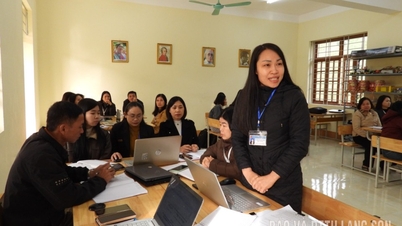
Furthermore, the school also focuses on training teachers and students in the application of technology. The school has collaborated in organizing training sessions on AI, robotics, sensor programming, and guidance on utilizing online learning platforms for its teaching staff. Currently, 100% of teachers teaching Computer Science, Technology, and Physics have used at least one AI tool in their teaching. Not only in science subjects, but also in social science subjects, teachers have received training and are using AI in their teaching. Ms. Ha Thi Bich Thao, a Literature teacher, shared: “Social science teachers also use AI to support lesson design, saving time and allowing them to focus more on organizing learning activities and group discussions.”
The school also encourages students to participate in online technology courses. Last academic year, 400 students completed an online AI course organized by Samsung Group and received certificates. This provides a foundation for students to systematically access technological content, from concepts and principles to applications. In experiential learning sessions, teachers organize students into groups, assigning them tasks to design technological products that serve daily life, such as models of smart traffic lights, smart homes, and navigation vehicles. Through these activities, students apply their learned knowledge while developing collaboration and problem-solving skills.
Thanks to the coordinated implementation, the school has achieved many concrete results. In the 2024-2025 school year, the school's robot team won first prize nationally in the Humanoid Robot category, second prize in the Huna soccer robot category, third prize in the national STEM competition, and an honorable mention in the AI & Robotics Challenge competition... According to the school's survey, in the school year, the percentage of students interested in lessons with technology applications reached over 82%. The number of students participating in the STEM – Robotics Club increased from 18 in 2024 to 46 in 2025. In addition, 90% of students participating in robot activities showed significant progress in logical thinking, problem-solving skills, and teamwork.
Based on the results achieved, the school continues to set the goal of gradually increasing the percentage of lessons applying technology, in order to standardize professional activities in a modern direction, in line with the digital transformation roadmap of the industry.
Source: https://baolangson.vn/doi-moi-day-hoc-tu-ung-dung-cong-nghe-5056774.html


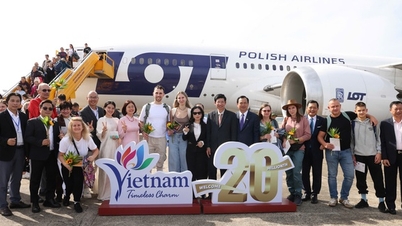
![[Photo] Two flights successfully landed and took off at Long Thanh Airport.](/_next/image?url=https%3A%2F%2Fvphoto.vietnam.vn%2Fthumb%2F1200x675%2Fvietnam%2Fresource%2FIMAGE%2F2025%2F12%2F15%2F1765808718882_ndo_br_img-8897-resize-5807-jpg.webp&w=3840&q=75)































































Comment (0)