

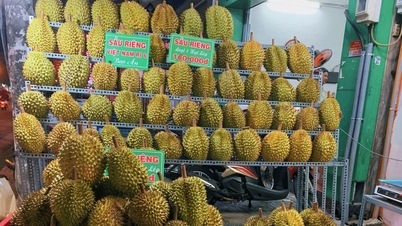
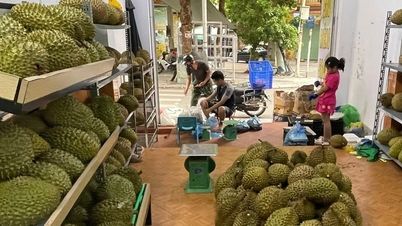
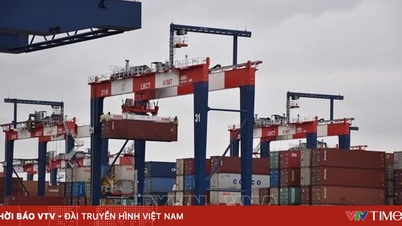
Nearly 2,000 containers of durian exported from Dak Lak province are currently stuck at warehouses and border gates after designated testing laboratories temporarily suspended accepting samples and returning residue test results.
According to the Dak Lak Durian Association, very few units currently have the capacity to simultaneously test for both mandatory indicators: Cadmium and Yellow O. This has caused disruptions to purchasing and exporting activities, and the price of durian at the farm has plummeted from over 100,000 VND to around 80,000 VND/kg, causing significant losses for farmers. The Association has petitioned the Ministry of Agriculture and Environment to promptly restore testing activities and prioritize processing export samples during the peak harvest season.
Currently, some laboratories have started returning results, but the acceptance of new samples remains limited. If this situation persists, there is a significant risk of affecting delivery schedules and the reputation of Vietnamese durian in the international market.
Solutions to alleviate the backlog of durian exports.
Faced with the backlog of durian exports at border gates, the Ministry of Agriculture and Environment held an emergency meeting with durian testing laboratories nationwide to find solutions to resolve the issue.
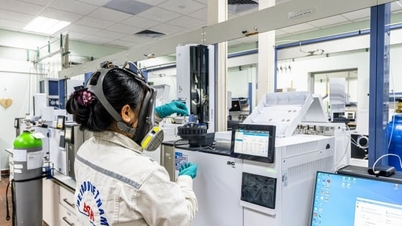
Equipment undergoing maintenance, servicing, or malfunctioning was the leading reason cited by testing laboratories for delays in testing for cadmium and Yellow O residues in durian at an online meeting organized by the Ministry of Agriculture and Environment last weekend. In addition, the testing capacity of the centers was also mentioned as one of the reasons.

Nearly 2,000 containers of durian intended for export are stuck in a backlog.
Mr. Tran Duy Phong, Director of the Regional Center for Processing Quality and Market Development, Ministry of Agriculture and Environment, stated: "We serve the needs of the State management as well as the people and businesses with many different agricultural and aquatic product samples. Due to the limited equipment, when receiving many requests for analysis on various sample types at the same time, it is impossible to focus solely on durian samples. That is a major difficulty."
To address the delays in durian testing, the Ministry of Agriculture and Environment has requested relevant units to review legal conditions, enhance equipment and personnel in testing laboratories, and expedite the approval process for newly licensed testing laboratories.
Mr. Hoang Trung, Deputy Minister of Agriculture and Environment, shared: "We have been and continue to work with the General Administration of Customs of China to strengthen and expedite their approval and accreditation of more of our testing laboratories, as well as to re-accredit those laboratories that have been suspended as soon as possible. These are solutions we need to implement immediately."
Besides temporary solutions, the fundamental solution is to ensure honesty, accuracy, and prevent corruption within the testing laboratories themselves, which is a pressing issue at this time. Furthermore, the Ministry of Agriculture and Environment has also set out to address and prevent cadmium and yellow dye residues at the source, aiming to facilitate and maintain the reputation of durian exports.
Mr. Hoang Trung, Deputy Minister of Agriculture and Environment, stated: "We are closely coordinating with the police to implement traceability measures regarding Yellow O. Currently, it is being used in processed durian for export. We have also completed a technical report identifying the cause, remedial measures, and management measures to send to China for their assessment and consideration. They may even send technical and inspection teams to work with us. Based on that, we will propose that they waive the two additional measures."
In fact, the durian harvest in the Central Highlands only has about 10 days left. Therefore, the Ministry of Agriculture and Environment is requiring testing centers nationwide to work at full capacity to ensure accuracy in order to serve businesses and the people.
Review of durian testing laboratories nationwide.
Following the delay in testing residue levels for several shipments of durian exported to China, the Ministry of Agriculture and Environment has requested that localities urgently review all testing centers recognized by China.
Currently, there are 24 laboratories nationwide approved by the General Administration of Customs of China to test for cadmium and yellow dye residues in exported durian, with a total processing capacity of approximately 3,200 samples per day. However, many of these units are temporarily shut down for the same unusual reason: maintenance or awaiting reassessment, leading to the risk of disruption in the sampling and results delivery process.
The Ministry of Agriculture and Environment requires laboratories with the necessary legal qualifications, equipment, and personnel to accelerate their work, even working day and night, to meet export demands. Simultaneously, they must ensure accurate and consistent testing procedures, avoiding discrepancies in results between domestic and Chinese markets, which could negatively impact the reputation of Vietnamese agricultural products. Currently, the Ministry is coordinating with localities and durian associations to update the list of laboratories with operational capacity and expedite the assessment process to expand the number of certified units. This aims to ensure the stability and sustainability of the durian export chain – a commodity that generates billions of USD annually.
Source: https://vtv.vn/gan-2000-container-sau-rieng-xuat-khau-bi-un-u-100251027110710307.htm

![[Photo] Prime Minister Pham Minh Chinh holds a phone call with the CEO of Russia's Rosatom Corporation.](/_next/image?url=https%3A%2F%2Fvphoto.vietnam.vn%2Fthumb%2F1200x675%2Fvietnam%2Fresource%2FIMAGE%2F2025%2F12%2F11%2F1765464552365_dsc-5295-jpg.webp&w=3840&q=75)



![[Photo] Closing Ceremony of the 10th Session of the 15th National Assembly](/_next/image?url=https%3A%2F%2Fvphoto.vietnam.vn%2Fthumb%2F1200x675%2Fvietnam%2Fresource%2FIMAGE%2F2025%2F12%2F11%2F1765448959967_image-1437-jpg.webp&w=3840&q=75)







































![[OFFICIAL] MISA GROUP ANNOUNCES ITS PIONEERING BRAND POSITIONING IN BUILDING AGENTIC AI FOR BUSINESSES, HOUSEHOLDS, AND THE GOVERNMENT](https://vphoto.vietnam.vn/thumb/402x226/vietnam/resource/IMAGE/2025/12/11/1765444754256_agentic-ai_postfb-scaled.png)









































Comment (0)