

Pork prices in Ha Tinh province have been continuously falling sharply, while feed prices remain high, causing businesses and livestock farm owners to face losses.
In the final months of 2023, pig farmers in the area continued to face many difficulties. Specifically, production costs (price of piglets, feed, electricity) increased significantly, while the price of live pigs dropped sharply (currently at 48,000 - 49,000 VND/kg).
Furthermore, some localities in Ha Tinh province (Cam Xuyen, Nghi Xuan, Duc Tho) are recording outbreaks of African swine fever, with a high risk of spreading. Consequently, pig farmers are having to increase their disease prevention and control costs compared to normal times. If the market does not show positive signs of improvement in the remaining months of the year, pig farmers will continue to suffer losses.
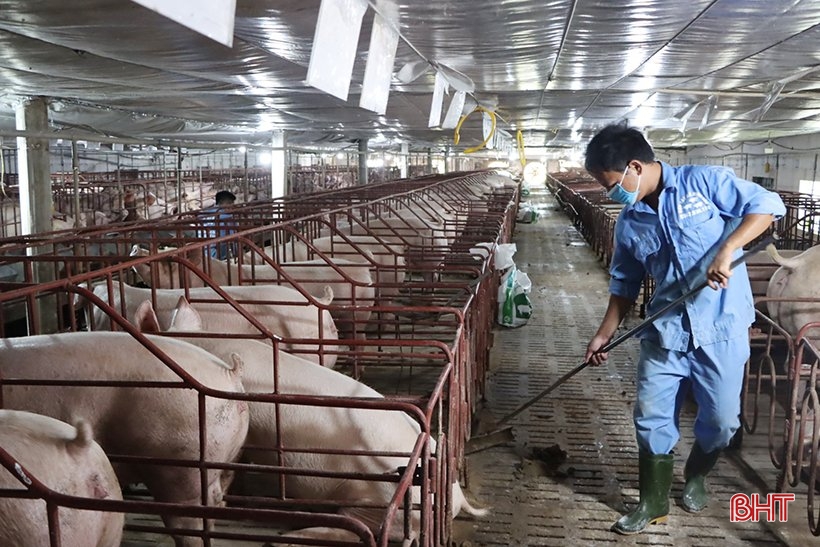
Farms are facing losses due to sharply falling pork prices while production costs have risen.
For several months now, Ha Tinh Agricultural and Forestry Development Joint Stock Company (Phu Loc commune, Can Loc district) has faced numerous challenges. For a long time, the company has maintained a stable production chain across 18 farms in Can Loc, Duc Tho, and Nghi Xuan districts. However, due to the difficult market conditions, the company has gradually reduced its herd size (from 2,700 sows to 2,200, and from 4,000 to 3,200 fattening pigs per batch).
According to reports, at one point, the price of live pigs dropped to 46,000 - 47,000 VND/kg (about 10 days ago), meaning the company lost approximately 700,000 VND per pig sold. Currently, at 48,000 - 49,000 VND/kg, the Ha Tinh Agricultural and Forestry Development Joint Stock Company is losing about 500,000 VND per pig sold. If production and business conditions do not improve towards the end of the year, the company will face significant difficulties.
The pig farm owned by Mr. Nguyen Tien Son's family (Cam Son commune, Cam Xuyen district) is also facing losses as live pig prices plummet.
Mr. Son said: “The farm just sold 1,200 commercial pigs at a price of 48,000 VND/kg. With high costs for piglets (1.5 million VND/pig at the time of stocking), and increased production costs, we lost about 500,000 VND per pig sold. Currently, the price of live pigs shows no signs of recovery, the price of animal feed is still up 30% compared to two years ago, along with the risk of disease outbreaks and difficulties in investment resources, so the farm has had to reduce the number of market-ready pigs to the lowest possible level.”
Currently, farm-based livestock production in Ha Tinh accounts for 65%, while household-based livestock production accounts for 35%. For small-scale pig farmers who have to purchase piglets, the situation is becoming increasingly difficult.
The family of Ms. Phan Thi Hien (Tay Son village, Luu Vinh Son commune, Thach Ha district) specializes in raising commercial pigs on a scale of 25-30 pigs per batch. Recently, the family sold 25 pigs at a price of 50,000 VND/kg, resulting in a loss of 20 million VND.
Ms. Hien said: “With 30 pigs currently being raised, I spent nearly 40 million VND on piglets. In addition, the price of animal feed is also high (a 25 kg pig costs 360,000 VND), plus the increased cost of disease prevention and control for livestock, making it very difficult for farmers. If the price of live pigs doesn't improve in the coming time, my family will continue to suffer losses and will have to consider temporarily suspending pig farming.”
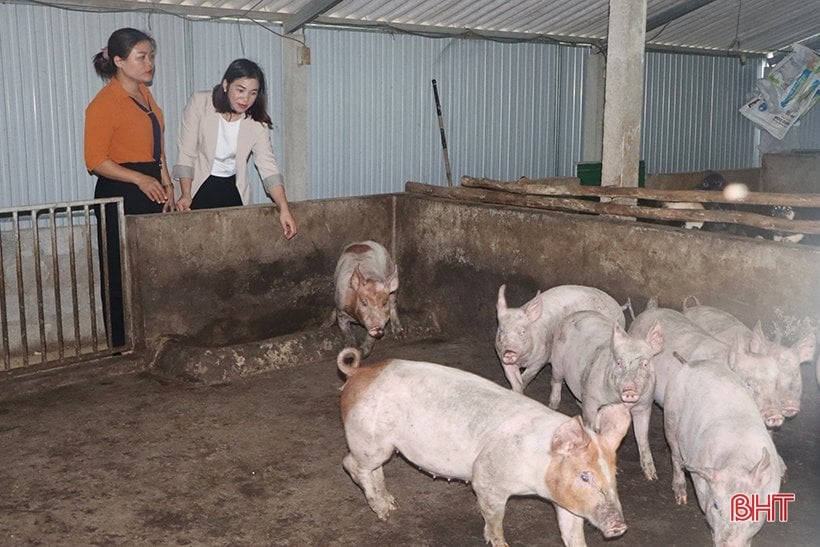
Officials from the Farmers' Association of Luu Vinh Son commune (Thach Ha district) inspect the pig farming model of Ms. Phan Thi Hien's family.
Mr. Phan Quy Duong – Head of the Livestock Management Department (Ha Tinh Provincial Department of Livestock and Veterinary Medicine) said: "The total pig population in the province currently reaches 400,332, of which 307,700 are market pigs. According to calculations, with the current high costs of disease prevention, feed, etc., the price of live pigs must reach 53,000 - 55,000 VND/kg or higher for farmers to break even. To ensure smooth livestock operations in the remaining months of the year, pig farmers in the area need to proactively access information; monitor and analyze market signals, and assess prices to make appropriate investment decisions."
According to experts, the province recently experienced prolonged heavy rains, causing flooding in many livestock areas and barns, leading to environmental pollution and the persistence of pathogens. Furthermore, the changing weather and reduced animal resistance create favorable conditions for disease outbreaks.
Therefore, when restocking and increasing herd sizes at the end of the year to serve the Lunar New Year market, livestock owners need to pay attention to purchasing breeding stock from reliable and high-quality sources in the area. In addition, farmers need to proactively implement disease prevention and control measures; disinfect and sanitize barns according to the guidance of the professional sector; and strengthen the animals' resistance...
Thu Phuong - Phan Tram
Source


![[Photo] Prime Minister Pham Minh Chinh attends the Conference summarizing and implementing tasks of the judicial sector.](/_next/image?url=https%3A%2F%2Fvphoto.vietnam.vn%2Fthumb%2F1200x675%2Fvietnam%2Fresource%2FIMAGE%2F2025%2F12%2F13%2F1765616082148_dsc-5565-jpg.webp&w=3840&q=75)






















































































Comment (0)