

In line with the policy of promoting electronic payments in road transport, non-stop toll collection at bus stations has been included in the nationwide implementation plan. According to the roadmap, by the end of 2026, all Type 1 bus stations in urban areas must complete the installation and operation of the automated toll collection system; Type 2 bus stations will complete it one year later. In Hanoi , the City People's Committee has issued a document requesting bus stations in the area to urgently implement this. However, there remains a significant gap between the policy and its practical implementation.
Observations at the Nuoc Ngam bus station (Hanoi) in early December 2025 showed that the non-stop toll collection system had been installed at the station's entrance and exit and was in the testing phase. The toll collection data is currently only used for checking and evaluating the accuracy of the operation. Nevertheless, for bus company employees who regularly handle departure procedures, this is considered a solution that offers many benefits.
Mr. Nguyen Huu Thao, a representative of a bus company operating the Ha Tinh - Hanoi route, shared that automated fare collection significantly reduces the time and effort for drivers and bus assistants. "Previously, we had to go back and forth to process orders; now, we just need to submit the order on the system, and the company transfers the money – it's much faster and more convenient," Mr. Thao said. Sharing the same view, Mr. Nguyen Van Cuong, a driver on the Nghe An - Hanoi route, believes that this system helps bus companies be more proactive in financial matters, minimizes direct contact, and reduces pressure during peak hours.
Besides facilitating transportation businesses, non-stop toll collection at bus stations is also highly valued from a management perspective. With automated control of vehicle entry and exit, the toll collection process becomes more transparent and accountable, reducing losses and alleviating congestion at the station gates.
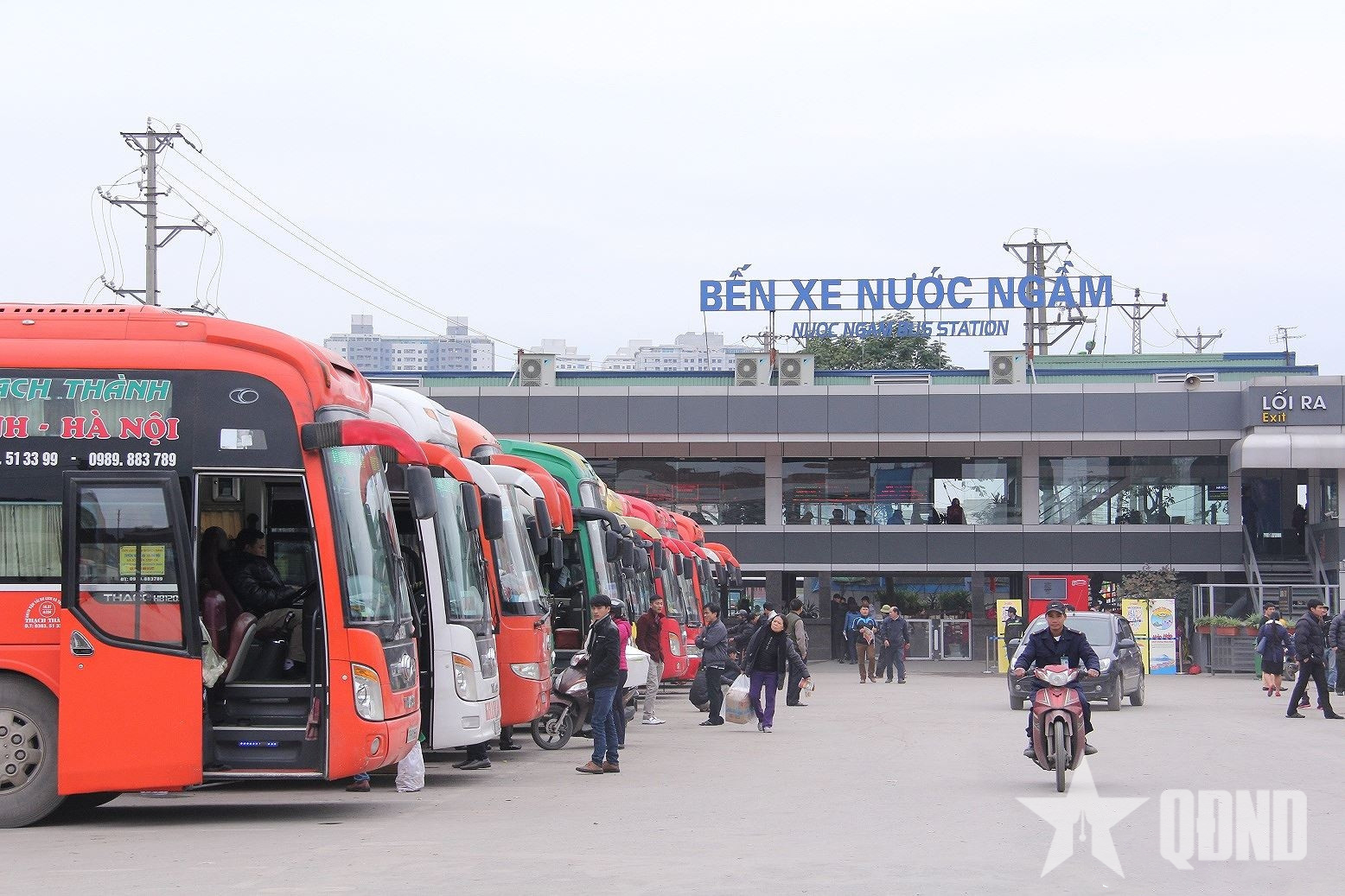
However, according to bus station management units, despite the obvious benefits, the implementation of cashless toll collection is still facing many difficulties. Ms. Nguyen Thi Thuy, an officer in the Nuoc Ngam Bus Station's Dispatching Department, said that after receiving the city's directive, the bus station proactively installed and tested the system.
"Technically, the system makes it easier for vehicles to enter and exit the terminal. However, a major drawback is the initial installation cost and the operating costs paid to a third party. We don't know how to properly account for these expenses, which puts considerable pressure on businesses and transportation companies," Ms. Thuy said.
In reality, the entire investment cost for the current automated fare collection system is primarily borne by the bus station management. Besides the initial installation cost, bus stations also have to pay monthly maintenance and operating fees to the service provider. Given that many bus stations are facing revenue difficulties, especially as passenger numbers have not fully recovered from the fluctuations in the transportation market, this is a challenging problem to solve.
Another issue of concern to management units and transport businesses is the system's consistency. According to current regulations, when inspecting passenger transport vehicles operating on fixed routes, authorities rely on departure orders to determine if the vehicle has violated its route. If the non-stop toll collection system at bus stations is not fully integrated with the necessary information, or if the data is not interconnected with the management agency, inspection and monitoring will be difficult, potentially leading to new problems.
Transportation experts believe that cashless toll collection at bus terminals is an inevitable trend, consistent with the goal of building smart transportation and smart cities. However, for this policy to be truly effective, a clear financial mechanism is needed, clarifying the allocation of costs between the bus terminal management unit, transportation companies, and technology service providers. At the same time, the State needs to promptly issue unified technical standards to ensure that the toll collection system at bus terminals is connected and shares data with relevant state management agencies.
Furthermore, implementation needs a suitable roadmap to avoid putting excessive pressure on bus stations and transportation businesses in a short period. Consideration could be given to initial support policies, encouraging socialized investment, or allowing the system's operating costs to be included in the bus station service pricing structure in a reasonable and transparent manner.
From the experience in Hanoi, it can be seen that non-stop toll collection at bus stations has initially shown positive signs, but many "bottlenecks" still need to be resolved. Once the issues regarding costs, mechanisms, and synchronization are addressed, this toll collection method will not only benefit businesses and workers in the transportation industry, but also contribute to improving the effectiveness of state management, aiming for a more modern, transparent, and efficient transportation environment.
Source: https://baolangson.vn/van-con-nhieu-nut-that-trong-thu-phi-khong-dung-tai-ben-xe-5068068.html


![[Photo] Prime Minister Pham Minh Chinh attends the Conference summarizing and implementing tasks of the judicial sector.](/_next/image?url=https%3A%2F%2Fvphoto.vietnam.vn%2Fthumb%2F1200x675%2Fvietnam%2Fresource%2FIMAGE%2F2025%2F12%2F13%2F1765616082148_dsc-5565-jpg.webp&w=3840&q=75)















































































Comment (0)