

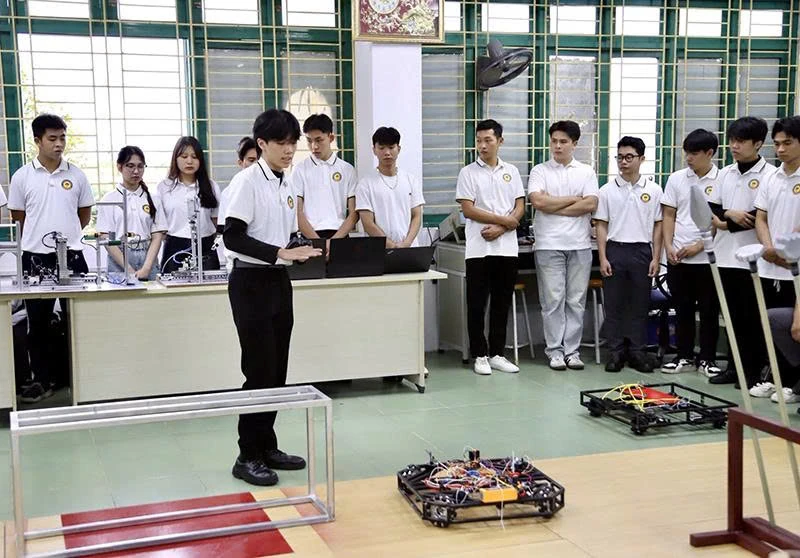
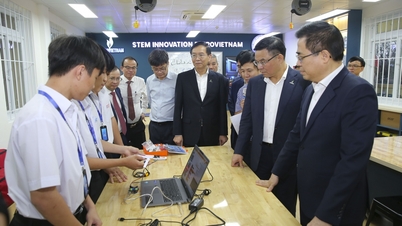
The Robotics lab at Hong Duc University has officially opened, providing a space for research and creativity for students.
However, to move forward, the school recognizes that curriculum reform needs to be placed within the context of the strong shifts in the labor market and the trend of digital economic development. From now until 2030, the school strives to focus on opening at least 10 new training programs, prioritizing artificial intelligence, data science, semiconductors, information technology, mathematics and engineering, tourism, and logistics. These are all key sectors, linked to the province's development strategy during the period of integration and digital transformation. This adjustment demonstrates the school's proactive vision in connecting training with practical needs and new growth drivers of the economy.
Another key highlight in the school's training development strategy is strengthening links with businesses and local communities. The training model based on a "order-based" mechanism is being implemented to align with actual recruitment needs, giving students early exposure to the labor market. Simultaneously, international cooperation in training through credit recognition, foreign lecturers teaching in English, and student exchange programs is gradually expanding, affirming the school's integration trend.
To realize its vision of becoming a regional training center, the university places special emphasis on developing its faculty. Currently, the university has 409 lecturers, including 194 PhDs (accounting for 47%) and 29 associate professors – a higher percentage than the average of many universities in the country. The goal of increasing the percentage of PhDs to 55% by 2030 and having at least 10% of lecturers hold the title of professor or associate professor demonstrates a strong determination to raise academic standards and bring the university closer to the international model of a research university.
If the quality of education is the foundation, then science and technology (S&T) is the driving force for the university to rise to the group of strong research universities nationwide. In recent years, scientific research activities have made remarkable progress, as evidenced by the quantity and quality of published scientific projects and products. With 48 national, ministerial, and provincial-level projects and 1,648 scientific articles, including 345 published in prestigious international journals, the university is clearly demonstrating its research capacity in many fields of basic and applied science.
In the context of science and technology becoming a driving force for economic growth, the university sets a higher goal: building strong, interdisciplinary research groups to proactively propose provincial and national-level scientific tasks. This is a model that many advanced universities have adopted, creating conditions for the formation of large, sustainable research directions capable of solving local development problems. For Thanh Hoa – a province that is strongly developing processing, manufacturing, logistics, tourism, and high-tech agriculture industries – the collaboration of scientists from Hong Duc University will become a crucial resource.
Besides developing research capabilities, the university focuses on strongly promoting the application and transfer of research results into practice. This is also an area with significant potential, as the commercialization of science and technology products has not yet reached a level commensurate with the potential of the faculty. To overcome this, the university is perfecting mechanisms to encourage lecturers to register intellectual property, establishing a Science and Technology Development and Innovation Fund to support research groups in bringing their products to market. This is an important step in building the university's science and technology brand and directly contributing to the socio-economic development of the locality.
International cooperation in scientific research is being promoted in a more substantive direction. Seeking international projects, participating in research networks, engaging in academic exchanges, and linking with prestigious universities in the region will expand the scientific landscape, helping faculty members improve their capacity for international publication and access new research methods. This will not only create academic breakthroughs but also enhance the university's image in the process of integrating into higher education.
Alongside research, the startup and innovation ecosystem is becoming a key area of development for the university. Startup competitions, idea incubation activities, business networking, and support for student product development have created a strong environment for fostering innovation within the learning community. In particular, the "State - University - Business" linkage model, guided by Resolution No. 57 of the Politburo, opens up opportunities for the university to become an important knowledge bridge, participating in solving development problems in the province, and gradually realizing the goal of becoming a regional center for science and technology research and knowledge transfer.
Text and photos: Truong Giang
Source: https://baothanhhoa.vn/hanh-trinh-tro-thanh-trung-tam-nghien-khoa-hoc-va-cong-nghe-272038.htm
![[Photo] Prime Minister Pham Minh Chinh receives the Governor of Tochigi Province (Japan)](/_next/image?url=https%3A%2F%2Fvphoto.vietnam.vn%2Fthumb%2F1200x675%2Fvietnam%2Fresource%2FIMAGE%2F2025%2F12%2F16%2F1765892133176_dsc-8082-6425-jpg.webp&w=3840&q=75)

![[Image] Leaked images ahead of the 2025 Community Action Awards gala.](/_next/image?url=https%3A%2F%2Fvphoto.vietnam.vn%2Fthumb%2F1200x675%2Fvietnam%2Fresource%2FIMAGE%2F2025%2F12%2F16%2F1765882828720_ndo_br_thiet-ke-chua-co-ten-45-png.webp&w=3840&q=75)
![[Photo] Prime Minister Pham Minh Chinh receives Lao Minister of Education and Sports Thongsalith Mangnormek](/_next/image?url=https%3A%2F%2Fvphoto.vietnam.vn%2Fthumb%2F1200x675%2Fvietnam%2Fresource%2FIMAGE%2F2025%2F12%2F16%2F1765876834721_dsc-7519-jpg.webp&w=3840&q=75)

![[Live] 2025 Community Action Awards Gala](/_next/image?url=https%3A%2F%2Fvphoto.vietnam.vn%2Fthumb%2F1200x675%2Fvietnam%2Fresource%2FIMAGE%2F2025%2F12%2F16%2F1765899631650_ndo_tr_z7334013144784-9f9fe10a6d63584c85aff40f2957c250-jpg.webp&w=3840&q=75)























































Comment (0)