

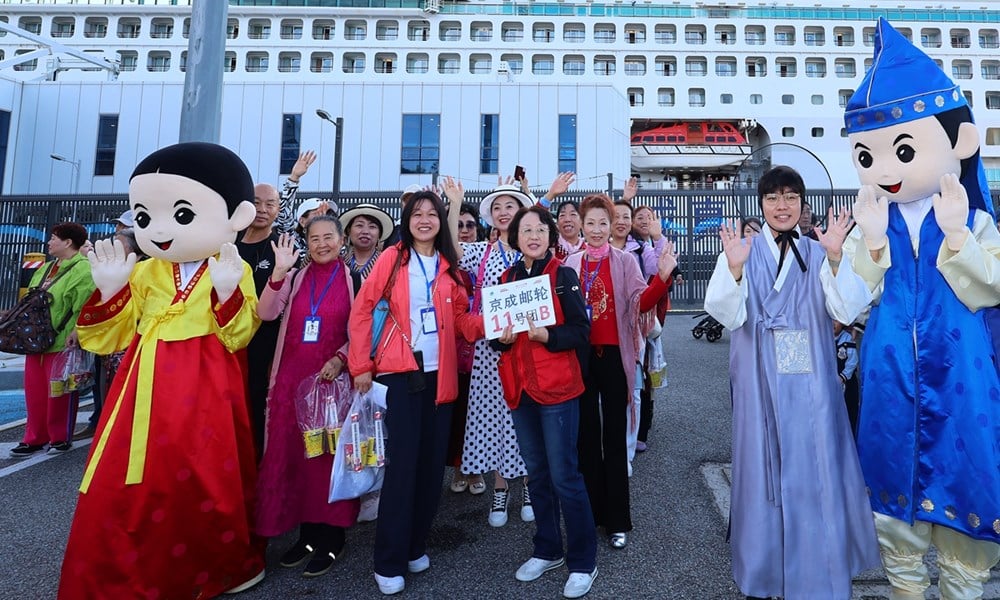
This initiative not only promotes people-to-people exchanges and revives international tourism, but also shapes a multi-directional, open cooperation model that brings tangible benefits to many countries.
Positive moves from South Korea, New Zealand, the Philippines, and Russia have demonstrated the growing appeal and influence of this policy as the world seeks new drivers for growth and connectivity.
One clear signal coming from South Korea is that its tourism industry recently proposed to the government an extension of the visa-free policy for Chinese tour groups.
This is a collective appeal from South Korean travel, airline, hotel, cultural, culinary, and major corporate businesses.
This reflects a growing awareness of the benefits of opening up, as well as the positive interaction between South Korea's policies and China's unilateral visa waiver policy.
China has proactively opened its doors to the world with an open and flexible attitude, thereby stimulating potential tourism demand and creating an "institutional supply" that promotes two-way tourism flows.
The effectiveness of this model is clearly demonstrated by the numbers. Since South Korea implemented visa exemption for Chinese tour groups at the end of September, the number of Chinese tourists visiting Shinsegae Duty-Free Shop in Myeongdong has increased by 90% in just one month, leading to a 40% increase in sales.
The South Korean tourism industry asserts that this demonstrates that visa policies should be viewed as an important economic tool, contributing to increased consumption, job creation, and growth.
South Korea's call to extend the visa-free policy is not only in line with economic interests but also demonstrates a commitment to promoting sustainable people-to-people exchanges.
The significance of visa-free travel between China and South Korea extends far beyond tourism. In the first 10 months of the year, more than 7 million round-trip visitors were recorded, exceeding the total number of visitors for the entire previous year.
It's not just South Korea; the "circle of friends" benefiting from China's visa-free policy is expanding. Currently, China has unilaterally or bilaterally waived visa requirements for more than 70 countries.
Meanwhile, the number of countries eligible for visa-free transit into China has increased to 55, along with 60 entry points allowing a maximum stay of up to 240 hours.
These steps demonstrate China's determination to build a convenient, highly connected tourism ecosystem that aligns with the shifting trends of international travelers.
Data from the Shenzhen border control station shows a clear impact; by the end of November, the number of passengers entering and exiting Shenzhen airport had exceeded 6 million, the highest level in 5 years, a 23.4% increase compared to the same period last year.
Notably, nearly 60% of foreign visitors entered the country through visa-free entry, an increase of over 133% compared to the previous year.
These figures reflect China's strong appeal as a modern, safe, and culturally rich destination, and demonstrate the world's growing appreciation for the benefits of connecting with a market of over 1.4 billion people.
Moreover, many countries are proactively responding to signals of reopening from China. New Zealand has implemented a visa-free policy for Chinese citizens holding a valid Australian visa.
Meanwhile, the Philippines has implemented an eVisa system, and Russia has announced that its visa-free policy for Chinese tourists will take effect. This is no coincidence, but a result of China becoming an important hub in the global tourism flow.
At the same time, Chinese tourists, the world's largest and most affluent group of travelers, are driving a transformation in the global tourism industry.
They are focusing on in-depth cultural experiences, green tourism, and exploring local identity, forcing many international destinations to innovate their services and improve product quality.
Conversely, international tourists visiting China under the visa-free policy are discovering a more authentic and multifaceted China, not just the Forbidden City or the Great Wall, but also modern streets, peaceful villages, and vibrant everyday life.
From the success of the China-South Korea visa waiver policy to the positive response from many countries around the world, a common trend emerges: openness and cooperation are no longer just slogans, but strategic choices that benefit all parties.
China's visa-free policy, therefore, is not only a measure to simplify procedures, but also a symbol of an open foreign policy vision, oriented towards shared development in the future.
Source: https://baovanhoa.vn/du-lich/hieu-ung-du-lich-tu-chinh-sach-mien-thi-thuc-trung-quoc-185252.html

![[Image] Hanoi's urban life under the challenge of a "scorching hot" environment](https://vphoto.vietnam.vn/thumb/1200x675/vietnam/resource/IMAGE/2026/05/25/1779706979265_nang-nong-t5-2026-minh-duy-7-4636-jpg.webp)



![[Image] Close-up view of the interchange connecting the two expressways and Long Thanh Airport.](https://vphoto.vietnam.vn/thumb/1200x675/vietnam/resource/IMAGE/2026/05/25/1779703378210_ndo_br_z7863716673926-224453a31600126cce10622af6290afd-4549-jpg.webp)










































































Comment (0)